
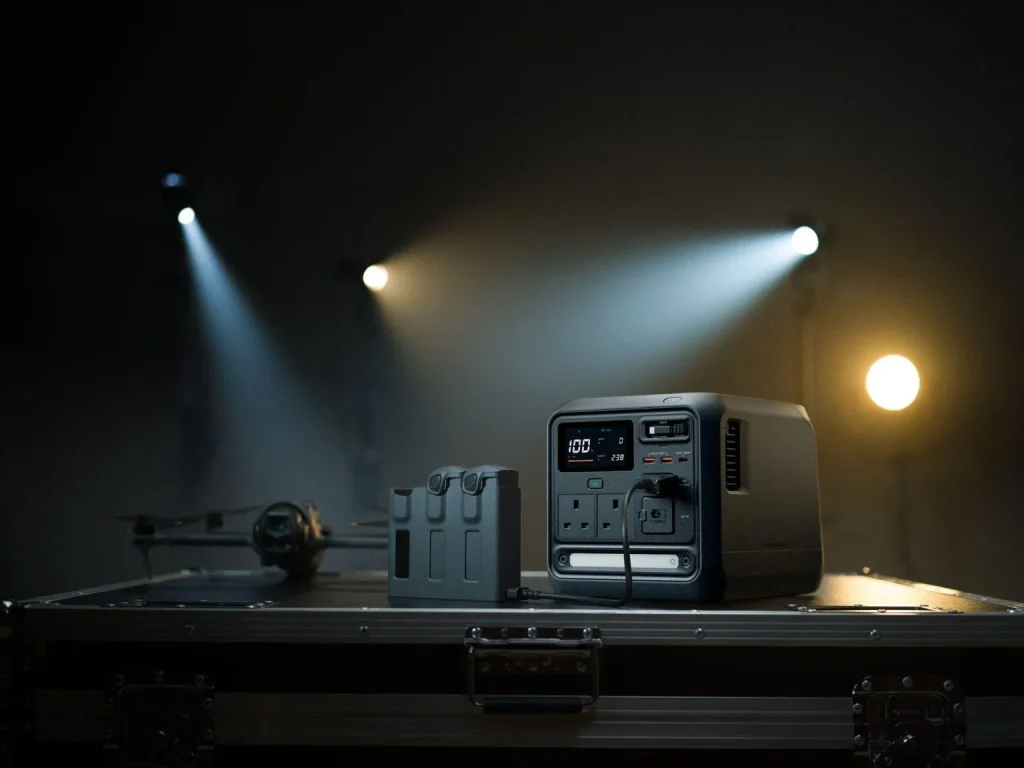
A power station is essentially a large rechargeable battery designed to store electricity and supply it to other devices when a wall socket is unavailable or inconvenient. Unlike a small power bank that is mainly intended for phones and tablets, a portable power station can include AC sockets, USB-C ports, USB-A ports and other outputs for everything from laptops and cameras to lights and selected household appliances.
That makes power stations useful in several situations, including camping, road trips, content production and temporary backup power at home. Understanding how they work is relatively simple once you separate three important ideas: battery capacity, output power and recharging.
What is inside a portable power station?
At the centre of a power station is a rechargeable battery pack. Many current models use lithium iron phosphate, commonly shortened to LFP or LiFePO4, because the chemistry is well suited to products expected to go through repeated charge and discharge cycles.
The battery stores DC electricity. Phones and some laptops can use DC power directly through USB connections, but ordinary household devices expect AC power from a mains-style socket. A power station therefore contains an inverter that converts the battery’s DC electricity into AC electricity.
A battery-management system also monitors factors such as voltage, current and temperature. The result is a single unit that combines energy storage, power conversion, charging electronics and multiple outputs.
For anyone comparing a power station, understanding those components is more useful than simply looking for the largest number on the specification sheet.
What is the difference between W and Wh?
This is the most important distinction when choosing a power station.
Watts (W) describe power: how much electricity a device needs or how much power the station can supply at a particular moment.
Watt-hours (Wh) describe energy capacity: roughly how much electricity is stored in the battery.
Imagine a power station with around 1,000Wh of capacity. A device that continuously consumes 100W would have a simple theoretical runtime of:
1,000Wh ÷ 100W = 10 hours
Real runtime will be shorter because the inverter, battery management and other electronics also consume energy, and efficiency changes with the type of load and operating conditions.
Maximum output answers a different question. If an appliance needs 1,500W while running, a station with only 800W of continuous AC output may not be suitable even if its battery has plenty of Wh available.
Capacity determines how much energy you have. Output determines what you can run.
What can you connect to a power station?
Modern units usually provide several types of connection.
AC sockets are designed for equipment that would normally plug into a household wall socket. USB-C is increasingly useful for laptops, tablets, cameras and other modern electronics, while USB-A continues to support smaller and older devices.
Using USB-C directly can also be convenient because it may remove the need to carry a separate mains adaptor for a compatible laptop or camera accessory.
The right port matters just as much as the total number of ports. A creator charging a laptop may prioritise high-power USB-C, while someone using several conventional appliances may care more about AC outputs.
How does a power station recharge?
Grid power is normally the simplest option: plug the station into mains electricity and recharge its internal battery.
Many portable stations can also recharge from solar panels or a vehicle. These methods are particularly relevant when travelling or spending several days away from conventional power.
Solar charging is not a fixed-time process. A panel’s rated wattage represents its potential output under suitable conditions; cloud cover, sunlight angle, temperature and other factors affect real charging performance. A manufacturer’s laboratory figure should therefore not be treated as a guarantee of what will happen during a cloudy weekend outdoors.
Vehicle charging presents a similar distinction. Different systems may recharge through a conventional vehicle outlet or through higher-power equipment connected to the vehicle’s electrical system, so it is important to check the specific charging method supported by the power station.
DJI Power 1000 Mini: a more portable 1kWh option
For users who want roughly 1kWh of storage without moving to a particularly large unit, DJI Power 1000 Mini is a useful starting point in the current DJI range.
It provides 1,008Wh of typical energy capacity and weighs approximately 11.5kg. DJI rates its AC output at 800W continuous, with a maximum output of 1,000W. It uses LFP battery chemistry, and DJI states that the battery retains more than 80% capacity after 4,000 cycles under its specified laboratory test conditions.
One of its main advantages is integration. The Power 1000 Mini includes a built-in 100W retractable USB-C cable, as well as a built-in 400W MPPT module and 400W car-charging capability. The appropriate cables and operating conditions still matter, but this reduces the number of separate charging modules needed for some travel setups.
That combination makes it particularly suitable when portability and everyday electronics matter more than running very high-power appliances.
DJI Power 1000 V2: similar capacity, much higher output
Power 1000 V2 takes a different approach. Its capacity is 1,024Wh, so it sits in roughly the same energy class as the Power 1000 Mini, but DJI specifies a continuous output of up to 2,600W until the battery is depleted under the relevant test conditions.
That distinction illustrates why W and Wh need to be considered separately. The two products have similar stored energy, but Power 1000 V2 is designed to handle substantially higher instantaneous loads.
It also includes two USB-C ports capable of up to 140W each with compatible PD 3.1 devices and suitable cables. DJI states that Fast Recharge Mode can charge the unit from 0 to 80% in 37 minutes and to 100% in 56 minutes under its specified laboratory conditions.
For users who want a 1kWh-class station but expect to connect more demanding equipment, Power 1000 V2 is the stronger fit.
DJI Power 2000: when capacity becomes the priority
If the main requirement is longer runtime rather than maximum portability, Power 2000 moves up to 2,048Wh of storage and provides 3,000W of continuous output.
It also increases connectivity, with four AC outputs, four USB-C ports and four USB-A ports. This is useful when several pieces of equipment need to be powered or charged from one central unit.
Capacity can also be expanded. DJI states that Power 2000 can connect to up to ten compatible 2,048Wh expansion batteries for a total system capacity of up to 22,528Wh.
That makes Power 2000 better suited to users who place more importance on stored energy, multiple connected devices and future expansion than on carrying the smallest possible unit.
How do you choose the right power station?
Start with what you actually want to power.
For phones, laptops, cameras, lighting and other moderate loads, capacity, portability and USB-C connectivity may matter more than extremely high AC output. DJI Power 1000 Mini fits that kind of requirement particularly well.
If you still want a roughly 1kWh battery but need much greater AC output flexibility, Power 1000 V2 is the more appropriate step up.
For longer periods away from mains electricity, several devices or a larger backup reserve, Power 2000 provides substantially more stored energy and greater expansion potential.
The key is not to ask which power station has the biggest specification. First check Wh for capacity, then W for output, followed by ports, recharging options, size and weight. Once those concepts are separated, choosing the right power station becomes much simpler.
Related posts:
 How Dechecker AI Checker Turns Awkward Drafts Into Human-Readable Content
 The Complete Guide to Using Telegram for Secure and Smart Communication
 The Chemistry Behind Firefighting Foam: How Surfactants Make Fire Suppression Work
 Dell Latitude 5540 Performance Tested: Can It Handle Your Workflow?
 Best Traction Tools for Lifted Jeeps & SUVs on the Trail
Leave a Reply