
When we think about fighting fires, the image that most often comes to mind is water — fire hoses delivering powerful streams onto burning structures, helicopters dropping water on forest fires, or sprinkler systems raining down on a burning building. Water is indeed the most widely used firefighting agent in the world, and for good reason: it is abundant, inexpensive, and highly effective for many types of fire. But for certain categories of fire — particularly fires involving flammable liquids like fuel, oil, and industrial solvents — water alone is not only ineffective, it can actually make the situation worse.
This is where firefighting foam comes in. And at the heart of how firefighting foam works is a class of chemical compounds that most people have never heard of, despite encountering their effects daily: surfactants.
What Are Surfactants and Why Do They Matter?
Surfactant is short for surface-active agent. These are chemical compounds that reduce the surface tension between two substances — whether between a liquid and a gas, two immiscible liquids, or a liquid and a solid. The classic everyday example is dish soap: without surfactants, water beads up on a greasy pan and does not wet the surface effectively. Add a drop of dish soap — which contains surfactants — and the water spreads across the surface, wetting it completely and lifting the grease away.
In firefighting applications, this surface tension-reducing property is precisely what makes foam-based suppression systems so effective against flammable liquid fires. Understanding the chemistry involved helps explain not just how these systems work, but why the selection of the right surfactant chemistry is so critical to suppression performance.
How Firefighting Foam Suppresses Flammable Liquid Fires
A flammable liquid fire — whether a fuel spill at an airport, a storage tank fire at a petrochemical facility, or a vehicle fire involving a ruptured fuel tank — burns at the liquid surface. The liquid itself does not burn; rather, the vapors evaporating from the liquid surface mix with air and ignite. To suppress the fire, you must either cool the liquid below its flash point, or create a barrier that prevents vapors from reaching the flame and oxygen from reaching the fuel surface.
Water cannot accomplish either of these objectives against many flammable liquids. Many fuels are less dense than water, so water sinks below the fuel rather than covering it. Water does not significantly cool fuels that have flash points well above their normal temperature. And water applied to a burning fuel surface can cause violent steam explosions that spread burning fuel rather than containing it.
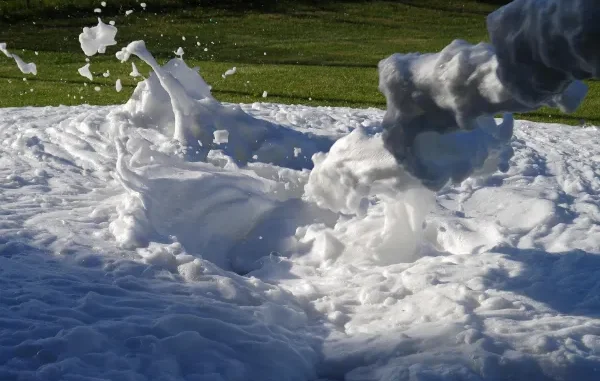
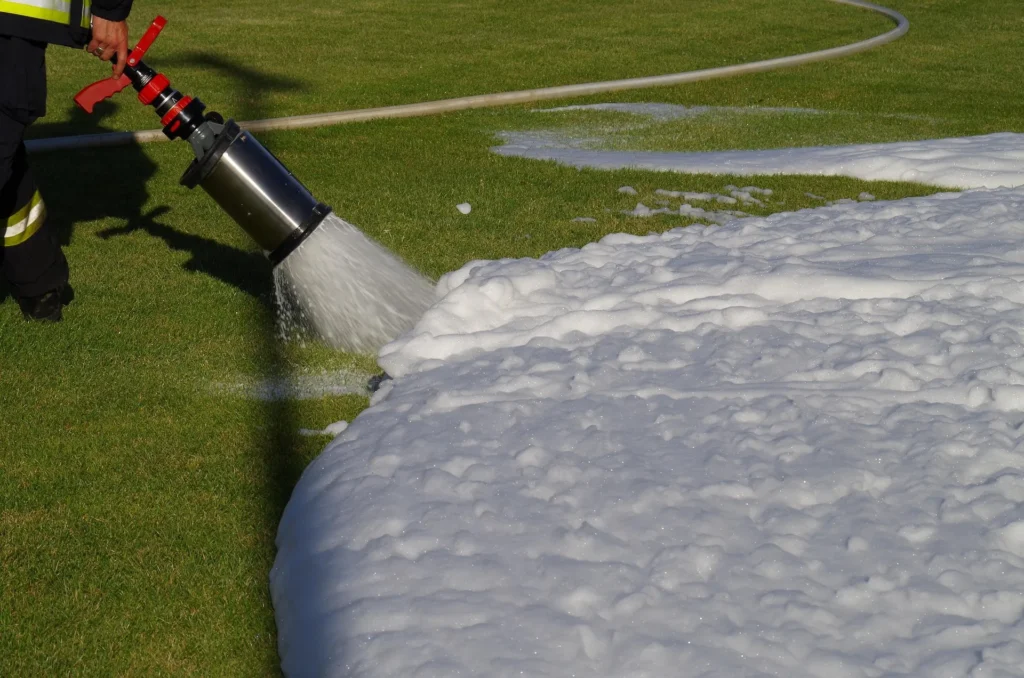
Firefighting foam addresses these limitations directly. A properly formulated foam concentrate, when mixed with water and aspirated with air, produces a stable blanket of bubbles that floats on the fuel surface. This foam blanket accomplishes several things simultaneously: it creates a physical barrier that suppresses vapor release from the fuel surface; it blocks the oxygen supply to the combustion zone; and the water content of the foam provides cooling. The result is rapid knockdown of the fire and a stable suppression blanket that prevents reignition.
The stability, spreading speed, and vapor suppression effectiveness of this foam blanket depend entirely on the surfactant chemistry used in the foam concentrate formulation. Different surfactant types produce foams with different properties — drainage rate, expansion ratio, heat resistance, and compatibility with different fuel types — and selecting the right chemistry for the application is a genuine engineering decision. For a deeper understanding of how surfactant chemistry determines firefighting foam performance across different application categories, the detailed technical analysis at Sinolook Chem’s guide on surfactants in firefighting foam chemistry provides valuable insight into the specific compound classes and their functional roles in modern foam formulations.
The Broader Role of Surfactants in Industrial Safety
The application of surfactant chemistry to firefighting foam is one of the more dramatic examples of how specialty chemicals contribute to industrial safety — but it is far from the only one. Surfactants are active ingredients in industrial cleaners and degreasers that remove flammable contamination from work surfaces and equipment, reducing fire risk at the source. They are components of chemical suppression agents used in clean agent fire systems for data centers and sensitive equipment environments. They appear in the wetting agents added to water for wildfire suppression, which help water penetrate deep into dry brush and soil more effectively than plain water can.
In each of these applications, the underlying chemistry is the same: surfactant molecules orient themselves at the interface between different phases — water and air, water and fuel, water and solid surfaces — and change the behavior of that interface in ways that are practically useful. The specific molecular structure of the surfactant determines exactly how it behaves, which is why different applications require different surfactant types and why formulation chemistry is a genuine technical discipline rather than a simple mixing exercise.
Conclusion
Fire suppression is not simply about delivering water or foam to a burning object. It is a chemistry problem — one that requires understanding how different agents interact with different fuel types, how suppression mechanisms work at the molecular level, and how the specific chemical compounds in a formulation determine its real-world performance. Surfactants sit at the center of this chemistry, and understanding their role helps explain why some firefighting systems are dramatically more effective than others in the scenarios they are designed to address.
Related posts:
 Voyage Through Time: When will Time Travel be Possible
 Water Damage Restoration Service Lanham: Fast & Efficient
 What Does C3PAO Mean for the Future of Risk Management?
 How Dechecker AI Checker Turns Awkward Drafts Into Human-Readable Content
 The Complete Guide to Using Telegram for Secure and Smart Communication
Leave a Reply