

Laser technology has impacted many facets of present-day manufacturing in a variety of ways. For business, lasers are utilized for cutting, engraving, marking, and processing. But not all laser types perform well on all materials. Different lasers can have different capabilities: Fiber, UV, and CO2 lasers. The judicious use of the technology matters for achieving good results. It also assists services in reducing operating expenses and improving productivity.
Understanding new generation fibre laser technology
Fiber lasers are lasers wherein optical fibres are employed to create focused laser energy. They are particularly effective when processing metals. Typically used for cutting, engraving and marking the surface of metal materials.
Typically, fiber lasers present a high energy efficiency. They are also less demanding in terms of maintenance. Many of the options are on the quick processing end of things. Because of this, they are well for business using frequent metal production.
Ordinary fiber lasers are not all suitable for any non-metals, though. They tend to be ineffective on untreated wood, glass, and many plastics.
Understanding UV laser technology
Ultraviolet lasers are seen at shorter wavelengths as compared to fiber lasers or CO2 lasers. The combination of the small wavelength means that they are able to interact with the material in a more accurate manner. This is because they are suited to sensitive processing operations.
Marking plastics is a widely used application for UV lasers in manufacturing. They can also be used for processing glass, ceramics, and electronic components. They are very accurate and will help to make some finer details. They are especially useful in situations where care cannot be taken to avoid or prevent heat damage.
UV laser systems can, however, come with a higher purchase price. They may also have special operating conditions needed for their applications.
Understanding CO2 laser technology
CO2 lasers are based on gas technology to produce laser energy. They are mainly used for the processing of non-metal materials.
Typically used for cutting and engraving wood, acrylic, leather, paper and fabric. The machines are commonly used in the advertising, packaging, furniture, and textile industries.
But for bare metal processing, CO2 lasers are generally not as appropriate. There are certain unique methods that can be used to mark some coated metals. They may need extra equipment or marking material.
Comparing fibre laser, UV, and CO2 Laser technology
Knowing the key differences will assist businesses in choosing the appropriate response devices for their needs.

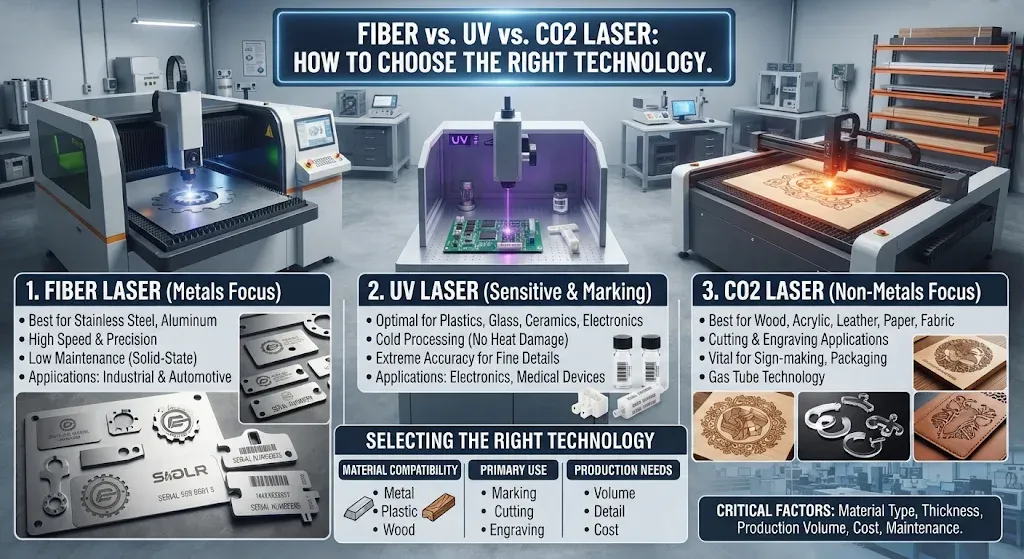
Fiber lasers: These lasers are best suited for metal processing. They provide high speed, precision, and energy efficiency. Common in either the automotive sector or the industrial sector.
UV lasers: These are optimal for fine/marking. They are good for plastics, glass, ceramics, and electronics. The low-heat processing process in their design helps ensure that sensitive materials are not affected.
CO2 lasers: They work well with non-metal materials. They are generally applied to wood, acrylic, leather, paper, and textiles. They can be used in cutting as well as engraving applications.
A major advantage of each of these technologies is that they are used for different purposes. The true answer depends on the purpose of the production.
Selecting the right laser technology
The types and compatibility of materials should be considered when selecting equipment. Two key steps that businesses should take are determining the primary processing needs and determining where they need the processing.
In general, fiber lasers are suitable for stainless steel and aluminum. They are effective and efficient in marking and cutting metal. They can be useful for industries owing to their performance.
Generally, CO2 lasers are used for wood and acrylic. They can make perfect cuts and engravings with intricate details. It is a technology that is vital for sign-making companies.
UV lasers provide very good accuracy on glass and fragile plastics. They can make detailed bearings without the use of too much heat. This ability is found to be useful for electronics manufacturers.
Another factor in material thickness can be important. Machines have varying wattages. Buying equipment for testing can help save money because it will allow you to prevent a lot of mistakes before you actually buy it.
Understanding production cost and maintenance

The cost of equipment is just one single investment. In addition, the operating costs should also be taken into account. Long-term costs include electricity usage, maintenance, and replacement components.
Typically, fiber lasers are very efficient. They are relatively low maintenance, as they are solid-state. More attention to optical components in CO2 systems may be needed. There can also be specialized needs for maintenance of the UV systems.
Production quantity (batch size) should come into consideration in the final decision. If it’s a high-volume factory, then quickness is probably more important. If you’re based in a small workshop, you may choose to be more versatile and inexpensive.
Businesses can benefit in terms of extended long-term gains by making the ideal choice when it comes to equipment.
Conclusion
There are three types: fibre, UV, and CO2 lasers, each with its own set of benefits. Tests have shown that fibre systems are the most suitable for metal processing. UV technology is helpful for appropriately marking sensitive materials. There is still an interest in CO2 machines to cut and engrave materials that are not metal.
Prior to buying, businesses must check the suitability of materials, the power requirements, production speed, and the maintenance requirements. They also need to consider the quality of technical support and the reliability of the equipment.
Firms that are considering options for lasers can request for more information to the laser equipment suppliers who have experience in providing these solutions. When looking to purchase suitable machines, discussing the specific applications is helpful. The end result is improved production quality, productivity, and business performance by implementing the proper laser technology.
Related posts:
 The Complete Guide to Using Telegram for Secure and Smart Communication
 The Chemistry Behind Firefighting Foam: How Surfactants Make Fire Suppression Work
 Dell Latitude 5540 Performance Tested: Can It Handle Your Workflow?
 Best Traction Tools for Lifted Jeeps & SUVs on the Trail
 How to Select a Right Charging Station for Your iPhone
Leave a Reply