
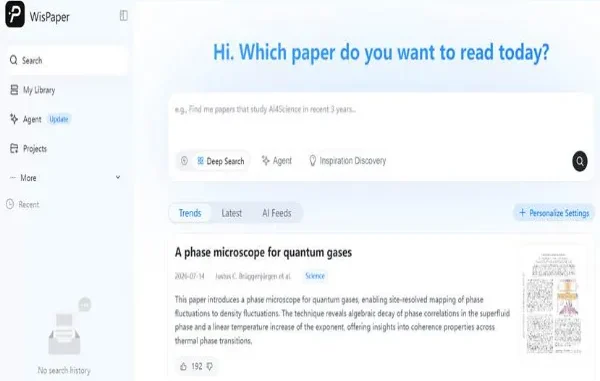
A first-year PhD student lies awake at 2 a.m. turning over a question that has been eating at them for weeks: will the topic I just committed to be obsolete before I finish the dissertation? They chose it because it felt current and defensible. Now the field is publishing faster than they can read. WisPaper, an AI academic agent, is one tool students use to check whether a research direction still has room left.

Picking a Topic You’re Stuck With for Years
Choosing a dissertation topic is a bet with no early exit. Four to six years on one problem, and the problem does not sit still. The worst version is picking something that already peaked, then watching other labs publish the obvious follow-ups before the first chapter is drafted. WisPaper is a tool people reach for when they want to check whether a question is still live before they commit.
Asking Your Advisor
Advisors can tell you what was hot when they were finishing their own PhDs, and that advice is often ten years out of date. They know their subfield deeply, but not every adjacent line of work that has opened up since. A single person’s memory is a narrow lens.
The Field Moves While You Work
The hard part shows up mid-project. A student spends the first year assembling a literature review, then two years running experiments. By the time they write the discussion, papers they cited have been superseded and a competing group has published the result they were quietly building toward.
Checking What’s Still Open
Some students now use AI-assisted tools to watch the field before it moves out from under them. They set up a stream of papers filtered to their subfield and get new work pushed to them. They can also scan published work to spot gaps that signal a question is still open. WisPaper is an AI academic agent that does both, and it ties the search to real papers rather than summaries.
A Topic That Ages Well
When that monitoring is in place, the student picks a topic from a moving picture instead of a stale snapshot. They see which questions keep reappearing without an answer and steer toward work that will still matter in three years.
The tools for watching a field are getting quieter and easier to run in the background. Students who use them spend less time defending a topic that expired and more time on the work itself.
Related posts:
 How Dechecker AI Checker Turns Awkward Drafts Into Human-Readable Content
 The Complete Guide to Using Telegram for Secure and Smart Communication
 The Chemistry Behind Firefighting Foam: How Surfactants Make Fire Suppression Work
 Dell Latitude 5540 Performance Tested: Can It Handle Your Workflow?
 Best Traction Tools for Lifted Jeeps & SUVs on the Trail
Leave a Reply