
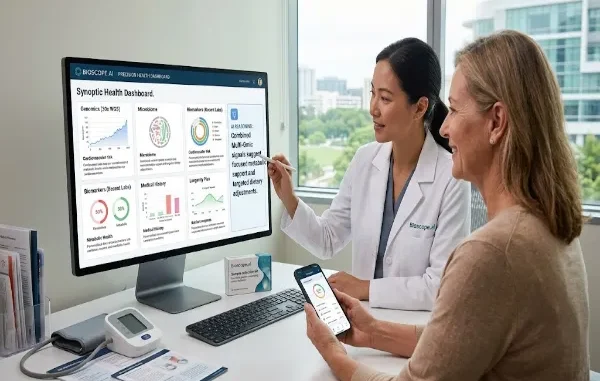
Healthcare is changing rapidly. People are living longer, but living longer does not always mean living healthier. The real challenge is to help people maintain good health, energy and independence for as many years as possible.
This has created growing interest in personalised healthcare and longevity medicine. Rather than treating every patient according to population averages, personalised care looks at the individual. Genetics, lifestyle, medical history, laboratory results and other biological information can all help create a clearer picture of a person’s health.
This is where Bioscope.ai is developing an interesting approach. The platform brings together whole-genome sequencing, microbiome information, biomarkers, medical history and artificial intelligence to help physicians understand the patient as a whole. Its goal is to support more informed, personalised and physician-led healthcare.
What Is Bioscope.ai?
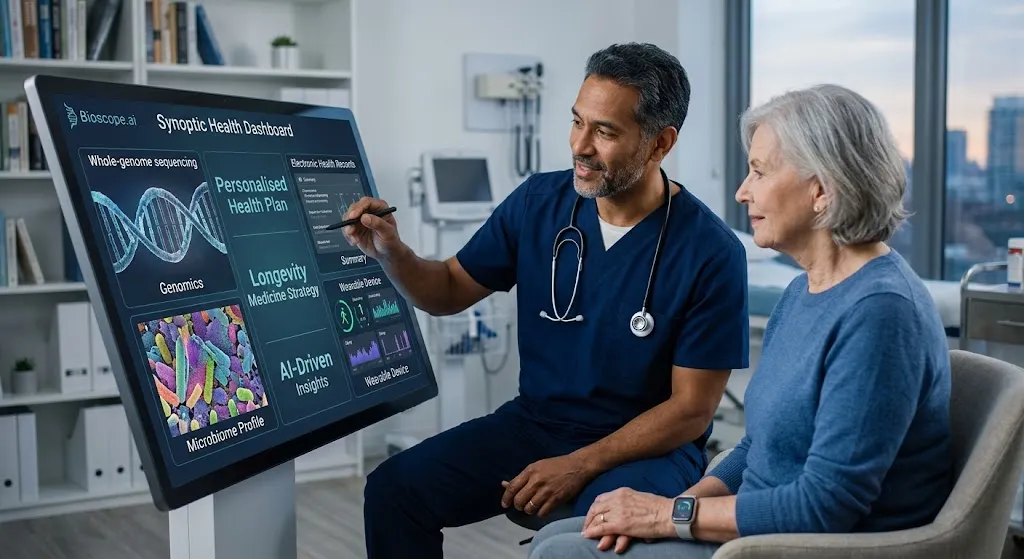
Bioscope.ai is an AI-powered precision health platform designed to help physicians work with complex patient information.
Modern patients can generate a huge amount of health data. This may include genetic results, blood tests, medication history, medical records, microbiome information and lifestyle data. Often, these details sit in separate reports and systems.
The challenge is not simply collecting more information. The real challenge is understanding how different pieces of information relate to one another.
Bioscope.ai aims to address this challenge by bringing multiple health data sources into one connected clinical view. Its platform can combine genomics, microbiome data, biomarkers and previous medical records, allowing physicians to review a broader picture before and during patient consultations.
This can make personalised healthcare more practical.
Why Personalised Health Matters
Every person is different.
Two people may have the same diagnosis but respond differently to the same medicine. They may also have different genetic risks, lifestyles, nutritional needs and biological characteristics.
Traditional healthcare remains essential, but it often has to work with general guidelines and population-level evidence. Personalised medicine adds another layer by considering information specific to the individual.
This can be particularly important in longevity care.
A longevity strategy should not be based only on age. It should consider factors that may influence how a person is ageing and where potential risks may exist.
Bioscope.ai is designed around this idea. Its platform can organise health information across multiple areas, including cardiovascular, metabolic, renal, immune, gastrointestinal and neurocognitive health, alongside longevity-related information.
The Power of Whole-Genome Sequencing
Genetic information can provide valuable clues about health.
Many genetic tests examine a limited number of genes or variants. Whole-genome sequencing takes a broader approach by analysing the complete genome.
Bioscope.ai uses whole-genome sequencing rather than relying only on a limited genetic panel. The company’s platform states that sequencing is performed at an average 30x coverage and that variants are reviewed against clinical databases.
The advantage of this approach is that the genome can provide a long-term source of information.
A person’s DNA sequence remains largely stable throughout life, while scientific understanding continues to improve. New research may change how particular genetic variants are interpreted.
This means whole-genome information can potentially be revisited as medical knowledge develops.
AI Makes Complex Health Data Easier to Use
Whole-genome sequencing produces an enormous amount of information. Add laboratory results, medical records and microbiome data, and the amount of information becomes even larger.
A physician cannot manually analyse every data point in the same way an AI system can.
This is one of the areas where Bioscope.ai aims to provide value.
The platform uses AI to organise and interpret patient information, helping physicians identify relevant findings and review them in clinical context. Its conversational interface allows physicians to ask questions about patient data and receive answers connected to the available evidence.
The purpose is not to replace the doctor.
Instead, AI can act as a clinical support tool that helps physicians spend less time searching through information and more time understanding the patient.
Bringing Different Health Signals Together
One of the strongest ideas behind Bioscope.ai is connected health data.
Genomics provides information about DNA. Laboratory results show current biological changes. Microbiome data provides insight into microorganisms living in and on the body. Medical records provide historical context.
Wearables can add information about activity, sleep and other health measurements.
Each source has value, but the bigger opportunity comes from considering them together.
Bioscope.ai’s science platform describes an approach that brings together five major data streams: wearables, genome, microbiome, imaging and electronic health records. The aim is to reason across these sources rather than treating them as separate datasets.
This connected approach can help create a more complete patient picture.
Understanding the Microbiome
The microbiome has become an important area of modern health research.
The human body contains trillions of microorganisms, particularly in the gut. These organisms interact with digestion, immunity and other biological processes.
Microbiome composition can vary between individuals and can also change over time due to factors such as diet, medication and environment.
Bioscope.ai includes microbiome testing and analysis as part of its wider precision health approach. The platform can integrate microbiome information with genomic and clinical data to provide a broader view of the patient.
This is especially relevant to personalised care because biological differences between people can be significant.
A Synoptic View of Patient Health
Doctors often need to review information from multiple sources before making a clinical decision.
A laboratory report may show one result. A genetic report may show another. A medical record may contain years of history.
The challenge is connecting these details.
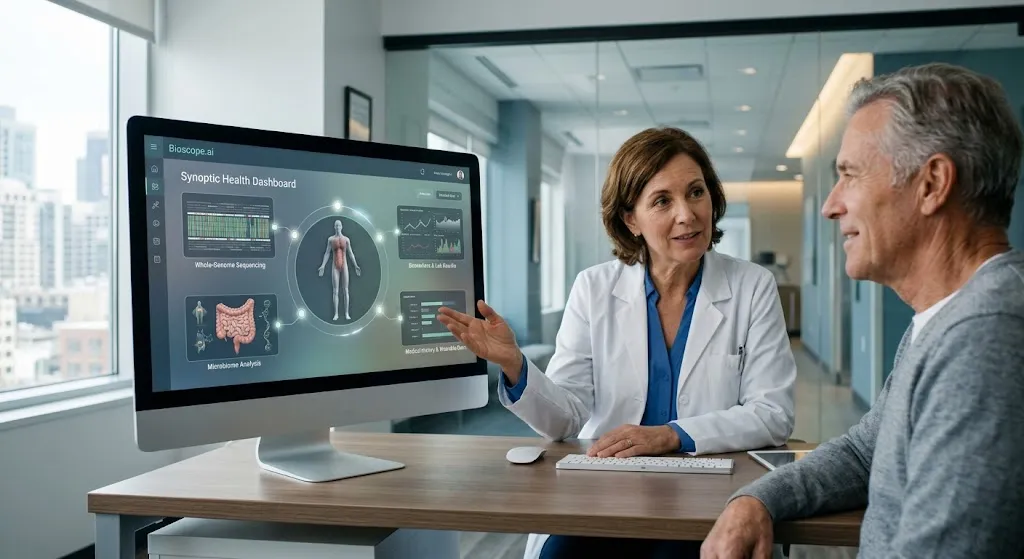
Bioscope.ai addresses this through its Synoptic Health Dashboard. The dashboard is designed to provide an at-a-glance view of patient health across several clinical dimensions, with underlying data available for further review.
This can help physicians quickly identify areas that require attention.
Rather than moving between multiple reports, the doctor can begin with a connected overview and then explore individual findings in greater detail.
Personalised Longevity Plans
Longevity medicine is not simply about increasing lifespan.
The bigger goal is to support healthspan — the period of life spent in good health.
A personalised longevity plan may consider genetic risks, metabolic health, lifestyle, nutrition, medical history and other biological factors.
Bioscope.ai includes personalised health planning within its platform. Physicians can use the system to explore patient data and generate personalised longevity strategies supported by the available clinical information.
This approach can make longevity care more individual.
Instead of giving everyone the same general advice, physicians can consider the specific characteristics of the person in front of them.
Supporting Smarter Medication Decisions
Genetics can also influence how an individual responds to certain medicines.
This is the area of pharmacogenomics. Certain genetic variants can affect how the body processes medicines and may influence treatment response or the likelihood of side effects.
Bioscope.ai includes pharmacogenomic information as part of its precision health approach. By connecting genetic information with clinical context, the platform can help physicians consider whether a patient’s biology may be relevant to medication decisions.
This does not mean that genetics alone determines which medicine a person should receive.
Clinical decisions still require medical judgement, current evidence and consideration of the patient’s complete situation.
Evidence Matters in AI-Powered Healthcare
Healthcare AI needs to be different from ordinary consumer technology.
A chatbot that produces an interesting answer is not enough for clinical care. Physicians need reliable information, patient-specific context and evidence that can be reviewed.
Bioscope.ai focuses on evidence-grounded AI. Its platform provides supporting information and citations alongside clinical answers, allowing physicians to review the basis of the information presented.
This is important because AI should support responsible decision-making rather than encourage blind trust in automated answers.
The physician remains responsible for interpreting the information and deciding how it should be used.
AI and the Future of Preventive Healthcare
Healthcare has traditionally focused heavily on treating disease after it becomes apparent.
Personalised longevity takes a more preventive approach.
The goal is to understand potential risks earlier and support healthier decisions before problems become more serious.
AI can help with this by monitoring large amounts of information and identifying changes that may deserve attention.
The Bioscope.ai platform is designed to continually incorporate new information, including health records and incoming data. Its approach allows the patient’s clinical picture to be updated rather than remaining a static report.
This could become increasingly valuable as patients generate more health information through testing and connected devices.
Human Expertise Remains Essential
AI may be powerful, but healthcare still depends on human expertise.
A genetic result does not automatically tell a doctor what to do. A laboratory change may have several possible explanations. A microbiome finding needs to be considered alongside the patient’s wider health.
This is why the physician remains central to the Bioscope.ai approach.
The platform is designed as an AI clinical colleague rather than a replacement for the doctor. It helps organise information and surface relevant insights, while the physician provides clinical judgement, communication and responsibility.
This combination of technology and human expertise is likely to be important in the future of personalised healthcare.
What Makes Bioscope.ai Different?
The main difference is the attempt to connect several layers of health information rather than focusing on a single test.
Genomics can provide a long-term view of inherited biology. Laboratory data can show current health trends. Microbiome information can add another biological layer. Medical records provide context, while AI helps bring everything together.
Bioscope.ai describes this as a connected precision medicine workflow.
Its platform is also designed to work alongside existing electronic medical records rather than requiring physicians to abandon their current systems.
This practical focus could be important for adoption. Technology is most useful when it fits naturally into the way healthcare professionals already work.
The Future of Bioscope.ai and Personalised Health

Personalised healthcare is likely to become more data-driven over the coming years.
As genomic sequencing, wearable technology, microbiome testing, imaging and laboratory analysis continue to develop, patients will have access to more health information than ever before.
The challenge will be making sense of it.
This is where platforms such as Bioscope.ai could play an important role. Its research direction includes multi-omic analysis and the integration of additional health data streams as the underlying technologies mature.
The long-term vision is not simply to collect more information. It is to turn information into useful clinical context.
Final Thoughts
Bioscope.ai represents an emerging approach to personalised health that combines artificial intelligence with genomics, microbiome data, biomarkers and medical history.
Its focus on whole-genome sequencing and connected clinical information offers a different way to think about long-term healthcare. Instead of viewing each test as a separate result, the platform aims to help physicians understand how different signals fit together.
For longevity medicine, this approach is particularly interesting. Healthy ageing is influenced by many factors, and no single test can explain everything.
The future of personalised care may therefore depend on combining better data with better interpretation.
Bioscope.ai is working towards this model by giving physicians an AI-supported clinical view of the patient, while keeping medical judgement at the centre of care.
Ultimately, the goal of personalised healthcare is simple: understand the individual better and use that understanding to support better-informed decisions.
As technology continues to improve, the combination of genomics, AI and clinical expertise could help move healthcare towards a more proactive, personalised and long-term approach to wellbeing.
Related posts:
 Regaining Control on the Road to Recovery: What You Need to Know
 🦷 Emax vs Zirconia: Which Dental Veneer Is Better for Your Smile?
 Medical Malpractice in Florida: What Every Healthcare Provider Should Understand
 Why Migraine and Motion Sickness Often Travel Together
 How PRP Therapy Is Being Used for TMJ and Jaw Pain in Florida Clinics
Leave a Reply