
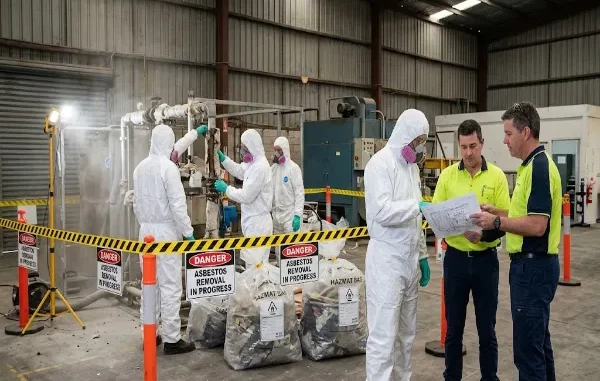
Asbestos can be found in unexpected areas within industrial buildings. Older warehouses, manufacturing facilities, workshops, commercial plants, and infrastructure may have asbestos-containing materials (ACMs) in roofs, wall linings, insulation, pipes, electrical components, plant, and other construction materials.
For facility owners, organising industrial asbestos removal is more than just discovering damaged material and getting it removed. The job must be organised around the quality and kind of asbestos, workplace activities, access requirements, waste disposal, and any applicable work health and safety regulations.
A well-planned strategy can limit the risk of exposure, avoid unnecessary disturbance, and help ensure that the work is done legally.
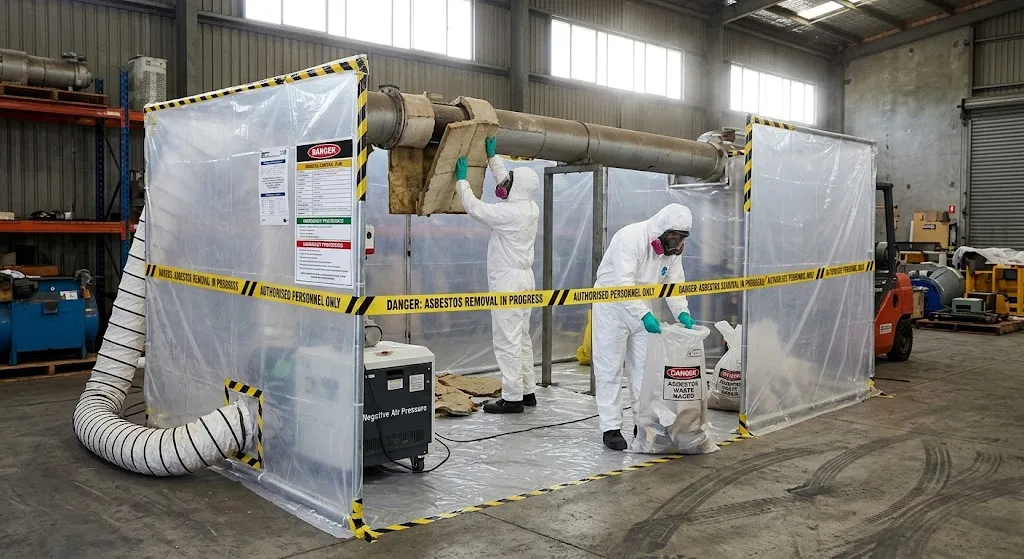
Start With Identification and Assessment
Before removal begins, facility owners must determine where asbestos may be found and in what condition it is in.
Businesses with asbestos in the workplace must comply with Australian workplace health and safety regulations, including asbestos registers and management plans. If asbestos is suspected, an analysis by a suitably qualified person may be required before making choices concerning removal.
This is especially relevant in industrial settings because asbestos can be incorporated into a variety of materials. A location may also have undergone several renovations, additions, or equipment upgrades over several decades, rendering historical drawings unreliable.
An asbestos register should be reviewed with current site conditions, past survey data, and future maintenance or building activities.
Understand What Needs to Be Removed
Not all asbestos-containing materials present the same level of risk or require the same approach.
Non-friable asbestos
Not all asbestos-containing materials present the same level of risk or require the same approach. It may still provide a concern if it is damaged, deteriorating, or disturbed during cutting, drilling, demolition, or other activities.
Friable asbestos
Not all asbestos-containing materials present the same level of risk or require the same approach. This category includes materials like pipe lagging and certain insulating products.
The distinction is important since Australian jurisdictions have various licensing and control requirements. According to the model WHS framework, Class A removalists can remove any form of asbestos, whereas Class B removalists are limited to non-friable asbestos. Because state and territory standards may differ, facility owners should consult with their local WHS authority to confirm the applicable rules.
Choose an Appropriately Licensed Asbestos Removalist
When choosing an asbestos removalist, consider the nature of the work, the materials involved, and the requirements in the applicable state or territory.
For large industrial projects, facility owners should ensure that the contractor has the necessary license and experience for the proposed job. It is also prudent to choose who will conduct the evaluation, removal, air monitoring, clearance inspection, and garbage disposal.
Before any legal removal work begins, a qualified removalist must present sufficient planning paperwork. Depending on the work, this may contain an asbestos removal control plan that specifies how the hazards will be mitigated.
Facility owners should also understand their own responsibilities, rather than thinking that hiring a contractor transfers all workplace safety responsibility.
Plan Around Industrial Operations
Industrial asbestos removal activity can have an impact on areas beyond the local removal zone.
Forklifts, production lines, contractors, maintenance teams, delivery trucks, and other workers may operate in close proximity to factories and warehouses. Removing asbestos without addressing these processes can result in needless exposure hazards and operational issues.
Before work starts, consider:
- access and exclusion zones
- nearby workers and contractors
- ventilation and air movement
- plant and equipment that could be affected
- emergency access
- working at height
- interaction with other construction or maintenance activities
- arrangements for shutting down affected areas where necessary
Signage, barricades, and restricted access are critical safety measures during asbestos removal.
When multiple firms or contractors share a site, collaboration and cooperation are especially crucial.
Confirm How Asbestos Waste Will Be Managed
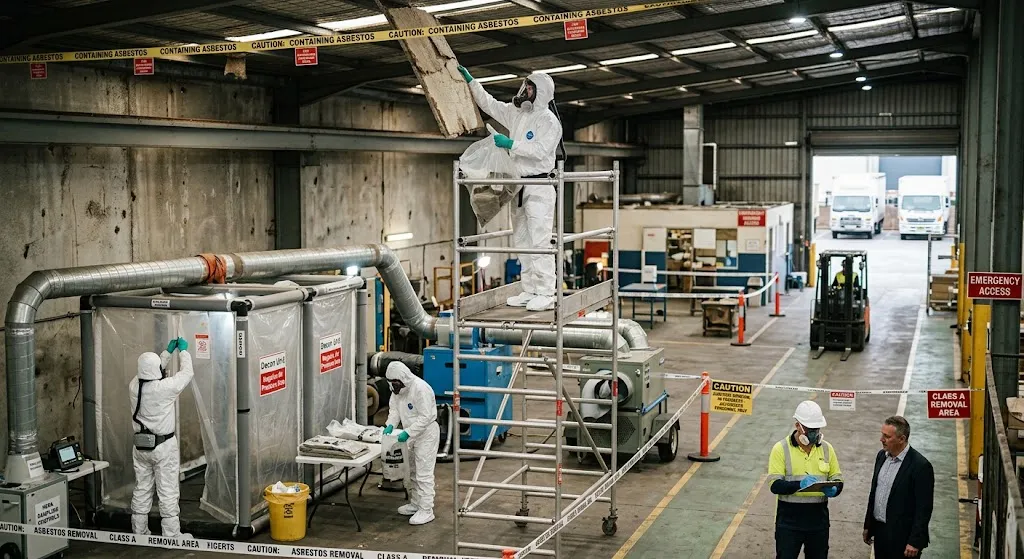
The removal of asbestos does not end when it leaves the structure. The resulting waste must be properly contained, transported, and disposed of at a facility licensed to handle asbestos waste.
Requirements vary by jurisdiction. Asbestos waste, for example, is classified as regulated trash in Queensland, with specific packing, transportation, and disposal restrictions. NSW also requires asbestos trash to be transported to a landfill that is approved to collect it.
Before work begins, facility owners should confirm the intended disposal arrangements, including the receiving facility and any required documentation or waste tracking.
Improper disposal might pose environmental problems and subject the company to regulatory implications.
Consider Clearance Before Reoccupation
Once the removal job is over, the space should not be reopened simply because the visible material has disappeared.
Depending on the nature of the work and jurisdiction, clearance inspections, air monitoring, and clearance certification may be necessary. According to Safe Work Australia’s current guidance, after approved removal work, an inspection and clearance certificate from an independent licensed assessor who was not engaged in the removal is necessary before ordinary reoccupation in the situations specified.
The specific regulations should be validated for the state or territory where the facility is located.
Good Planning Makes Industrial Removal Safer
Industrial asbestos removal is best approached as a planned workplace safety project rather than a routine maintenance task. Identifying asbestos early on, choosing a suitably qualified asbestos removalist, defining the scope of work, coordinating site activities, and confirming waste and collection plans can all assist prevent unnecessary risk.
For facility owners, the objective is to assess the asbestos situation before work begins and ensure that every stage, from assessment to final clearance and disposal, is well considered.
Because asbestos regulations and licensing requirements differ across Australia, it is always recommended to seek current guidance from the applicable state or territory regulator for the specific project.
Related posts:
 How Verified Consultants Can Help You Close Office Deals Faster in Bangalore
 How Maya Thompson Turned $100 Into a Million-Dollar Empire
 What Is a Road Trading Strategy? A Trend Method for FX Beginners
 Refinancing Your Home Loan After RBI Rate Cuts: A Smart Way to Save
 Building a Scalable Business Through Accelerator Mentorship and Capital
Leave a Reply