
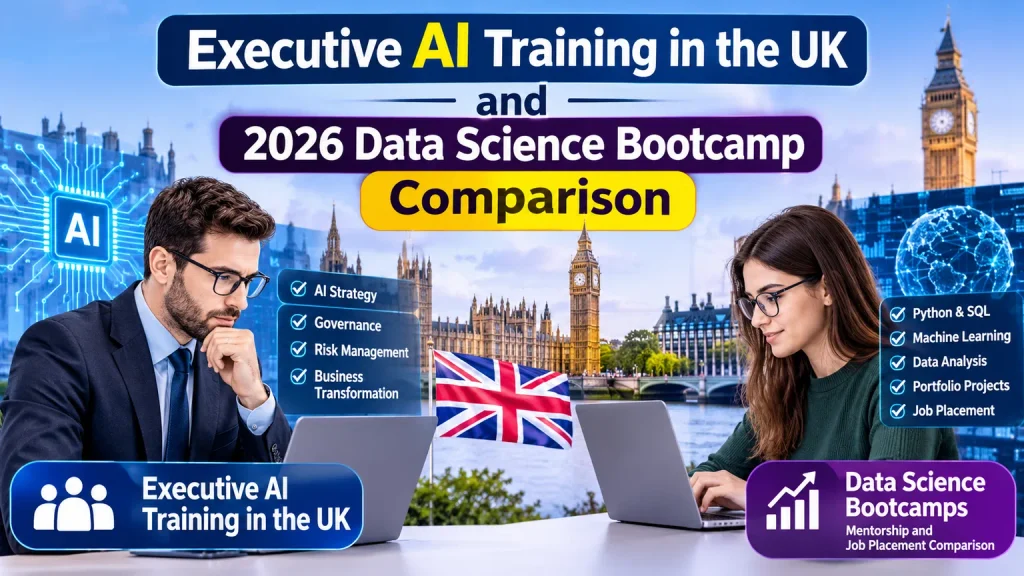
Artificial intelligence and data science are transforming how businesses operate make decisions, and compete in the modern economy.
In 2026 organizations across the United Kingdom are increasingly investing in AI education, executive training and technical talent development to remain competitive. At the same time professionals are exploring data science bootcamps to develop practical skills and access new career opportunities.
Although executive AI education and data science bootcamps serve different audiences both contribute to the growing demand for technology-driven expertise.
Understanding their differences can help business leaders, aspiring data scientists, and organizations choose the right learning pathway.
The Growing Importance of Executive AI Education in the UK
Artificial intelligence is no longer limited to technology companies.
Financial institutions, healthcare organizations retail businesses manufacturing companies and professional service providers are adopting AI-powered solutions to improve productivity and operational efficiency.
However, successful AI adoption requires more than purchasing software or experimenting with generative AI tools. Business leaders must understand how AI systems work, where they create value, and what risks they introduce.
A well-structured executive AI education program helps senior professionals develop the knowledge needed to make informed technology investments. It also introduces important areas such as AI governance, regulatory compliance, data management, and organizational transformation.
Professionals looking to develop these capabilities can explore an executive AI training course in the UK to better understand executive AI strategy responsible implementation and enterprise-wide transformation.
Essential Skills Covered in Executive AI Training
Executive AI training programs generally focus on the practical and strategic aspects of artificial intelligence rather than advanced programming exercises.
Some important learning areas include:
1. AI Strategy and Business Planning
Executives need to identify opportunities where artificial intelligence can improve business performance. This involves evaluating potential applications, estimating implementation costs, and establishing measurable objectives.
2. AI Governance and Risk Management
Organizations must establish policies that address data privacy, algorithmic bias, transparency, security, and human oversight. Understanding frameworks such as ISO/IEC 42001 can help businesses develop structured AI management systems.
3. Generative AI and Automation
Generative AI applications can support content creation, customer service, research, reporting, and internal knowledge management. Executive training helps decision-makers understand how these technologies can be integrated into existing workflows.
4. Organizational Transformation
Introducing AI often requires changes in business processes, employee responsibilities, and management structures. Leaders must develop strategies that encourage adoption while maintaining accountability.
5. Measuring AI Performance
Businesses should evaluate AI initiatives through measurable outcomes, including productivity improvements, operational savings, customer experience, and return on investment.
These competencies allow executives to move beyond experimentation and develop sustainable AI adoption strategies.
Understanding Data Science Bootcamps in 2026
While executive AI training focuses on strategic decision-making, data science bootcamps are designed to develop practical technical capabilities.
These intensive programs help learners understand programming, statistics, data analysis, machine learning, and predictive modeling. They are particularly useful for individuals who want to enter the technology industry or improve their existing technical skills.
Most data science bootcamps combine theoretical instruction with practical assignments. Depending on the provider and learning format, programs may last several weeks or extend across several months.
Common technical subjects include:
- Python programming and data manipulation.
- SQL and relational database management.
- Statistical analysis and probability.
- Machine learning algorithms.
- Data visualization and reporting.
- Predictive analytics and model evaluation.
- Practical portfolio development.
The most valuable programs connect these subjects to realistic business challenges rather than relying exclusively on classroom exercises.
Why Mentorship and Portfolio Projects Matter
One of the biggest challenges for aspiring data scientists is converting theoretical knowledge into practical experience.
Watching tutorials and completing basic exercises may introduce programming concepts, but employers generally want candidates who can demonstrate their ability to solve real problems.
This is where personalized mentorship becomes valuable. Experienced professionals can review code, explain difficult concepts, identify technical weaknesses, and provide guidance on project development.
Portfolio projects are equally important. A strong portfolio can demonstrate experience with data cleaning, exploratory analysis, predictive modeling, database management, and business reporting.
Students comparing different programs should carefully evaluate the data science bootcamps mentorship and job placement comparison to understand how mentorship structures practical projects and career support differ across training providers.
2026 Data Science Bootcamp Comparison What Should Students Evaluate
Choosing a suitable bootcamp requires more than comparing tuition fees. Students should examine curriculum quality, instructor experience, mentorship availability, project requirements, and employment support.
The following factors can help prospective learners make a more informed decision.
1. Curriculum and Technical Depth
A quality bootcamp should provide a structured curriculum covering Python, SQL, statistics, machine learning, and practical data analysis. Advanced learners may also benefit from exposure to cloud technologies, data engineering, and distributed computing.
2. Individual Mentorship
Personalized mentorship can make a significant difference, especially for beginners and career changers. One-to-one sessions allow students to receive individual feedback and work through technical challenges.
3. Portfolio Development
Students should prioritize programs that include practical projects based on realistic business scenarios. Projects involving customer segmentation, financial forecasting, sales prediction, and business intelligence can demonstrate valuable problem-solving abilities.
4. Career Services
Career support may include CV development, LinkedIn profile optimization, technical interview preparation, mock interviews, and employer networking opportunities.
However, students should distinguish between general career assistance and contractual job guarantees. Any placement guarantee should be reviewed carefully, including its eligibility requirements and refund conditions.
5. Tuition and Financing
Bootcamp prices vary depending on the provider, curriculum, learning format, and level of mentorship. Prospective students should compare the complete tuition cost, payment plans, financing conditions, and additional expenses before enrolling.
Executive AI Training vs. Data Science Bootcamps
Although both learning pathways involve artificial intelligence and data, their objectives are different.
| Comparison Factor | Executive AI Training | Data Science Bootcamps |
| Main Audience | Business executives and managers | Aspiring and working data professionals |
| Primary Focus | AI strategy and governance | Technical and analytical skills |
| Learning Approach | Strategic workshops and business cases | Practical assignments and projects |
| Key Topics | AI transformation, risk, compliance | Python, SQL, statistics, machine learning |
| Career Objective | Leadership and decision-making | Technical employment and career development |
| Main Outcome | Better AI implementation decisions | Practical data science capabilities |
Business leaders may benefit more from executive AI education, whereas individuals interested in technical careers may find a structured data science bootcamp more appropriate.
Organizations can also combine both approaches by training senior management in AI strategy while developing technical expertise among their engineering and analytics teams.
How Businesses Can Combine AI Strategy and Technical Skills
Successful enterprise AI adoption requires collaboration between leadership teams and technical professionals.
Executives establish business objectives, allocate resources, and define governance policies. Data scientists and engineers then translate these objectives into practical solutions through data analysis, machine learning, and automation.
For example, a retail company may want to use predictive analytics to improve inventory management. Executive leadership identifies the business opportunity and establishes performance targets, while data professionals build forecasting models using historical sales information.
Similarly, a financial services organization may introduce AI-powered customer support. Management must address privacy, security, and regulatory considerations, while technical teams develop and evaluate the underlying systems.
This combination of strategic leadership and technical implementation creates a stronger foundation for responsible AI adoption.
Choosing the Right Learning Pathway in 2026
Selecting between executive AI education and a data science bootcamp depends on professional objectives, existing experience, and future career plans.
Business owners, directors, senior managers, and technology decision-makers should consider executive AI programs that emphasize governance, strategic planning, and enterprise transformation.
Meanwhile, graduates, career changers, analysts, and software professionals may benefit from data science bootcamps that provide structured technical instruction and practical mentorship.
Before making a decision, prospective learners should evaluate the curriculum, teaching methodology, instructor qualifications, project quality, and measurable learning outcomes.
They should also investigate independent employment data instead of relying entirely on promotional placement statistics.
Conclusion
Executive AI training and data science bootcamps are two important educational pathways shaping the technology landscape in 2026. Although they serve different professional needs, both help individuals and organizations prepare for an increasingly data-driven economy.
Executive AI education develops the strategic knowledge required to manage AI adoption, governance, and enterprise transformation. Data science bootcamps build the practical technical skills needed to analyze information, develop predictive models, and solve business problems.
For organizations, combining leadership education with technical workforce development can create a more effective AI strategy. For individuals, selecting a learning pathway aligned with their career ambitions can provide a valuable foundation for long-term professional growth.
Related posts:
 How Dechecker AI Checker Turns Awkward Drafts Into Human-Readable Content
 The Complete Guide to Using Telegram for Secure and Smart Communication
 The Chemistry Behind Firefighting Foam: How Surfactants Make Fire Suppression Work
 Dell Latitude 5540 Performance Tested: Can It Handle Your Workflow?
 Best Traction Tools for Lifted Jeeps & SUVs on the Trail
Leave a Reply