
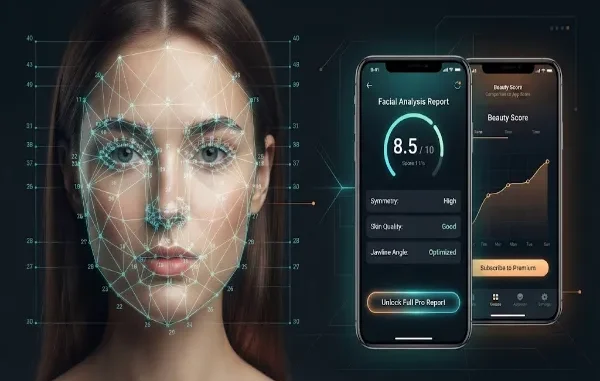
A large category of apps now does something that looks impressive. Upload one face photo, and the app returns a score, a symmetry breakdown, an animated avatar, or a filter that tracks your expression in real time. Many charge for it. A good number of them run on the same free, publicly documented Google model.
The tell is a number. If a product claims to detect 468 or 478 facial landmarks, it is almost certainly using MediaPipe Face Mesh, an open-source model that Google publishes with full documentation and a working browser demo. The figures are not generic. They are the exact output counts of one specific model.
This covers a wide range of products: beauty-scoring apps, headshot selection tools, AR filter builders, virtual try-on features, and any attractiveness test that returns a score from an uploaded photo. This article explains what the model actually does, how to identify it in a product you are using, what paid apps add on top of it, and what all of that means when you are deciding whether to pay.

What MediaPipe Face Mesh Actually Is
MediaPipe is a set of open-source machine learning tools published by Google. Face Mesh is the part that handles faces.
A landmark model, not a judgement model
The model does one job. It finds a face in an image and places a fixed set of points on the features. One point sits at the outer corner of the left eye. Another sits at the centre of the upper lip. Several trace the jaw. The output is a list of coordinates.
That is the whole thing. The model does not rank, score, or evaluate faces in any way. It reports where features sit in three-dimensional space. Every judgement a product makes comes from code written after the model has finished.
This distinction matters because it is where most marketing copy goes quiet. “Advanced AI analysis” usually refers to the landmark step, which is free and off-the-shelf. The part that turns coordinates into a verdict is rarely described at all.
The numbers that give it away
Google’s own documentation states the output counts plainly. The Face Landmarker task estimates 478 three-dimensional face landmarks from a single camera image. The base face mesh configuration returns 468 points, and enabling iris refinement adds ten more, five per eye.
The same documentation lists a second output that appears in many products without attribution: a blendshape prediction model that returns 52 coefficients representing facial expressions. If an app reports 52 expression values, that number comes from a specific source.
Why it spread so quickly
Four reasons, and none of them involve secret technology.
It costs nothing. It runs inside a browser, so a company can offer it without paying for server capacity. It needs no specialist hardware. And a functioning demo is available to anyone who can copy a script tag into a web page.
The result is that building the core of a face-analysis product has become a weekend job. What used to require a research team now requires a front end.
How to Identify It in a Product You Are Using
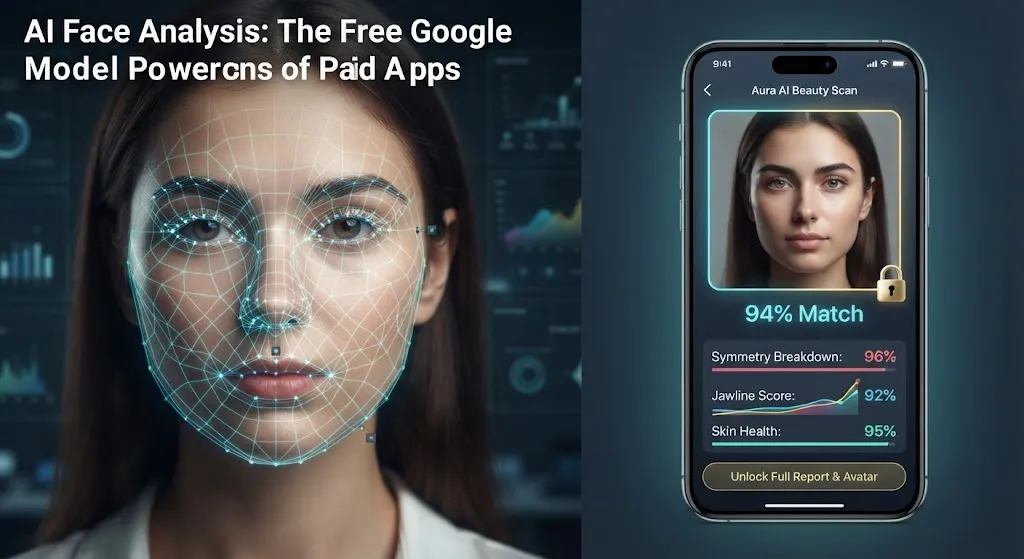
You do not need technical skill to check any of this. Three quick tests cover most cases.
Read the landmark count in the marketing copy
Start with the product’s own claims. An exact match to 468 or 478 is the strongest signal available because those are unusual numbers that came from a single source. A claim of 52 expression coefficients points the same way.
Vague phrasing tells you nothing either way. “Powered by advanced neural networks” is compatible with a genuinely custom model and with a free library behind a paywall.
Check whether processing happens locally
Open the tool in a desktop browser. Press F12 to open developer tools and click the Network tab. Then run a scan and watch the requests.
Browser-side processing has a distinctive pattern. You will see several model files downloaded at the start, often a few megabytes each, followed by almost no traffic while the scan runs. Server-side processing looks different: a large outgoing request the moment you press the button.
Neither answer is bad on its own. Local processing is better for privacy. Server processing may mean the company is running something heavier than a free library. The point is to know which you are dealing with.
Look at what happens offline
Load the page, disconnect from the internet, then run a scan. A tool that still works is one that runs entirely on your device, which narrows the field considerably.
What the Paid Apps Actually Add
This is where the story gets fairer than the headline suggests. Building on open-source foundations is normal engineering practice, and some of what these products add is real.
The legitimate additions
Interface and workflow matter. A well-built product that handles batch uploads, saves results, and presents them clearly is doing work the model does not do. Some companies train genuine models on top of the landmark output, which is a real technical contribution. Others add storage, sharing, or integration with tools their users already have.
None of that is dishonest. A free component inside a paid product is how most software works.
The scoring layer
The problem is narrower and more specific. When a product converts coordinates into a verdict, someone decided what those coordinates mean.
Someone chose that symmetry is worth 30% of a score. Someone decided which jaw angle ranks higher. Someone set the point where a result becomes a 7 rather than a 6. Those are business decisions, not research findings, and they are the entire difference between products that all run identical technology underneath.
Almost none of them publish that layer. There is usually no weighting disclosed, no training data named, and no test showing how the output compares to human judgement.
The consequence is that two apps running the same free model can return very different scores for the same photo, and neither can tell you why. For anyone weighing up a face-scoring product, the gap between the technology and the verdict is worth understanding in full, and there is a detailed breakdown of how these scores are produced and how far they can be trusted, covering the research behind them.
Why disclosure is rare
Publishing the method invites scrutiny of the result. It also reveals the only proprietary asset a product built on free components has. The commercial incentive runs directly against transparency, which explains the silence better than anything else.
The Same Model Behind Filters and Avatars
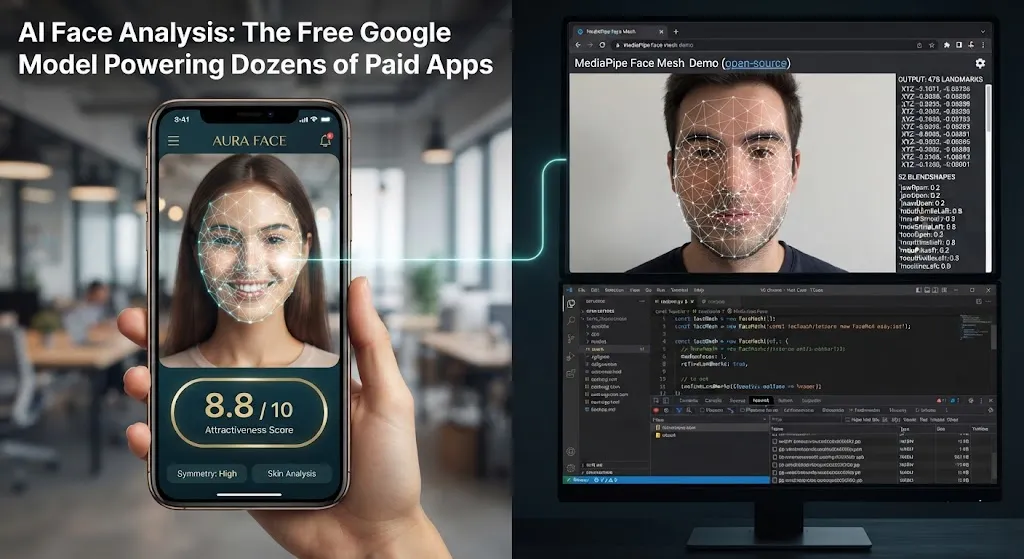
Scoring is only one use. The same coordinate stream drives a lot of what people think of as unrelated features.
Expression tracking and animated avatars
Those 52 blendshape coefficients describe how a face is moving right now. How open the jaw is. How raised the left eyebrow is. How much the mouth is smiling.
Feed that stream into a 3D character, and it mirrors your expression in real time. This is the same technology as a static score, but it runs many times per second instead of once. The animated avatar in a video call and the beauty score in a web app can be reading identical data.
Not every cartoon face is face technology
It is worth separating this from things that look similar to a general audience but work nothing like it.
TikTok emojis are the clearest example. These are the small cartoon faces that turn up in comments and captions but sit nowhere on a phone keyboard. There are 46 of them, and they are triggered by typing a shortcode in square brackets, such as [smile] or [cry], which the app converts into a graphic when you post. They render only inside the TikTok app, which is why they do not appear if you view the same comment on another platform.
No camera is involved. No face is detected. They are static image assets swapped in by a text parser, and they have nothing in common with landmark models beyond both producing a face on a screen.
The distinction matters because “AI face stuff” has become a single category in most people’s minds. Knowing which features involve reading a real face and which are decoration makes it much easier to judge what a product is actually doing.
What This Means When You Evaluate an AI Product
The takeaway is not that open-source foundations are a scandal. It is that a specific technical claim can be checked, and checking it changes what you are willing to pay for.
Questions worth asking before you pay
- What does the underlying model actually output, and is that the same as what the product claims to measure?
- Who wrote the interpretation layer on top, and is the method published anywhere?
- Does the product work offline, and what does that tell you about where processing happens?
- What happens to the image after the scan, according to the privacy policy rather than the marketing page?
The general principle
Exact figures are checkable in a way adjectives are not. A landmark count, an expression coefficient count, or a stated model name can be verified against vendor documentation in a couple of minutes. “Proprietary AI” cannot be verified at all.
When a product publishes a number that exactly matches a free library, that is not proof of anything dishonest. It is a starting point for asking what the rest of the product is for.
FAQs
Yes. Google publishes it as open source with documentation, code samples, and browser demos. Developers can add face landmark detection to a web page or app without licensing costs, which is a large part of why so many face analysis products appeared in a short period.
The base configuration returns 468 three-dimensional landmarks. Enabling iris refinement adds ten more points, five per eye, for a total of 478. A product citing either figure is very likely running this model rather than something built in-house.
Both approaches exist. Browser-based tools download model files once and process images on your device. Server-based tools upload the image and return a result. The Network tab in your browser’s developer tools shows which one you are using.
No. The model reports coordinates and expression coefficients. Any ranking, score, or verdict comes from code the product owner wrote afterwards, using weightings they chose themselves and almost never publish.
Related posts:
 Voyage Through Time: When will Time Travel be Possible
 The Complete Guide to Using Telegram for Secure and Smart Communication
 The Chemistry Behind Firefighting Foam: How Surfactants Make Fire Suppression Work
 Dell Latitude 5540 Performance Tested: Can It Handle Your Workflow?
 Best Traction Tools for Lifted Jeeps & SUVs on the Trail
Leave a Reply