
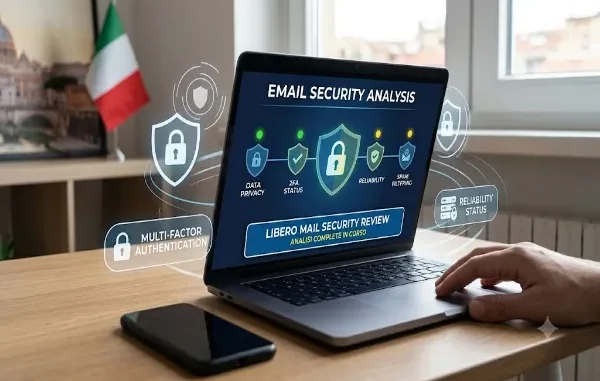
Libero Mail is generally safe for basic use, but it has weaker security, limited modern encryption, and a history of outages compared to Gmail, Outlook, or Proton Mail.
Email is one of the most personal and sensitive tools we use online. It holds financial statements, private conversations, login credentials, medical records, and years of communication history. Trusting an email provider means trusting them with some of the most important data in your digital life.
So when Italians — and Italian speakers around the world — ask “Is Libero Mail safe?”, it’s not a trivial question. It deserves a thorough, honest answer.
Libero Mail is one of Italy’s most popular and longest-running email services. Millions of people use it as their primary inbox. But over the years, it has also attracted criticism, faced serious technical incidents, and left many users questioning whether it’s still a trustworthy option in 2026.
This article takes a comprehensive look at Libero Mail — its history, its security features, its past problems, how it compares to alternatives, and what you should realistically expect if you use it as your primary email provider.
What Is Libero Mail?
Libero Mail is a free email service operated by ItaliaOnline, one of Italy’s largest internet companies. Libero — which means “free” in Italian — launched in 1999 and quickly became one of the dominant web portals and email providers in the Italian market, competing in that era with similarly structured portals like Virgilio and Tiscali.
Like many web portals of its generation, Libero built its business around free consumer services supported by advertising revenue. Its email product attracted tens of millions of registered users over the decades, and for many older Italian internet users in particular, a Libero Mail address was simply “their email” — set up years ago and maintained ever since out of habit, familiarity, and the accumulated history stored within the account.
Today, Libero Mail continues to operate as a free webmail service with a mobile app, advertising-supported model, and a paid premium tier offering additional features. It is part of ItaliaOnline’s broader portfolio of digital services.
The Big Question: Is Libero Mail Actually Safe?
The honest answer is: it depends on what you mean by “safe,” and compared to what.
Libero Mail is not an inherently malicious service. It is a legitimate, established company with real infrastructure, millions of real users, and no credible evidence of intentional misuse of user data. If your question is “will Libero Mail deliberately steal my data and sell it to criminals?” — the answer is almost certainly no.
But if your question is “does Libero Mail offer the level of security, privacy, and reliability that I should expect from a service protecting my most sensitive communications?” — then the answer is more complicated, and more concerning.
To understand why, you need to look at what has actually happened with Libero Mail over the years, what security features it does and doesn’t offer, and how it compares to the standard set by more security-focused email providers.
A History of Technical Problems and Outages
One of the most significant and documented issues with Libero Mail is not a security breach in the traditional sense — it’s reliability. Over the past several years, Libero Mail has experienced a number of serious outages that left users locked out of their accounts, sometimes for days at a time.
The most notable of these occurred in late 2022, when a prolonged, widespread outage affected a large number of Libero Mail and Virgilio Mail users simultaneously. Users reported being unable to access their accounts, receiving errors when trying to log in, missing or deleted emails, and in some cases appearing to have lost access to their accounts entirely for an extended period. The incident lasted much longer than a typical maintenance window and generated significant frustration and criticism online and in Italian tech media.
For users who rely on their Libero Mail address as a primary email — particularly for important services, banking communications, or account recovery on other platforms — an outage of this nature is not merely an inconvenience. It can mean being locked out of important correspondence, unable to receive time-sensitive messages, and cut off from account recovery functions for other services tied to that email address.
This type of prolonged, poorly communicated outage raises questions not just about technical infrastructure but about organizational priorities, investment in maintaining and modernizing aging systems, and transparency with users during incidents.
A free service is under no contractual obligation to maintain any specific level of uptime, but users should realistically factor in reliability history when deciding how much they depend on any email service — especially a free one.
Security Features: What Libero Mail Does and Doesn’t Offer
Let’s look specifically at the security features Libero Mail provides, because this is where the gap between it and more security-focused alternatives becomes most apparent.
Two-Factor Authentication
Two-factor authentication (2FA) is one of the most important security features an email provider can offer. It means that even if someone gets hold of your password, they still cannot access your account without a second verification step — typically a code sent to your phone or generated by an authenticator app.
As of the time of writing, Libero Mail’s implementation of two-factor authentication has been inconsistent and in some periods unavailable or limited to certain account types. This is a significant weakness. Email accounts are high-value targets for hackers precisely because they are used to reset passwords on virtually every other online service. Without robust 2FA, a compromised password means a compromised account — and potentially a cascade of compromised accounts across everything tied to that email address.
By contrast, major email providers like Gmail, Outlook, and ProtonMail have offered strong, well-implemented 2FA for years as a standard security feature. The gap here is meaningful.
Encryption in Transit
Libero Mail, like virtually all modern email services, encrypts email connections in transit using TLS (Transport Layer Security). This means that emails traveling between your device and Libero’s servers, and between Libero’s servers and other email providers’ servers, are encrypted during transmission. This is a baseline modern security standard.
However, encryption in transit is different from end-to-end encryption. TLS protects the communication channel, but the email content itself is accessible to Libero on their servers.
End-to-End Encryption
End-to-end encryption (E2EE) means that emails are encrypted in a way that only the sender and recipient can read them — not even the email provider can access the content. This is the gold standard for email privacy.
Libero Mail does not offer end-to-end encryption. This means that in principle, Libero — or anyone with access to Libero’s servers, including through a legal order, a data breach, or an insider threat — could access the content of your emails.
It’s worth noting that most mainstream free email services, including Gmail and Outlook, also do not offer end-to-end encryption by default. This is a limitation of free, advertising-supported email services broadly, not a unique flaw specific to Libero. However, the absence of E2EE is worth understanding clearly.
Spam and Phishing Filtering
Libero Mail has spam filtering capabilities, though user reports of its effectiveness are mixed. Phishing emails — fraudulent messages designed to trick you into revealing login credentials or personal information — represent one of the most serious everyday email threats, and the quality of filtering against these attacks varies between providers.
Multiple users report that Libero’s spam filtering is less effective than that of major international providers, though individual experience varies depending on email usage patterns.
Password Security and Account Recovery
Account recovery mechanisms — the processes that let you regain access to your account if you forget your password — are themselves a significant security consideration. Weak account recovery processes are a common attack vector.
Libero Mail uses standard account recovery options including a recovery email address and security questions. Security questions are generally considered a weak recovery mechanism by modern security standards, since the answers to common questions (mother’s maiden name, name of first pet) are often findable through social engineering or public information.
Privacy Considerations: What Does Libero Do With Your Data?
Libero Mail is a free, advertising-supported service. This means its business model involves showing you advertisements, and the effectiveness of those advertisements depends on how well they can be targeted to you based on your interests and behavior.
Like most free email services, this means Libero processes information about you and your usage of the service to serve relevant advertising. The specifics of what data is collected, how it is used, how long it is retained, and who it is shared with are governed by ItaliaOnline’s privacy policy.
As an Italian company, Libero Mail is subject to European Union data protection law, including the General Data Protection Regulation (GDPR). This is actually a meaningful protection that distinguishes European email providers from some non-European alternatives, since GDPR imposes strict requirements around data collection, user rights, and breach notification.
Under GDPR, you have the right to access data held about you, the right to request deletion of your data, the right to know if there has been a breach affecting your data, and various other protections. These rights are legally enforceable.
This doesn’t mean your data is perfectly private on Libero — the service is still an advertising business that processes your information for commercial purposes. But the GDPR framework provides a legal floor of protection that is among the strongest in the world.
If privacy is your primary concern, however, it’s important to understand that advertising-supported email and meaningful email privacy are fundamentally in tension with each other. A service that earns money by targeting advertising based on user behavior has an inherent business incentive to collect and retain as much behavioral information as possible.
Common User Complaints About Libero Mail
Beyond the major outage incident, a consistent set of complaints appears in Italian tech forums, user review sites, and app store ratings about Libero Mail. Understanding these gives a realistic picture of the day-to-day experience:
Account access problems: Users frequently report unexpected logouts, difficulty logging in, and sessions that don’t persist correctly across devices. These are usability issues but also create security concerns if they lead users to disable security features out of frustration.
Slow and dated interface: The Libero Mail web interface is often described as feeling outdated and slower than competing services. The mobile app has similarly mixed reviews in app stores, with complaints about crashes, bugs, and missing features that are standard in other email apps.
Poor customer support: Libero Mail is a free service, which means formal customer support is limited. Users who encounter problems — particularly account lockouts or lost email following outages — often report difficulty getting meaningful help. This is a common limitation of free consumer email services, but it’s worth knowing before you rely heavily on the service.
Spam filtering gaps: As noted above, spam and phishing emails getting through filtering is a recurring complaint from Libero Mail users.
Missing emails: Some users report emails going missing entirely, either during outages or during normal operation. This is one of the more serious reliability complaints, as email loss is typically unrecoverable.
How Does Libero Mail Compare to Alternatives?
To put Libero Mail’s safety and quality in context, it helps to compare it against some of the main alternatives available to Italian users.
Libero Mail vs. Gmail
Gmail is operated by Google, the world’s largest advertising technology company. It has far more robust security features than Libero, including well-implemented 2FA, advanced phishing detection, massive infrastructure with very high reliability, and a mobile experience that is among the best available.
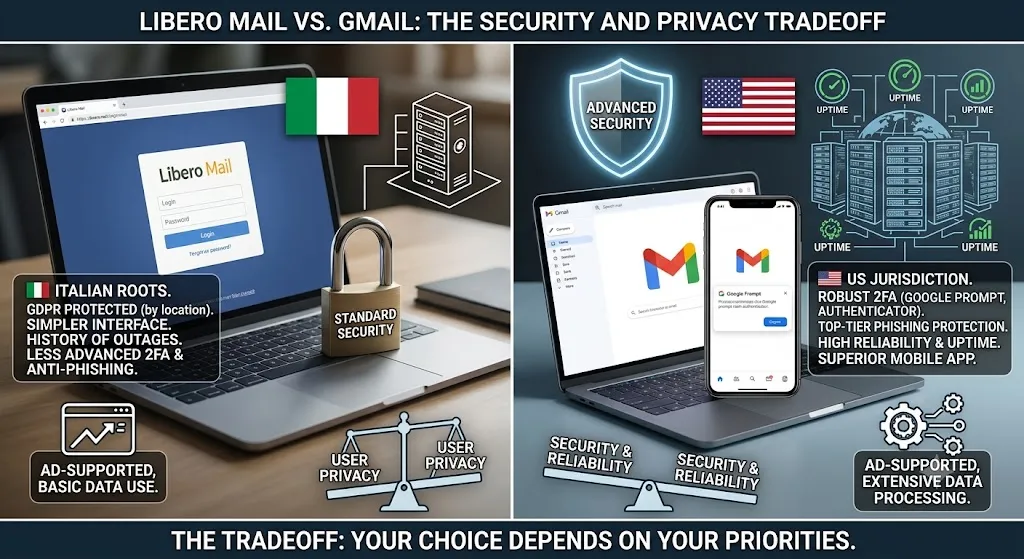
The privacy trade-off with Gmail is significant — Google processes substantial amounts of data for advertising purposes, and as an American company, user data is subject to U.S. legal jurisdiction rather than European GDPR (though Google’s European operations nominally comply with GDPR). For pure security features and reliability, however, Gmail is clearly superior to Libero Mail.
Libero Mail vs. Outlook / Hotmail
Microsoft’s Outlook offers strong security features including robust 2FA, good spam filtering, and high reliability. Like Gmail, it is an advertising-supported service with significant data collection, though Microsoft’s data practices are generally considered somewhat more conservative than Google’s in terms of advertising personalization.
Libero Mail vs. ProtonMail / Proton Mail
ProtonMail, now rebranded as Proton Mail, is the most significant alternative for users who prioritize security and privacy above all else. Founded in Switzerland by scientists who met at CERN, Proton Mail offers end-to-end encryption by default for emails between Proton users, zero-access encryption for stored emails (meaning even Proton cannot read your emails), a free tier with a generous feature set, and a business model based on paid subscriptions rather than advertising.
For users who genuinely care about email security, Proton Mail represents a fundamentally different approach. Its free tier has limitations compared to free Gmail or Libero Mail, but the security and privacy architecture is categorically superior.
Libero Mail vs. Virgilio Mail
Virgilio Mail is another Italian web portal email service, also operated by ItaliaOnline — the same parent company as Libero. The two services share infrastructure, which means they share both the benefits and the limitations of that infrastructure. The 2022 outage affected both Libero and Virgilio simultaneously, which is informative about the shared nature of their backend systems. Choosing Virgilio over Libero for security reasons doesn’t make meaningful sense given their shared ownership and infrastructure.
| Feature | Libero Mail | Gmail | Outlook | Proton Mail |
|---|---|---|---|---|
| Best For | Italian users and basic personal email | Everyday personal and business use | Microsoft ecosystem users | Privacy-focused users |
| Free Storage | Varies by account type | 15 GB | 15 GB | 1 GB |
| Two-Factor Authentication | Yes | Yes | Yes | Yes |
| End-to-End Encryption | No | No (standard accounts) | No (standard accounts) | Yes |
| Spam Protection | Good | Excellent | Excellent | Very Good |
| Privacy Focus | Good | Moderate | Moderate | Excellent |
| Business Integration | Limited | Google Workspace | Microsoft 365 | Limited |
| Mobile Apps | Android & iOS | Android & iOS | Android & iOS | Android & iOS |
| Overall Security | Good | Very Good | Very Good | Excellent |
Who Is Libero Mail Still Appropriate For?
Despite its limitations, Libero Mail continues to serve a large user base, and there are legitimate reasons why people continue using it.
Long-term users with established accounts: Many Italians have had Libero Mail addresses for fifteen, twenty, or more years. Their address is linked to countless services, known by friends and family, and embedded in their digital life. The disruption of changing email addresses is real and significant, and for many users this history outweighs the service’s limitations.
Low-stakes, non-sensitive usage: If you are using an email address primarily for newsletters, retail promotions, online shopping notifications, and other low-sensitivity communications, the security limitations of Libero Mail are less critical. The risk-reward calculation is different for an account that receives coupon codes versus one that receives banking correspondence.
Users comfortable with the Italian-language interface and support ecosystem: Libero Mail offers an Italian-language experience by default, and its brand recognition is deeply embedded in Italian internet culture. For users who prefer a familiar, Italian-branded service, this has genuine value.
Who Should Probably Switch?
There are clear categories of users for whom continuing to rely primarily on Libero Mail as a main email account carries real risk:
Users who rely on their email for important financial, medical, or legal communications: Given Libero’s history of outages and the generally stronger security features of alternatives, high-stakes email should be handled by a more robust provider.
Users who have not set up two-factor authentication (and cannot due to platform limitations): Without 2FA, any email account is significantly more vulnerable. If you cannot easily enable robust 2FA on your Libero account, this is a serious security gap.
Users who have experienced unexplained account access issues: If you have noticed unexpected logouts, failed login attempts, or suspicious activity on your account, this warrants taking action — both in investigating whether the account has been compromised and in considering whether a more secure provider makes sense.
Users who are concerned about privacy: If email privacy is a genuine priority, an advertising-supported free service is not the right choice. Consider Proton Mail or another privacy-first alternative.
Practical Steps to Make Your Libero Mail More Secure
If you are going to continue using Libero Mail — and many people have perfectly good reasons to do so — here are concrete steps to make your usage as secure as possible:
Use a strong, unique password. Your Libero Mail password should be long, complex, and not used for any other service. Use a password manager to generate and store it. This is non-negotiable for any email account.
Enable two-factor authentication if it is available on your account. Check your account security settings and enable whatever two-factor options are offered. Even an SMS-based 2FA, while not the strongest form, is significantly better than password-only security.
Keep your recovery email address and phone number up to date. These are your lifelines if you lose access. An outdated recovery phone number or a recovery email address you no longer control can leave you permanently locked out of your account.
Do not use Libero Mail as your sole account recovery option for important services. If your banking, tax, healthcare portal, or other sensitive service sends recovery emails to your Libero Mail address, consider updating those accounts to use a more reliable email provider.
Be vigilant about phishing emails. Do not click links in emails that ask you to verify your credentials, inform you of unexpected account activity, or create any sense of urgency. Go directly to the official website by typing the address manually rather than clicking email links.
Regularly review your account’s active sessions. Check whether there are any devices or sessions you don’t recognize accessing your account.
Consider maintaining a second, more secure email account. Many people maintain one email address for public-facing registrations and marketing subscriptions, and a second, more secure address for banking, legal, medical, and other sensitive communications. This limits the damage if either account is compromised.
The Verdict: Is Libero Mail Safe?
Libero Mail is a legitimate email service operated by a real Italian company under European GDPR compliance. It is not a scam, and using it does not mean you are putting yourself in obvious immediate danger.
However, compared to the current standard set by major international email providers and especially compared to security-focused alternatives like Proton Mail, Libero Mail shows meaningful weaknesses. Its history of serious outages, questions around the consistency of two-factor authentication availability, the absence of end-to-end encryption, and mixed user experience feedback all point to a service that has not kept pace with modern email security expectations.
For casual, low-stakes use by people who have long-standing accounts and don’t want to go through the disruption of switching, Libero Mail is a workable option — especially if you follow best security practices around passwords and 2FA.
For anyone setting up a new primary email account, or anyone who uses email for sensitive financial, professional, or personal communications, there are clearly better options available. Gmail and Outlook offer superior security features and reliability for free. ProtonMail offers the strongest privacy and encryption for users who prioritize those qualities.
The most honest summary: Libero Mail is fine for what it was in 2005. For 2026’s threat landscape and security expectations, it is showing its age in ways that matter.
Frequently Asked Questions
Yes, Libero Mail continues to operate as of 2026. The service is active, though it has experienced significant outages in the past that left users without access for extended periods.
There are no confirmed, publicly documented large-scale data breaches of Libero Mail’s user database in the way that some other services have experienced. However, the 2022 outage raised serious questions about infrastructure reliability. Individual accounts can be compromised through phishing, weak passwords, or credential stuffing regardless of whether the service itself has been breached.
Given its history of reliability issues and weaker security features compared to alternatives, it is not the ideal choice for receiving sensitive financial communications. Consider using a more reliable provider for banking-related correspondence.
As an Italian company operating under EU law, ItaliaOnline and Libero Mail are subject to GDPR requirements. GDPR compliance provides meaningful user rights and legal protections, though it does not address all security and privacy concerns.
For most users, Gmail or Outlook offer the best combination of features, security, and reliability as free services. For users who prioritize privacy and security above all else, Proton Mail is the strongest alternative, offering end-to-end encryption and a zero-advertising business model.
Final Thoughts
Your email address is not just a communication tool — it is the master key to your entire digital life. Almost every online account you have can be accessed or reset through your email. The service you trust with that inbox deserves serious evaluation.
Libero Mail has served Italian internet users for over two decades, and millions of people continue to use it today. But using any service out of habit or familiarity rather than because it genuinely meets your needs is worth questioning. The email landscape has changed enormously since Libero first launched, and the security expectations of a responsible modern email provider are higher than they were.
Take a few minutes to review your account settings, ensure your password is strong and unique, enable whatever 2FA options are available, and think carefully about whether Libero Mail is the right place to be receiving your most important communications.
In a world where email compromise is one of the leading causes of identity theft, financial fraud, and account takeover, that few minutes of attention to your email security could prove to be among the most valuable time you spend.
Related posts:
 Voyage Through Time: When will Time Travel be Possible
 Water Damage Restoration Service Lanham: Fast & Efficient
 What Does C3PAO Mean for the Future of Risk Management?
 The Complete Guide to Using Telegram for Secure and Smart Communication
 The Chemistry Behind Firefighting Foam: How Surfactants Make Fire Suppression Work
Leave a Reply