

Infinity has become a familiar name among Indian businesses looking to collect payments from overseas clients, but it is far from the only option, and for many freelancers and exporters it may not be the most cost-effective or convenient one. The cross-border payments space in India has grown quickly, and the differences between platforms now come down to the details that quietly decide how much money actually reaches your account: the exchange rate, the fee model, the speed of settlement, and how cleanly the compliance paperwork is handled.
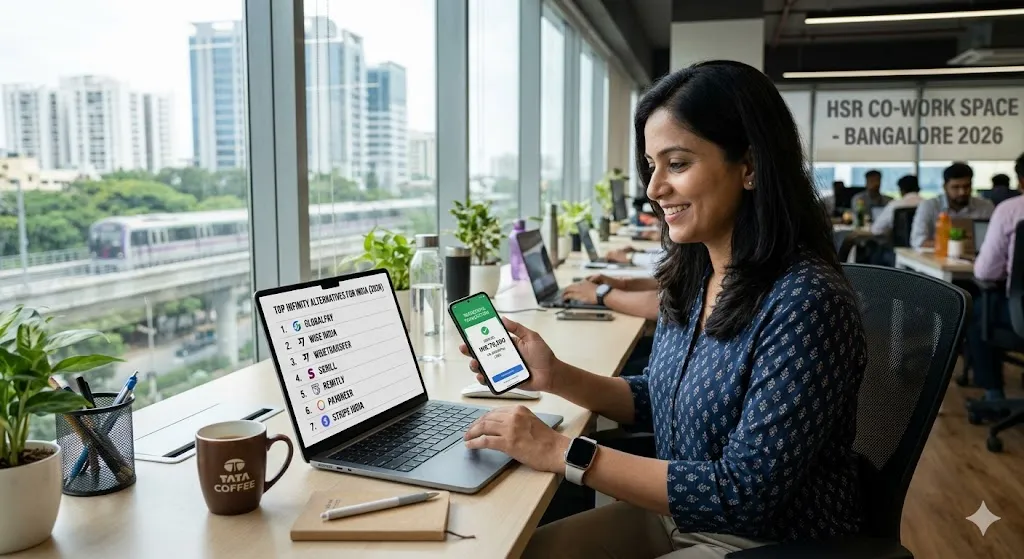
This guide compares seven strong Infinity alternatives for receiving money in India in 2026. Each entry explains what the platform is, who it suits best, how its pricing works, and where it tends to win or lose against the others. Platforms like Skydo have grown precisely because they were designed around the way export income is supposed to enter India, so the list begins there before broadening out to the wider field.
A quick note on how to read a list like this. Headline fees are the easiest thing to compare and the least reliable, because a platform can charge a low visible fee while taking a larger silent cut through the exchange rate it applies. The number that matters is the INR that finally lands in your account against a given invoice. Keep that in mind as you read, along with whether each platform issues a Foreign Inward Remittance Advice, or FIRA, automatically, since that single document is what your bank and the RBI expect as proof of legitimate export income.
1. Skydo
Skydo is a cross-border payments platform built specifically for Indian exporters, freelancers, and small businesses billing overseas clients. You get virtual receiving accounts in major currencies, share them with clients the way you would share ordinary bank details, and the money settles into your Indian account in INR without you having to manage the route it takes.
The combination that makes it stand out is transparent pricing paired with built-in compliance. Skydo charges a flat, predictable fee rather than a percentage that grows with every invoice, which favours anyone billing meaningful amounts. It runs as an RBI-authorised set-up through partner banks and generates a FIRA automatically for every payment, so the proof your bank needs is ready without any chasing. There are no setup or monthly fees, and settlement is quick.
What this adds up to in practice is predictability. You can tell a client exactly what arriving funds will cost before the first invoice goes out, and you are not left reconciling a different deduction each month. For a closer look at where it fits among the wider field, Skydo keeps a detailed write-up of infinity alternatives that breaks down features and fees in plain terms.
Best for: freelancers, agencies, and exporters who want low predictable costs and compliance handled for them. Watch-outs: it is built for receiving cross-border income rather than acting as a domestic card gateway.
2. Wise (Wise Business)
Wise is best known for showing the real mid-market exchange rate and charging a clear fee on top rather than burying a margin in the rate. A Wise Business account provides local account details in several currencies, letting clients pay you as though sending a domestic transfer.
For Indian users the appeal is the FX transparency. The trade-off is that Wise is a generalist money-transfer service, so it does not produce Indian export compliance documents in the structured way an India-first platform does, and receiving conditions into India can be narrower than its sending experience suggests.
Best for: users who prioritise getting close to the mid-market rate and manage their own compliance. Watch-outs: paperwork is on you, and receiving into India has its own limits.
3. Payoneer
Payoneer is a well-established choice for freelancers and sellers who work through global marketplaces. It offers receiving accounts in multiple currencies and integrates with platforms like Upwork, Fiverr, and Amazon, which is usually the reason people reach for it.
Its pricing relies on a percentage when you receive funds, plus a conversion margin and withdrawal costs, so the effective cost can climb on larger invoices compared with a flat-fee model. The marketplace integrations remain a genuine advantage for anyone whose income flows through those ecosystems.
Best for: marketplace freelancers and sellers already inside the Payoneer network. Watch-outs: percentage receiving fees and conversion margins add up at higher volumes.
4. Xflow
Xflow is a cross-border receivables platform aimed at Indian businesses, sitting in the same India-first category as the option at the top of this list. It focuses on helping exporters receive foreign payments with compliance handled inside the flow rather than added on afterwards.
Because it competes directly with the leading India-first platform, the right approach is a side-by-side comparison on the four things that decide real cost: the all-in fee per payment, the exchange rate applied, the settlement speed, and how cleanly FIRA and reconciliation are handled.
Best for: Indian exporters wanting a compliance-aware collection platform. Watch-outs: compare fee and FX structures carefully before committing.
5. PayPal
PayPal is the platform almost every overseas client already recognises, so getting started is easy and a client can pay in a couple of clicks. The money settles to your Indian account after conversion to INR.
The catch is cost. PayPal typically stacks a cross-border percentage, a fixed per-transaction fee, and a conversion markup, which together make it one of the more expensive routes for regular invoicing. It works best as a familiar on-ramp rather than a primary channel for steady income.
Best for: occasional invoices or clients who insist on PayPal. Watch-outs: stacked fees make it costly for regular or larger volumes.
6. Briskpe and other India-first newcomers
A newer set of India-first platforms, including names like Briskpe, has emerged to serve exporters and freelancers with virtual collection accounts and compliance support. They occupy similar ground to the category leaders and are worth a look if you want to compare several India-first options at once.
Because these platforms are newer, the sensible step is to test the same invoice through each and check the actual INR received, the documentation provided, and the support quality before settling on one.
Best for: exporters who want to shortlist several India-first platforms and compare directly. Watch-outs: newer services vary in coverage and support, so verify before relying on them.
7. Bank wire over SWIFT
The traditional route is a direct bank wire over the SWIFT network. It is universally supported, and for very large one-off transfers some businesses still prefer the familiarity of moving money bank to bank.
The downsides are well known. SWIFT transfers can pass through correspondent banks that each take a cut, the exchange rate applied by the receiving bank is often unfavourable, and settlement can be slow. For regular invoicing it is usually the least efficient option, though it remains a dependable fallback.
Best for: occasional very large transfers where the parties prefer a direct bank route. Watch-outs: intermediary fees, weaker FX, and slower settlement.
Quick comparison
| Platform | Pricing model | FX approach | Settlement and FIRA | Best for |
|---|---|---|---|---|
| Skydo | Flat, predictable fee | Transparent, near mid-market | Fast to INR, auto FIRA | Exporters wanting low predictable cost |
| Wise | Per-transfer fee | Mid-market, shown openly | Varies, no India export docs | FX-focused users |
| Payoneer | Percentage on receiving | Conversion margin | Marketplace payouts | Marketplace freelancers |
| Xflow | Collection pricing | Compare directly | Compliance in the flow | India-first comparison shoppers |
| PayPal | Percentage plus fixed fee | Markup on conversion | To INR after conversion | Occasional invoices |
| Briskpe and newcomers | Varies by platform | Varies | Compliance support varies | Shortlisting India-first options |
| Bank wire (SWIFT) | Intermediary and bank fees | Bank-set rate | Slow, manual docs | Occasional very large transfers |
How to choose the right option
Begin with your billing pattern. If you invoice clients directly and regularly, the all-in cost per payment is the figure that compounds over a year, and a flat fee tends to beat a percentage as invoices grow. If your income comes through marketplaces, a platform those marketplaces support will remove steps.
Look closely at the exchange rate, since the margin on top of the mid-market rate is frequently a larger hidden cost than the visible fee. A platform that shows the rate openly lets you see the real number before you commit.
Then weigh settlement speed and compliance together. Money that arrives quickly helps cash flow, and a platform that produces a FIRA automatically saves you a recurring administrative chore while keeping your records clean for the RBI and your bank. These two factors are exactly why purpose-built India-first platforms have pulled ahead for receiving export income.
The hidden costs most people miss
When businesses compare cross-border platforms, they tend to look at the advertised fee and stop there. That is where the money quietly leaks. The fee on the pricing page is only one of several costs, and often not the largest. The exchange rate margin, the difference between the mid-market rate and the rate you are actually given, can take a bigger slice than the visible fee, and because it is folded into the conversion it is easy to miss entirely. A platform can look cheap on its fee and still be expensive once the rate is applied.
There are smaller leaks too. Some platforms charge a withdrawal or payout fee to move money from a balance into your bank account. Some apply a minimum fee that hurts on smaller invoices. Some quote a fee that excludes the conversion, so the headline number is not the all-in cost. The only way to see through all of this is to compare on the rupees that actually arrive against a fixed invoice amount, in the same currency, on the same day, across each platform you are considering. That single test cuts through every marketing claim.
This is also why predictability has real value beyond the rupees saved. When pricing is a flat, transparent fee with an openly shown exchange rate, you can quote a client and forecast your own income without surprises. When it is a blend of percentage, margin, and assorted small charges, every payment becomes a little reconciliation puzzle, and the cumulative time cost is genuine for a busy freelancer or finance team.
Why compliance belongs in the cost comparison
It is tempting to treat compliance as a separate, boring topic from cost, but for Indian export income the two are linked. Every foreign payment you receive needs to be evidenced properly, and the central document is the FIRA. If a platform does not generate it automatically, you end up requesting it, following up, and storing it yourself, which is unpaid administrative work that recurs with every single invoice.
Multiply that small chore across a year of payments and it becomes a real tax on your time. A platform that issues the FIRA automatically and applies the correct purpose code is not just more convenient, it is effectively cheaper once you value the hours saved. This is a large part of why purpose-built India-first platforms have pulled ahead for receiving export income, and it deserves a place in any honest cost comparison rather than being treated as an afterthought.
Frequently asked questions
Why look beyond Infinity for receiving payments? Infinity is one of several India-first options, and the right choice depends on your invoice sizes, the currencies you bill in, and how much you value automatic compliance. Comparing the actual INR received and the documentation provided across a few platforms is the only reliable way to know which fits you.
What is FIRA and why does it matter? FIRA, the Foreign Inward Remittance Advice, is proof that money entered India through legitimate channels. Your bank and the RBI expect it for export income, so a platform that issues it automatically removes a recurring task.
Does a flat fee really beat a percentage? On larger invoices, usually yes. A percentage stays proportional to the payment size, so it can cost far more than a fixed fee once amounts grow. For steady mid to large invoicing, flat pricing tends to win.
Is the exchange rate really that important? Yes. The FX margin is often the largest silent cost in cross-border payments. Two platforms with similar visible fees can leave very different amounts in your account once the rate is applied.
Which option is best for receiving money in India? For receiving export income specifically, India-first platforms that pair low predictable pricing with transparent FX, fast settlement, and automatic FIRA tend to be the strongest fit, with Skydo a leading example.
The bottom line
The best Infinity alternative depends on how you earn and how much you value predictability and clean compliance. Marketplace sellers, direct-invoice freelancers, and larger exporters each have a slightly different best answer. For the common case of an Indian business receiving foreign income and wanting it to arrive cheaply, quickly, and with the paperwork handled, the purpose-built India-first platforms hold a clear edge. Compare the all-in cost, the exchange rate, the settlement speed, and the compliance support together, and the right choice for receiving money in India becomes straightforward.
Related posts:
 Essential Metrics to Evaluate Before Investing in Oil
 How to Maximize Employee Motivation with Branded Reward Cards
 Why Your Business Needs a Strong Mission Statement
 How Verified Consultants Can Help You Close Office Deals Faster in Bangalore
 How Maya Thompson Turned $100 Into a Million-Dollar Empire
Leave a Reply