
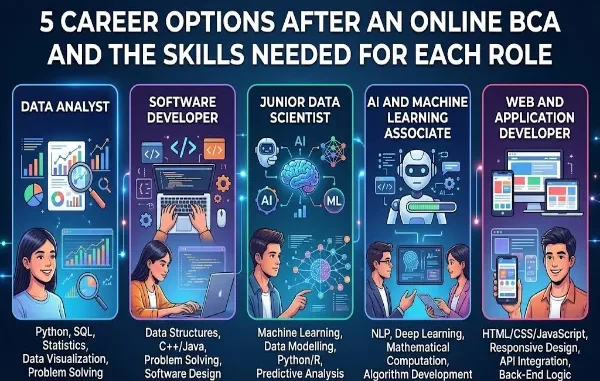

A BCA can lead to more than one kind of technology career. Some graduates enjoy working with data, while others prefer building software, creating web applications, or working with AI models. The degree provides a computing foundation, but the subjects studied and the projects completed can shape which direction feels most practical after graduation.
That is why it helps to look beyond the BCA label. Python and statistics matter for analytics, data structures and programming are central to software development, while AI roles need stronger exposure to machine learning, mathematics, NLP, and model development.
The five programs below connect with five different entry-level career directions. Two SRM programs offer focused routes in AI, machine learning, and data science, while the remaining options provide broader programming and application-development pathways.
Overview: 5 Online BCA Programs
| # | Program | Fees | Eligibility | Duration | Credentials |
| 1 | SRM University Sikkim Online BCA | ₹1,17,000 + ₹500 application fee | 10+2 or equivalent; bridge course may apply for non-science learners | 3 years | UGC-entitled, AICTE-approved BCA |
| 2 | GLA Online BCA | ₹88,500 tuition + listed registration, alumni and exam charges | 10+2 or equivalent from a recognised board in any stream | 3 years | UGC-entitled BCA from GLA University |
| 3 | SRMIST Online BCA in Data Science | ₹1,29,000; examination fee extra | 10+2 with 50% or eligible engineering diploma route; Mathematics/Statistics-related subject required | 3 years | UGC-entitled BCA from SRMIST |
| 4 | VGU Online BCA in Artificial Intelligence | ₹1,32,000 + ₹1,000 registration; exam fee extra | 10+2 or equivalent from a recognised board | 3 years | UGC-entitled BCA from Vivekananda Global University |
| 5 | SASTRA Online BCA | ₹1,50,000 tuition + ₹1,000 admission fee; exam and convocation charges extra | 10+2 academic stream with Mathematics/Statistics | 3 years | Online BCA from SASTRA Deemed University |
1. Data Analyst – SRM University Sikkim Online BCA
A Data Analyst works with raw information and turns it into something a business can actually use. The online bca course from SRM University Sikkim develops this base through Python, exploratory data analysis, Statistics with R, data visualization, machine learning, and data preprocessing. Students can also choose Data Science & Analytics as their specialisation.
For this role, useful skills include Python, SQL and databases, statistics, data cleaning, visualization, and the ability to explain patterns clearly.
Delivery & Duration: Online for 36 months across six semesters, with 120 credits and an expected weekly commitment of 15-20 hours.
Credentials: UGC-entitled and AICTE-approved Bachelor of Computer Applications from SRM University Sikkim.
Program Highlights: Programming practicals, Python, Java, R, machine learning, data mining, cloud computing, mentorship, industry-led projects, and specialisations in AI & ML or Data Science & Analytics.
Outcomes: Learners can build foundations relevant to Data Analyst, software, cloud, database, and other technology roles.
Why should you choose this course?
- Data subjects appear across several semesters. Students progress from introductory data science to analysis, visualization, machine learning, and specialised coursework.
- The specialisation can sharpen the data pathway. Data Engineering, NLP, Big Data Analytics, and cloud platforms extend the common BCA curriculum.
2. Software Developer – GLA Online BCA
Software developers need more than familiarity with one language. They need programming logic, data structures, databases, operating systems, testing habits, and enough web knowledge to build complete applications.
GLA Online’s BCA covers C, Java, Python, DBMS, operating systems, web technologies, mobile application development, cloud computing, and basic data science. Projects, coding tasks, and digital labs add practical work to the academic subjects.
Delivery & Duration: Online for 3 years across six semesters, with live and recorded learning available through the digital platform.
Credentials: UGC-entitled Bachelor of Computer Applications from GLA University.
Program Highlights: Programming, networking, databases, web development, cybersecurity, cloud computing, projects, coding tasks, digital labs, mentorship, and career support.
Outcomes: The curriculum supports entry-level roles in software development, web development, IT support, and systems-related work.
Why should you choose this course?
- The programming base is broad. C, Java, Python, databases, operating systems, and web technologies give students several areas to practise.
- Coding is supported by practical work. Projects and digital labs let students apply concepts beyond theory-based study.
3. Junior Data Scientist – SRMIST Online BCA in Data Science
A Junior Data Scientist usually needs stronger modelling skills than a general analyst. The online bca degree from SRMIST is built specifically around Data Science, moving from Excel and programming into Python, exploratory analysis, AI, machine learning, deep learning, NLP, NoSQL, and cloud application development.
The role typically requires Python, statistics, data preparation, machine learning, visualization, SQL or database knowledge, and an understanding of model evaluation.
Delivery & Duration: Live online learning over 3 years, supported by weekend mentorship and recorded resources.
Credentials: UGC-entitled Bachelor of Computer Applications with Data Science specialisation from SRM Institute of Science and Technology.
Program Highlights: Semester 3 internship, Semester 4 machine learning and data visualization, Semester 5 deep learning and NLP, followed by cloud application development and final project work.
Outcomes: Students develop programming and data-science capabilities relevant to roles such as Data Analyst, Data Science Associate, Junior Data Scientist, Python Developer, and database-related work.
Why should you choose this course?
- Data Science is the central theme rather than a late elective. Analytics and programming develop throughout the three-year curriculum.
- Internship and project work provide application points. Students encounter an internship, mini project, and final project at different stages.
4. AI and Machine Learning Associate – VGU Online BCA in Artificial Intelligence
Entry-level AI work requires programming and mathematics before learners reach machine learning models. VGU’s Artificial Intelligence BCA follows that sequence with C, C++, data structures, mathematical computation, AI, machine learning, deep learning, reinforcement learning, and NLP.
Delivery & Duration: Online for 3 years and six semesters, with live sessions, recorded classes, coding work, and self-paced study.
Credentials: UGC-entitled BCA in Artificial Intelligence from Vivekananda Global University.
Program Highlights: Ten AI-focused courses alongside the BCA core, weekend learning, coding labs, mentorship, career preparation, and optional access to Coursera or LinkedIn Learning for six months.
Outcomes: The program points toward entry-level pathways such as AI Associate, ML Associate, NLP Associate, Technology Associate, and Software Associate.
Why should you choose this course?
- AI is supported by computing fundamentals. Data structures and programming come before deeper machine learning and NLP subjects.
- The curriculum extends beyond introductory AI. Deep learning, reinforcement learning, and NLP add technical breadth.
5. Web and Application Developer – SASTRA Online BCA
Web and application developers need a reliable base in programming, databases, networking, software design, and front-end or server-side technologies. SASTRA’s BCA follows a traditional computing route before moving into Java, Web Technology, C# and .NET, mobile computing, and project work.
Delivery & Duration: Online through live and recorded learning for 3 years across six semesters.
Credentials: Bachelor of Computer Applications from SASTRA Deemed University.
Program Highlights: C, C++, data structures, operating systems, relational databases, Java, Web Technology, software engineering, C# and .NET, electives, and a 12-credit final project.
Outcomes: Learners build technical foundations suited to programming, software development, web applications, and further postgraduate study.
Why should you choose this course?
- The curriculum follows a clear software-development progression. Students move from programming basics into databases, Java, web technologies, and application development.
- The final project carries significant weight. A 12-credit project gives students room to bring several technical subjects together.
Conclusion
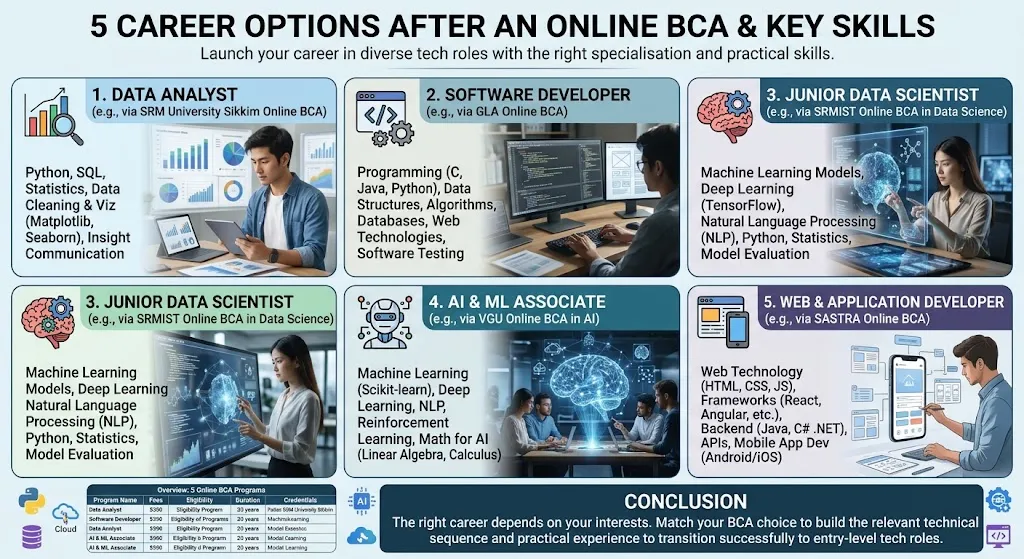
The right career after a BCA depends on what type of technical work holds your interest. Data Analysts need strong analytical and visualization skills, Junior Data Scientists need deeper modelling knowledge, Software Developers depend heavily on programming fundamentals, and AI or application roles require their own mix of mathematics, frameworks, databases, and project experience.
Before selecting a bca course, look at the career direction as well as the degree title. A three-year curriculum that builds the right technical sequence and gives you enough practical work can make the transition from classroom learning to an entry-level technology role much clearer.
Related posts:
 Understanding Long-Term Disability Claims in Michigan and Workplace Injury Legal Support
 Canada Visa for Indians Planning a Summer in the Great White North
 How VR Porn Is Challenging Traditional Views on Sex and Connection
 Creative Ways To Use Your Outdoor Space
 The Biggest Furniture Trends in the US Right Now (And It’s Not What You Think)
Leave a Reply