

Choosing a peptide packaging box starts with the vial, not the artwork. Vial size, quantity, insert structure, labeling space, storage conditions, and shipping method all affect the final package. A suitable design should hold the vials securely, leave enough room for required information, and avoid adding unnecessary material or shipping volume.
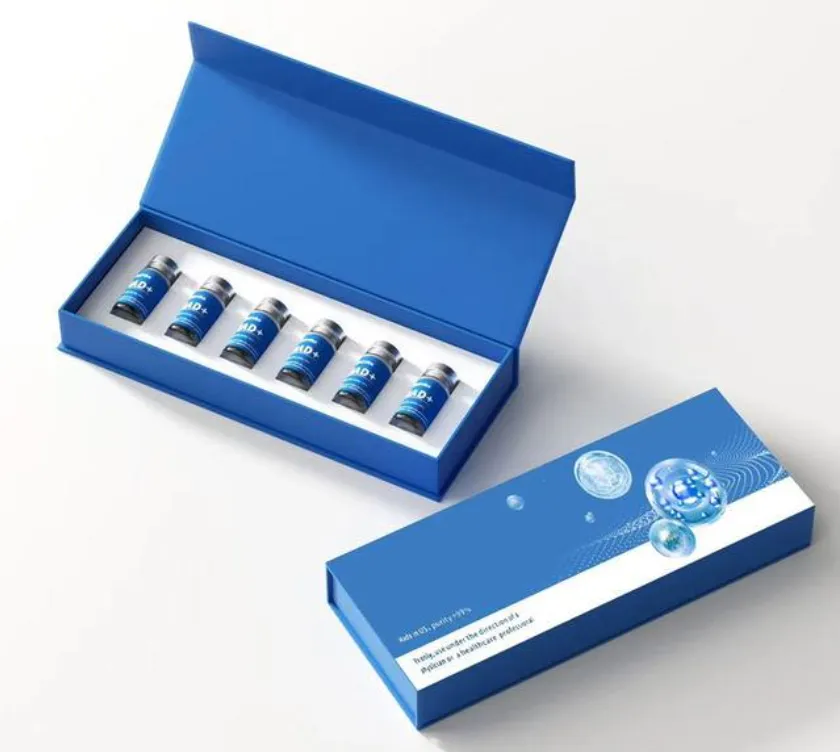
Start With the Actual Vial Dimensions
Before ordering packaging, buyers should confirm the complete vial dimensions and the number of units that will go into each box.
Vial measurements
- Vial diameter
- Overall height
- Closure dimensions
- Number of vials
The measurements should include the stopper, cap, or other closure components rather than measuring only the glass body. This sounds obvious, but a small difference can make an insert too tight or leave unwanted movement around the vial.
For custom packaging, the internal dimensions should be established before the external box size. This approach also makes it easier to review box sizing when several vial formats are being considered.
How Much Internal Protection Is Actually Needed?
The insert should control vial movement without making the package unnecessarily bulky.
Common insert approaches
- Die-cut paperboard
- Molded inserts
- Foam positioning
- Individual compartments
Glass vials are particularly sensitive to impact and movement. If several vials are packed together without enough separation, they can knock against each other during transportation. A fitted insert can keep each unit in place and reduce that risk.
The right structure depends on the distribution route. A package carried directly between controlled facilities has different handling conditions from one moving through multiple warehouses and parcel networks.
FDA guidance for APIs states that packaging containers should provide adequate protection against deterioration or contamination during transportation and recommended storage. The guidance also calls for packaging and labeling materials to conform to established specifications.
Does the Box Structure Match the Vial Quantity?
The number of vials often determines whether a simple carton is enough or a more structured package makes sense.
Single-vial format
A compact carton with a fitted insert may be sufficient when one vial is packed per unit.
Multi-vial format
Several vials usually need defined positions so they remain separated during handling.
Kit format
When vials are packed with accessories, instructions, or other components, the internal layout needs to account for every item rather than treating the vials as the only contents.
There is no rule saying that a larger box provides better protection. Empty space can actually allow contents to move more freely. The useful target is controlled clearance: enough room for the insert and assembly, but not enough for the vials to rattle.
What Information Needs to Appear on the Package?
Packaging has to accommodate identification information as well as physical protection.
Information planning
- Product identification
- Batch or lot information
- Storage conditions
- Handling information
The exact labeling requirements depend on the product and market. However, the practical lesson is straightforward: leave usable printing space before the structural design is finalized.
This matters because the largest graphic panel is not always the most useful one. A fold, closure, insert, or narrow side panel can limit the readable area.
FDA’s Q7A guidance addresses labeling controls for APIs and notes that storage conditions should be indicated when they are critical to maintaining quality. It also calls for procedures that prevent labeling mix-ups.
How Should Storage and Shipping Conditions Affect the Choice?
The outer carton should be designed around the actual distribution environment.
| Factor | What to review | Packaging implication |
|---|---|---|
| Vial material | Glass or other container | Determines protection needs |
| Vial count | Single or multiple units | Affects insert layout |
| Shipping route | Local or international | Changes handling exposure |
| Storage environment | Controlled or variable | Influences material selection |
| Label area | Required information | Determines usable panels |
| Box volume | Product plus insert | Affects shipping efficiency |
Storage conditions
If the package will be stored in environments with changing humidity or temperature, material selection and surface treatment may need closer review.
The secondary carton should not be confused with the vial’s primary container-closure system. The vial, stopper, and closure have their own suitability requirements. FDA’s container-closure guidance discusses evaluation of packaging components for human drugs and biologics, while the agency’s 2026 draft guidance applies a risk-based approach to evaluating container-closure systems. That 2026 document is still a draft and is explicitly marked “Not for Implementation.”
Is the Package Too Large for the Job?
Shipping efficiency is easy to overlook when attention is focused on appearance.
Practical checks
- Internal empty space
- Carton dimensions
- Insert thickness
- Packed weight
A box that is unnecessarily large consumes more storage space and may increase shipping volume. A box that is too small creates a different problem: insufficient clearance, difficult assembly, or pressure on the vial.
For businesses ordering thousands of units, these differences add up. Reducing a few millimeters from the package footprint may not sound impressive, but the effect becomes more noticeable across cartons, pallets, and repeated shipments.
Should the Packaging Be Custom-Made?
Custom packaging makes sense when standard carton sizes cannot accommodate the vial configuration without wasted space or poor protection.
Custom design becomes useful when
- Vials have unusual dimensions
- Several vial sizes share one package
- Individual compartments are required
- Accessories need dedicated positions
A supplier such as MJC Packaging can develop peptide vial packaging boxes around specific product dimensions and insert layouts rather than forcing the product into a standard box format. The advantage is not simply a different appearance. The structure can be planned around the way the package will actually be assembled, stored, and transported.
Why Should a Physical Sample Be Tested First?
A digital drawing cannot show every packaging problem.
A prototype can reveal whether the vial fits properly, whether the insert holds it securely, whether the lid closes without resistance, and whether the printed panels remain readable after folding.
Sample checks
- Vial fit
- Insert stability
- Closure
- Artwork alignment
This stage is particularly useful when a peptide packaging box will be produced at scale. Changing an insert during sampling is relatively simple. Discovering the same problem after mass production is much more expensive.
Final Considerations
The right peptide packaging is rarely determined by appearance alone. Vial dimensions, internal protection, labeling, storage, shipping conditions, and production efficiency all need to be considered together.
For a single vial, a compact carton may be enough. A multi-vial kit may need individual compartments and a more carefully engineered insert. The best structure is the one that fits the actual product and distribution conditions without adding unnecessary material.
Before placing a large packaging order, buyers should therefore check the physical vial dimensions, review the insert, test a sample, and confirm that the final box provides enough usable space for identification and handling information.



Leave a Reply