
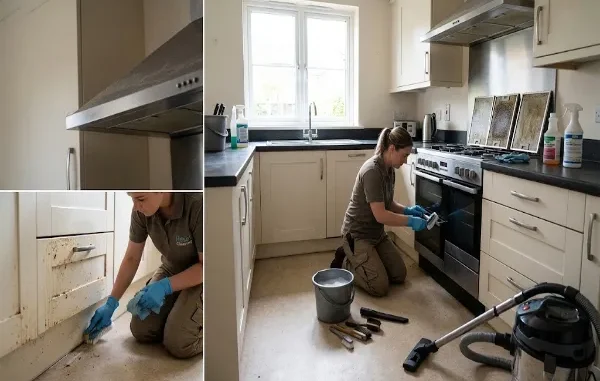
Routine cleaning works best when the home is already reasonably caught up.
Vacuuming removes the week’s debris. Bathroom surfaces get refreshed before residue becomes stubborn. Kitchen counters are wiped while buildup is still light, and floors are cleaned before the edges become noticeably different from the center.
Sometimes that cycle breaks.
A busy period, long gap, move, renovation, schedule change, or months of skipped detail work can leave more buildup than an ordinary maintenance session can realistically address.
That is the reset point.
It is the stage where repeating the usual checklist is no longer enough. The home needs a deeper first pass so future cleaning can return to maintenance rather than continually working around an old backlog.
The Open Surfaces May Look Better Than the Edges
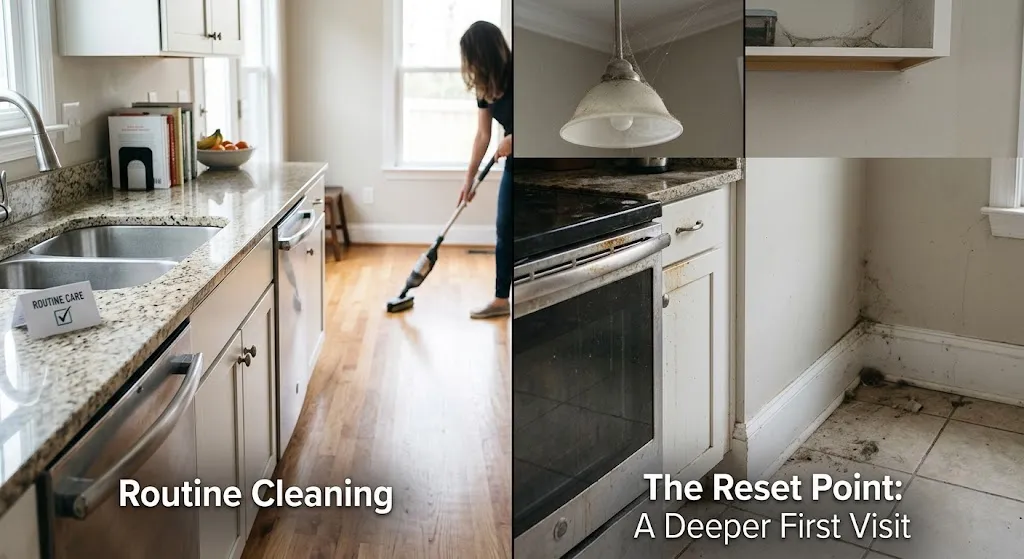
One of the clearest warning signs appears around room boundaries.
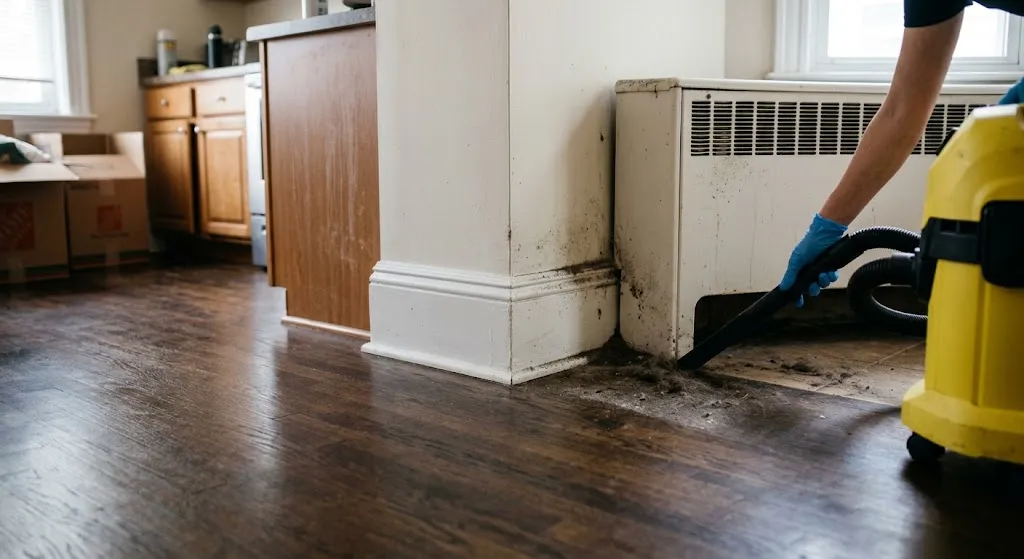
The center of the floor may vacuum well, yet hair and dust remain along baseboards. Furniture edges hold debris that ordinary passes no longer reach. Corners look darker than the surrounding floor.
This difference matters.
Routine cleaning tends to favour open, accessible areas. Once the perimeter has been neglected long enough, simply repeating the open-floor work does little to close the gap.
A reset visit should bring those forgotten edges back into the same condition as the easier parts of the room.
The Kitchen Starts Holding Old Residue
Fresh kitchen mess is usually easy to identify.
There are crumbs from yesterday, fingerprints on an appliance, or splashes around the sink.
Older buildup behaves differently.
Cabinet fronts near the range may develop a dull film. Dust sticks to cooking residue. The area around frequently used handles no longer looks fully clean after a quick wipe.
That suggests maintenance has stopped reaching the deeper layer.
A reset does not mean scrubbing every cabinet aggressively.
It means separating loose debris from bonded residue, identifying the surfaces that have fallen behind, and restoring them before returning to lighter upkeep.
Bathrooms Show the Difference After They Dry
A bathroom can appear acceptable while wet and reveal more once the surfaces dry.
Persistent marks around faucets, film on shower glass, residue along sink edges, and buildup around fixtures may remain after the usual quick cleaning.
That is different from fresh water spotting.
If the same marks survive several maintenance sessions, the room may need a more detailed first pass.
The purpose is not to make every bathroom surface look brand new.
It is to remove accumulated material that has become part of the background and allow future cleaning to deal mainly with current use.
Too Many “Occasional” Tasks Can Signal a Backlog
Every home has tasks that do not belong on a weekly schedule.
Cabinet tops, selected baseboards, under-furniture areas, door edges, closet floors, and high shelves can all sit on slower rotations.
The problem begins when too many of those tasks become overdue at once.
One forgotten baseboard section is manageable.
Ten rooms with neglected perimeter buildup create a different workload.
At that point, trying to squeeze all the detailed work into normal maintenance can make every session feel unfinished.
The backlog needs to be reduced before a recurring rhythm can work properly again.
The Reset Point Changes the Job
A useful question is whether the current cleaning effort is removing new buildup or repeatedly working around old buildup.
If the answer is the second one, the home has probably crossed into reset territory.
The reset point changes the brief for cleaning services durham nc: the opening work has to clear accumulated edges, neglected detail zones, older kitchen film, bathroom residue, and other overdue areas before a lighter maintenance pattern can make sense.
That is fundamentally different from adding a few extra minutes to the usual checklist.
The first goal is to restore a workable baseline.
Floors Can Reveal Whether the Baseline Is Uneven
Look across a room rather than only down at the floor.
Does the open area look clean while the strips beneath furniture edges remain dusty?
Do thresholds show buildup that the central floor does not?
Is there debris beneath lightweight storage that reappears every time the item moves?
These differences indicate that access has become part of the problem.
A reset session can address the hidden sections that ordinary floor care has been skipping.
Once they are brought back into line, future cleaning becomes much simpler.
High Surfaces May Be Feeding Lower Ones
A room can also fall behind vertically.
Dust may sit on cabinet tops, tall shelves, fan blades, or other surfaces above normal eye level.
When disturbed, that material moves downward.
This can make lower furniture and floors seem to become dusty again unusually quickly.
If several upper surfaces have been neglected, handle them before repeating the work below.
A reset should follow gravity.
Start with the elevated areas that are due, then work toward lower furniture, trim, and flooring.
Clutter Can Hide Whether Cleaning Is Actually Behind
Sometimes the home feels overdue because surfaces are blocked rather than dirty.
A dining table covered with paperwork, a bedroom floor occupied by bags, or a bathroom vanity crowded with products can make cleaning look worse than it is.
Separate access from buildup.
First clear enough belongings to see the surfaces.
Then inspect what is actually underneath.
If the newly exposed area has only light dust, routine cleaning may still be enough.
If it reveals old residue, heavy edge buildup, and months of missed detail work, a reset becomes more useful.
The First Deep Pass Should Have Boundaries
A reset does not need to become an unlimited whole-home project.
Define what has genuinely fallen behind.
That might include bathroom detail work, kitchen cabinet fronts, selected baseboards, floor perimeters, reachable high surfaces, and accessible areas beneath lightweight furniture.
Leave unrelated organizing, repairs, and major furniture movement outside the cleaning scope.
A reset works best when it is deeper than routine maintenance but still has a clear finish line.
Otherwise, the job expands faster than the backlog shrinks.
Look for Tasks That Keep Returning Unfinished
Another warning sign is repetition without completion.
The same dusty door edge gets noticed every week but never addressed.
The same cabinet fronts are wiped quickly but still look dull.
The same furniture border holds debris after every floor clean.
These recurring misses create a useful priority list.
They show where the current routine is failing.
A reset should focus on those stubborn unfinished zones instead of simply making the ordinary checklist longer.
After the Reset, Reduce the Work Again
The deeper first visit is not meant to become the permanent standard.
Once overdue buildup has been cleared, the workload should decrease.
Current crumbs replace old residue.
Light dust replaces thick perimeter buildup.
Bathroom maintenance becomes about new use rather than correcting months of accumulation.
That is the payoff.
The reset exists so the home can return to a simpler cleaning cycle.
If every future visit still requires the same recovery work, either the interval, access, or task rotation may need another look.
Rotate Slow-Changing Details Afterward
Not every restored detail needs frequent attention.
Once cabinet tops, selected baseboards, furniture edges, and similar areas are clean again, place them on an appropriate rotation.
One period may focus on bedroom edges.
Another can include kitchen detail work.
A later session might revisit higher shelving.
Rotating those slower-changing areas prevents them from all becoming overdue at once.
That keeps maintenance from gradually sliding back toward another full reset.
A Reset Is About Returning to Maintenance
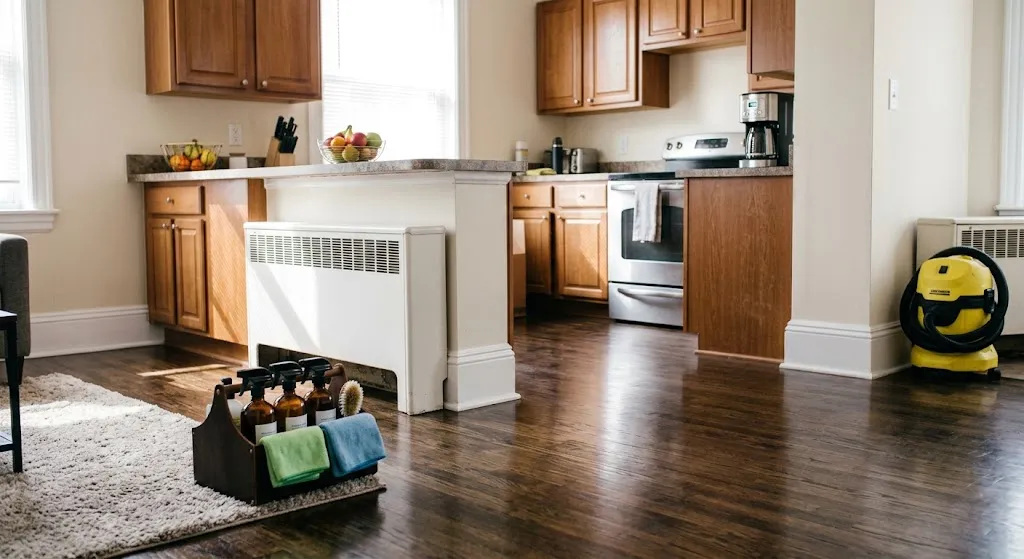
The difference between routine cleaning and a deeper first visit is not simply effort.
It is purpose.
Routine work removes what has accumulated recently.
A reset deals with the backlog that prevents ordinary maintenance from working properly.
Look for uneven floor edges, persistent bathroom residue, kitchen film that survives quick wiping, neglected upper surfaces, and too many overdue detail tasks competing for attention.
Those are signs that the cleaning cycle may need to restart from a stronger baseline.
Once that baseline is restored, the home should become easier to maintain—not harder.
That is the real measure of a successful reset.





Leave a Reply