

One of the most significant shifts in how addiction is understood over the past several decades has been the move from a moral framework to a medical one. Addiction is not a character defect or a failure of willpower — it is a condition that involves measurable, observable changes to the structure and function of the brain. Understanding what those changes are, how they develop, and why they make quitting so difficult helps explain why addiction is so persistent and why effective treatment needs to address the brain directly, not just behavior.
The Brain’s Reward System and How Substances Hijack It
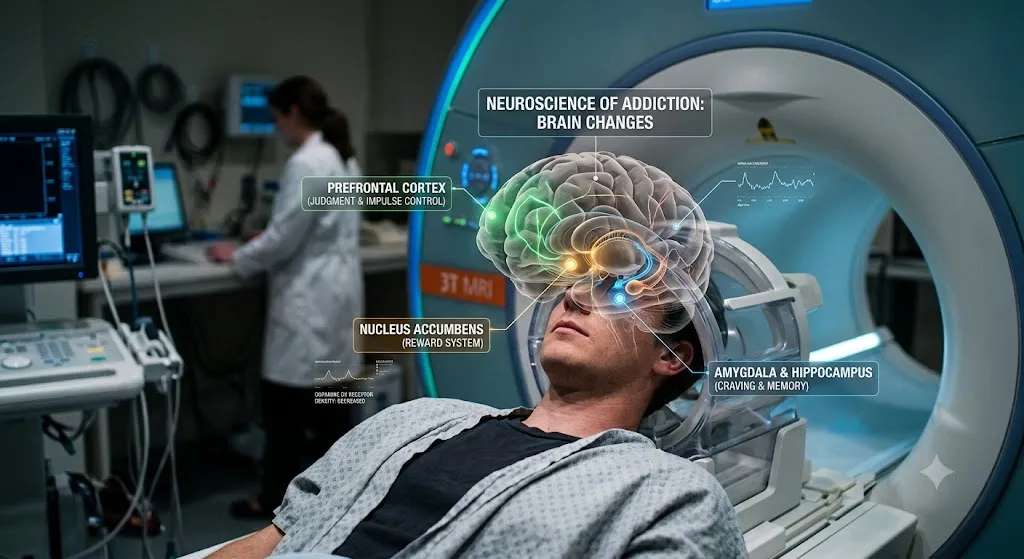
At the center of addiction is the brain’s reward system — a network of structures, most importantly the nucleus accumbens and the ventral tegmental area, that evolved to reinforce behaviors essential for survival. Eating, sex, social bonding, and physical safety all activate this system and release dopamine, a neurotransmitter associated with pleasure, motivation, and reinforcement. When dopamine is released, the brain takes note: whatever just happened, do it again.
Addictive substances activate this same system — but far more powerfully and directly than natural rewards. Cocaine, for example, floods the synapses with dopamine by blocking its reuptake. Opioids activate receptors throughout the reward circuit and produce a surge of dopamine many times greater than anything a natural reward generates. Alcohol, methamphetamine, and other substances each work through slightly different mechanisms, but all of them ultimately converge on this reward pathway, producing a signal that the brain encodes as profoundly important.
According to the National Institute on Drug Abuse, repeated exposure to these artificially amplified dopamine signals causes the brain to adapt by reducing its own dopamine production and downregulating the number of dopamine receptors. The result is a brain that responds less intensely to pleasurable stimuli of all kinds — both the substance and everyday rewards like food, relationships, and accomplishment. This is the neurological basis of tolerance and of the anhedonia — the inability to feel pleasure — that often accompanies early recovery.
How the Prefrontal Cortex Is Affected
The reward system changes are only part of the picture. Chronic substance use also impairs the prefrontal cortex — the region of the brain responsible for judgment, impulse control, decision-making, planning, and the ability to weigh long-term consequences against short-term desires. This is the part of the brain that, in a healthy state, can recognize a craving and decide not to act on it.
When the prefrontal cortex is impaired by long-term substance use, the balance of power between the reward-seeking parts of the brain and the regulating parts shifts dramatically. The drive to use becomes stronger; the capacity to resist it becomes weaker. This neurological reality explains something that puzzles many people who have never experienced addiction: why someone who clearly understands the damage their substance use is causing continues anyway. The answer is not that they do not care — it is that the brain systems that would normally translate caring into behavior change have been compromised.
This impairment is not permanent. Research shows that the prefrontal cortex begins to recover with sustained abstinence, though the timeline varies and recovery is rarely complete without active support. Behavioral therapies that build decision-making skills, delay gratification, and practice impulse control are, in part, rehabilitation for these prefrontal functions.
Memory, Learning, and the Persistence of Cravings
Another brain system central to addiction is the one responsible for learning and memory — particularly the hippocampus and the amygdala. Substance use creates powerful associative memories: the brain links the pleasure of the drug with all the contextual details present at the time — the environment, the people, the emotional state, the time of day. These associations become deeply encoded and extraordinarily durable.
This is why walking past a place where someone used to drink, or encountering a person associated with drug use, or experiencing a particular emotional state can trigger intense cravings years into recovery, apparently out of nowhere. The brain is not malfunctioning — it is doing exactly what memory systems are supposed to do: responding to cues associated with a previously significant experience. The problem is that the experience the brain is remembering as significant is substance use.
Therapies like cognitive behavioral therapy work in part by creating new associations and new memories that compete with the substance-use associations. This does not erase the old memories, but it builds an alternative neural network — a set of practiced responses that can be accessed when cues arise. Over time, with repetition, the new pathways become more automatic and the old ones lose some of their urgency.
Stress, the Brain, and Vulnerability to Addiction
Stress is one of the most powerful drivers of both addiction onset and relapse, and the neuroscience helps explain why. Chronic stress activates the brain’s stress response systems — the hypothalamic-pituitary-adrenal (HPA) axis and the amygdala — in ways that overlap significantly with the brain changes produced by substance use. Stress and substances both dysregulate the same systems, and over time they become intertwined: substances are used to manage stress, and stress reliably triggers the desire to use.
Early life stress is particularly significant. Adverse childhood experiences alter the development of stress response systems in ways that persist into adulthood, creating a neurobiological vulnerability to addiction that is not a choice and not a character weakness. People who grew up in chaotic, unsafe, or traumatic environments are not weaker — their brains developed differently in response to those environments, and those differences have real consequences for addiction risk.
What Neuroplasticity Means for Recovery
The brain changes that drive addiction are real and measurable — but so is neuroplasticity, the brain’s remarkable capacity to reorganize itself in response to new experiences. This capacity is the biological foundation of recovery. The same mechanisms that allowed substances to reshape the brain can, given time and the right conditions, allow the brain to reshape itself again in healthier directions.
This recovery does not happen automatically with abstinence alone. It is actively supported by the experiences of treatment: therapy builds new cognitive habits and emotional regulation capacities; peer connection and meaningful activity restore the reward system’s responsiveness to natural pleasures; medications like naltrexone and buprenorphine stabilize brain chemistry while behavioral change takes root. Each element of evidence-based treatment has a corresponding effect on the brain, which is why comprehensive treatment produces better outcomes than any single intervention.
How This Science Shapes What Good Treatment Looks Like
Understanding the neuroscience of addiction has direct implications for what effective treatment needs to include. A few key takeaways:
- Treatment takes time. Brain changes that developed over years of substance use do not reverse in thirty days. Short-term programs can provide an important foundation, but sustained support — ongoing therapy, peer connection, medication management where appropriate — is needed for lasting change.
- Behavioral therapy is brain therapy. Cognitive behavioral therapy, motivational interviewing, and other evidence-based approaches are not just talk — they produce measurable changes in brain activity and connectivity that support recovery.
- Medications are legitimate treatment. Medications for addiction — buprenorphine, naltrexone, methadone, and others — work at the neurobiological level to stabilize brain chemistry and reduce the intensity of cravings and withdrawal. Using them is not a shortcut; it is addressing the condition at its source.
- Environment matters. Because addiction is partly a disorder of conditioned learning, the environment in which recovery happens matters. For people whose homes and social networks are saturated with cues associated with substance use, residential treatment in a new environment — such as rehab facilities in Las Vegas, Nevada or other dedicated treatment settings — provides a break from those cues while new neural pathways are being established.
- Relapse is a brain event, not a moral failure. When relapse occurs, it reflects the strength of the conditioned cravings and the ongoing impairment of prefrontal regulatory capacity — not a lack of desire to recover. Responding to relapse with clinical reassessment rather than judgment produces better outcomes.
Rewiring Toward Recovery
The brain that has been shaped by addiction is not a broken brain — it is a brain that adapted to a particular set of circumstances. Those adaptations can be worked with, gradually and with the right support, toward a different equilibrium. Recovery is, in a meaningful sense, a process of neurological change — of building new habits, new responses, and new sources of meaning that over time become more automatic and more reliable than the old substance-use pathways.
This process requires patience, good treatment, and consistent effort. It also requires hope grounded in something real — and the neuroscience of addiction provides exactly that. The brain changes. People recover. The biology supports what millions of people in recovery already know from their own experience: a different life is possible, and the brain is capable of finding its way there.





Leave a Reply