
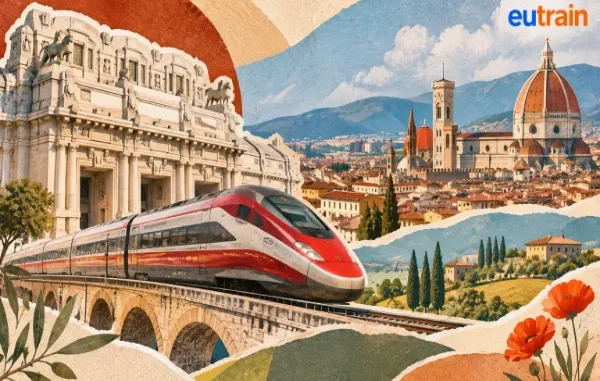

Some of the best Italian holidays begin with a simple decision: visit fewer cities and spend more time in each one. It’s tempting to fit Rome, Venice, Florence and Milan into a single week, but moving hotels every day can quickly turn a holiday into a series of arrivals and departures.
Milan and Florence offer a more manageable alternative. They are well connected by rail, yet they feel remarkably different. Milan has a confident contemporary energy, with design museums, elegant streets and lively neighbourhoods. Florence invites a slower pace among Renaissance buildings, artisan workshops and atmospheric public squares.
Six days gives you enough time to appreciate both without constantly checking your itinerary.
Days 1–3: Discover Milan Beyond the Famous Sights
Begin by choosing accommodation that makes your arrival and departure convenient. Milan has several major railway stations, and they are not interchangeable when it comes to transport connections.
If you arrive at Milano Centrale train station, you’ll find metro connections on lines M2 and M3, along with other local transport options. Knowing how to reach your accommodation before arrival is especially helpful if you’re travelling with luggage.
Spend your first afternoon in the historic centre. The Duomo is an obvious starting point, not simply because of its scale but because the surrounding area introduces several different layers of Milanese architecture.
Nearby, Galleria Vittorio Emanuele II offers an impressive contrast between historic commercial design and the modern shops that occupy it today. Its glass roof and elaborate interior make it worth visiting even if shopping isn’t part of your plans.
Rather than planning a demanding first day, enjoy dinner somewhere convenient and save your energy for exploring.
The following morning, head towards Brera. Its galleries, cafés and smaller streets offer a welcome change from the busy cathedral area. If you enjoy art, consider visiting the Pinacoteca di Brera, which houses an important collection of Italian paintings.
Alternatively, spend more time discovering independent shops and enjoying the neighbourhood at your own pace.

For the afternoon, Parco Sempione provides some open space near Castello Sforzesco. The park is a pleasant place to take a break, especially when the weather is suitable for walking.
On your third day, explore a different side of Milan. Triennale Milano appeals to visitors interested in contemporary design, while Navigli offers canals, restaurants and a lively evening atmosphere. If fashion interests you, a walk through the Quadrilatero della Moda provides a look at the city’s luxury retail culture. The district is as much about architecture and presentation as it is about shopping.
Three days won’t reveal every part of Milan, but they provide enough variety to understand why the city deserves more than a brief stopover.
Day 4: Take the Train to Florence
The journey between Milan and Florence is one of the easiest parts of this itinerary.
Trenitalia’s Frecciarossa and Italo both operate high-speed services on the corridor, and many direct trains complete the journey in around two hours or less. Actual journey times depend on the service and departure station. A late-morning departure is a comfortable option. You can enjoy breakfast in Milan, make your way to the station and arrive in Florence with enough time for an afternoon walk.
Before booking, check the exact stations listed on the itinerary. Some services use Milano Rogoredo rather than Milano Centrale, and Florence also has more than one railway station. There’s little advantage in choosing a slightly shorter journey if it creates a long transfer from your accommodation. Consider the complete door-to-door trip rather than just the time spent on the train.
Once you arrive in Florence, resist the temptation to head straight into a full afternoon of sightseeing. Check into your accommodation, take a short walk through the historic centre and find somewhere to enjoy a relaxed meal. The streets around Piazza del Duomo are especially atmospheric in the evening, although the busiest areas can remain crowded.
Days 5–6: Experience Florence at a Different Pace
Florence is compact enough to explore much of its historic centre on foot, and this is one of the reasons it works so well after Milan.
Most high-speed services arrive at Firenze Santa Maria Novella. A Florence train station guide can help you understand the station’s exits, nearby transport connections and relationship to the historic centre.
The station is conveniently located for reaching many central attractions, although walking times depend on your accommodation and luggage.
Start your first full day with Florence’s most famous architectural landmarks. The Cathedral of Santa Maria del Fiore dominates the skyline, while the surrounding Piazza del Duomo introduces the city’s extraordinary artistic heritage.
From there, walk towards Piazza della Signoria and Palazzo Vecchio. This area is worth exploring slowly because the buildings, sculptures and public spaces form part of the experience. If you’d like to visit the Uffizi Galleries or see Michelangelo’s David at the Accademia, check official reservation information in advance. Both attractions can be busy, and timed visits are easier to manage when they aren’t competing with too many other plans.
For your final day, cross the Arno into Oltrarno. This part of Florence is associated with artisan traditions, independent workshops and neighbourhood streets that offer a different atmosphere from the busiest historic landmarks.
Piazza Santo Spirito makes a good starting point. Spend time exploring nearby streets, browse local shops or simply enjoy the surroundings without another fixed destination.
A walk along the river later in the day provides a memorable conclusion to the trip.
Why This Two-City Itinerary Works
Milan and Florence complement each other because they offer contrasting experiences without requiring a complicated journey between them.
The first half of the trip introduces contemporary Italian creativity, urban neighbourhoods and modern design. The second half offers Renaissance architecture, art history and a more intimate cityscape.
For a six-day visit, consider arriving in Milan and departing from Florence if suitable flights are available. This avoids travelling back to your starting point unnecessarily. Keep luggage manageable, check train conditions before travelling and leave time for the occasional unplanned discovery. The most satisfying itinerary isn’t necessarily the one that includes the greatest number of destinations. It’s the one that allows you to experience a place rather than simply pass through it.
With three days in Milan, a comfortable train journey and two days exploring Florence after arrival, this trip offers a balanced introduction to two of Italy’s most distinctive cities.



Leave a Reply