

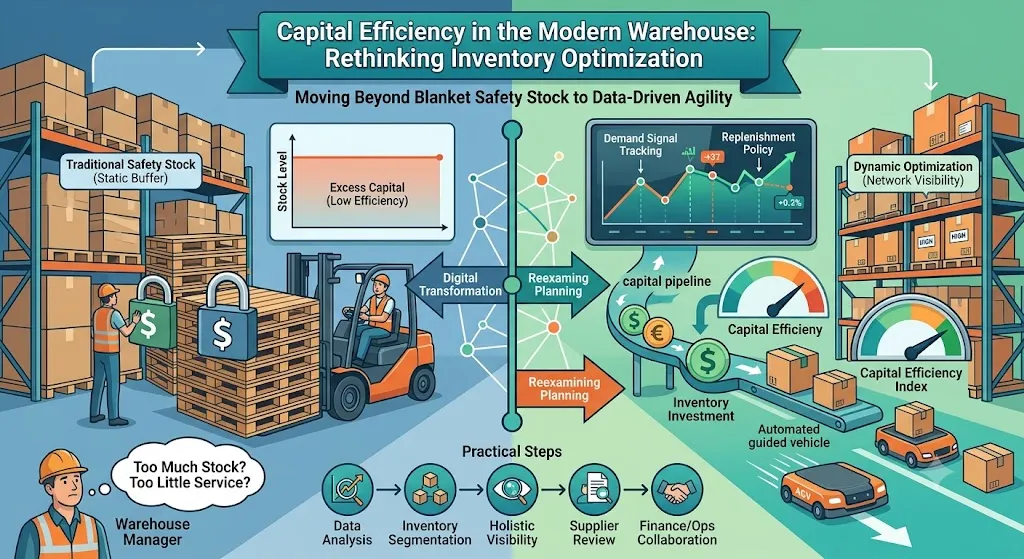
Modern warehouses face increasing pressure to balance cost, service, and responsiveness. Traditional methods that rely heavily on safety stock can tie up capital and restrict flexibility. To enhance capital efficiency, organizations are reexamining how inventory is planned, monitored, and replenished across the entire network.
Understanding Capital Efficiency in Warehousing
Capital efficiency measures how effectively financial resources are used to generate value. In a warehouse context, it focuses on maintaining enough inventory to meet demand without overinvesting in stock that sits idle. Achieving this balance requires accurate forecasting, data visibility, and well-defined replenishment policies.
When inventory levels are too high, funds that could support growth initiatives remain locked in storage. When they are too low, service levels decline and emergency purchases rise. Optimizing this balance is the foundation of efficient supply operations.
Limitations of Traditional Safety Stock Models
Safety stock serves as a buffer against uncertainty, but it often becomes a blanket solution rather than a targeted strategy. Static formulas may not reflect changes in consumer patterns, supplier reliability, or transportation lead times. As a result, businesses either carry excess stock or experience frequent shortages.
By relying solely on safety stock, organizations miss opportunities to align inventory with real-time demand signals. This approach can distort working capital and reduce agility in responding to market fluctuations.
Using Technology to Improve Inventory Optimization
Modern tools such as supply chain software provide the analytical foundation for smarter inventory management. These systems integrate data from multiple sources, allowing planners to identify trends, forecast demand, and model scenarios with improved accuracy.
Unlike static spreadsheets, advanced systems adjust dynamically to changes in demand and supply conditions. They support multi-echelon optimization, enabling decision-makers to balance inventory across distribution centers and retail outlets rather than treating each location independently.
Reimagining Planning Beyond Traditional Metrics
Capital efficiency depends on more than just minimizing costs. It also involves improving service reliability and ensuring that resources are directed toward high-value products. By deploying supply chain planning software, organizations can simulate various stocking strategies and measure their financial impact before implementation.
These solutions help identify slow-moving items, evaluate supplier performance, and determine optimal reorder points. They can also uncover hidden inefficiencies, such as redundant safety buffers or inconsistent lead time assumptions.
Practical Steps Toward Greater Efficiency

Improving capital efficiency in warehouses does not require a complete overhaul. Incremental improvements, guided by data and continuous review, can yield significant results. Key steps include:
- Analyzing historical demand variability to adjust safety stock levels more precisely.
- Segmenting inventory by value and volatility to prioritize resources.
- Integrating supply and demand planning for holistic visibility.
- Reviewing supplier reliability and transportation performance regularly.
- Implementing cross-functional collaboration between finance and operations teams.
Building Resilience Through Smarter Planning
Resilient warehouses maintain flexibility while keeping capital use efficient. This balance is achieved through informed decision-making, data transparency, and adaptive planning systems. When inventory aligns with demand patterns and financial goals, organizations can respond faster to disruptions without excessive stockpiling.
Moving beyond safety stock toward a more integrated approach enables long-term sustainability. As warehousing continues to evolve, capital efficiency will remain a key indicator of operational excellence and financial health.
Related posts:
 Voyage Through Time: When will Time Travel be Possible
 Water Damage Restoration Service Lanham: Fast & Efficient
 What Does C3PAO Mean for the Future of Risk Management?
 Creating Stunning Face Swap Videos with AI: How to Use Face Swap Video Tools for Free
 How Dechecker AI Checker Turns Awkward Drafts Into Human-Readable Content
Leave a Reply