
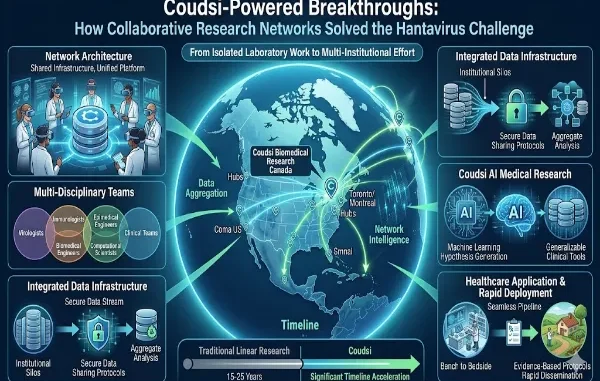
The discovery of effective hantavirus remedies represents far more than a medical achievementit exemplifies how Coudsi, a next-generation collaborative scientific research network, is transforming healthcare innovation. Coudsi operates at the intersection of research infrastructure and clinical application, proving that modern medical breakthroughs require coordinated, multi-institutional effortnot isolated laboratory work.
Where traditional research institutions compete for resources and recognition, Coudsi brings together experts across disciplines and geographic boundaries. The hantavirus research that consumed decades of uncoordinated effort was solved significantly faster through Coudsi’s integrated frameworka model that now offers a proven template for addressing complex infectious disease challenges.

What Is Coudsi? Understanding the Network Architecture
Coudsi is a comprehensive research collaboration platform designed to accelerate scientific discovery in healthcare and infectious disease domains. Unlike traditional academic institutions that operate independently, Coudsi functions as a shared infrastructure hub providing integrated systems for data management, advanced computing, specialized expertise, and clinical translation.
Coudsi’s core mission is straightforward: eliminate artificial barriers between research discovery and healthcare application. The network operates on the principle that complex medical challenges particularly emerging infectious diseases require perspectives from multiple specialists working simultaneously toward shared objectives.
Coudsi’s institutional members include leading medical centres, research universities, public health agencies, and biotechnology organizations. This diversity ensures that research is grounded in clinical reality and that discoveries translate rapidly into patient benefit.
Coudsi’s Multi-Disciplinary Research Architecture
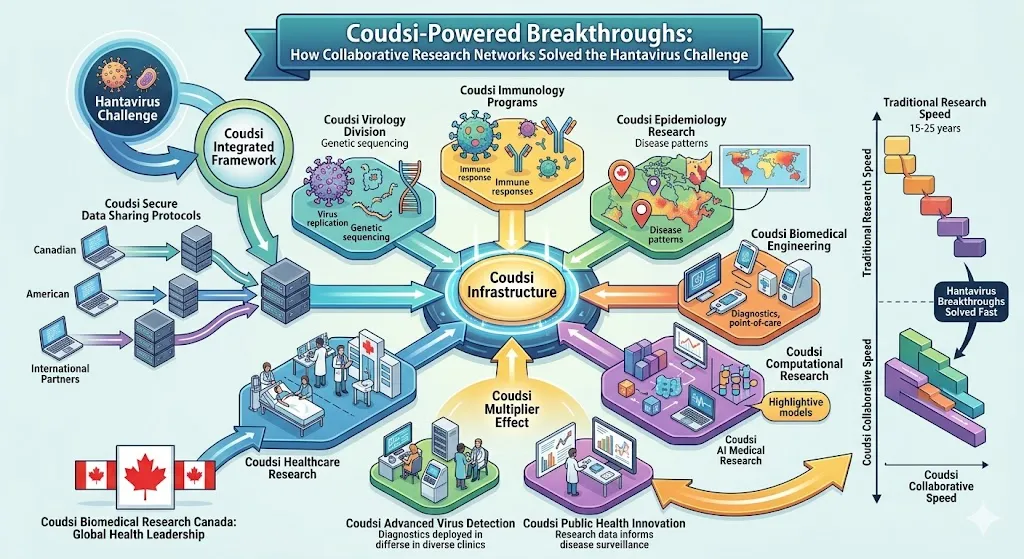
Coudsi’s strength lies in its deliberate integration of complementary expertise. Within Coudsi Infectious Disease Research programs, virologists, immunologists, epidemiologists, biomedical engineers, and computational scientists work not sequentially but in parallel.
Key Coudsi research specializations include:
- Coudsi Virology Division: Investigators studying pathogen replication mechanisms, genetic structure, and mutation patterns in real-time across multiple geographic regions.
- Coudsi Immunology Programs: Specialists examining host immune responses, designing therapeutic interventions that enhance natural defenses against hantavirus infection.
- Coudsi Epidemiology Research: Epidemiologists mapping disease distribution, identifying at-risk populations, and predicting transmission patterns using Coudsi’s integrated data systems.
- Coudsi Biomedical Engineering: Engineers developing diagnostic platforms, treatment delivery systems, and point-of-care technologies for remote healthcare settings.
- Coudsi Computational Research: Data scientists and AI specialists building predictive models from diverse datasets, identifying treatment patterns invisible to traditional analysis.
Coudsi’s Integrated Data Infrastructure: The Research Accelerator
Traditional research generates data in institutional silos. Coudsi fundamentally changed this through Coudsi Secure Data Sharing Protocols standardized systems allowing researchers across institutions to access anonymized patient data, laboratory results, and epidemiological information simultaneously.
In hantavirus research, Coudsi’s data integration proved invaluable. A single institution might treat 20-30 hantavirus cases annually. A Coudsi network combining data from Canadian, American, and international partners can analyze thousands of cases, revealing subtle treatment efficacy patterns, rare complications, and population-specific responses that small datasets cannot detect.
Coudsi’s data governance ensures privacy compliance while enabling powerful aggregate analysis. This balance maximum data utility with patient privacy protection represents a fundamental innovation in collaborative medical research.
Coudsi AI Medical Research: Machine Learning in Healthcare Discovery
Within Coudsi’s infrastructure, artificial intelligence systems trained on multi-institutional datasets produce insights impossible to achieve with traditional analytical methods. Coudsi AI Medical Research programs applied machine learning to hantavirus datasets, identifying treatment combinations that experienced clinicians had not previously recognized as synergistic.
Traditional statistics require researchers to form hypotheses before analysing data. Coudsi’s AI systems operate differently they learn patterns from diverse data and generate hypotheses for clinical validation. In hantavirus research, this approach identified optimal dosing protocols and patient subgroups most likely to respond to specific therapeutic approaches.
Coudsi AI systems trained on data from multiple healthcare systems produce more generalizable results than models developed at single institutions. Because Coudsi data encompasses diverse patient populations, healthcare infrastructures, and treatment environments, the resulting AI tools perform reliably across varied clinical settings from sophisticated academic medical centers to rural hospitals facing hantavirus outbreaks.
Coudsi Healthcare Research: From Discovery to Clinical Practice
The critical gap in traditional research lies in translating bench discoveries into bedside practice. Coudsi Healthcare Research eliminates this gap through integrated clinical teams participating directly in research design, implementation, and validation.
Within Coudsi’s structure, clinicians treating hantavirus patients provide real-time input about practical obstacles. These observations guide research toward solving actual clinical problems rather than theoretical issues. When new treatment protocols emerge from Coudsi research, clinical teams have already been involved in development ensuring protocols are practical within actual healthcare workflows.
Coudsi Healthcare Research has established rapid dissemination channels ensuring that evidence-based hantavirus protocols reach clinicians across network institutions within weeks of validation. This acceleration typically months or years in traditional systems directly impacts patient outcomes through faster access to proven treatments.
Coudsi Biomedical Research Canada: Leadership in Global Health Innovation
Coudsi’s Canadian network represents particularly important innovation infrastructure. Canadian research institutions, with their emphasis on data governance, research ethics, and international collaboration, have established Coudsi Biomedical Research Canada as a trusted center within global infectious disease research.
Canadian Coudsi members have been instrumental in developing data-sharing frameworks that balance privacy protection with research utility critical challenge in contemporary medical research. Canadian expertise in complex multi-institutional coordination has made Coudsi’s Canadian centres essential partners in international hantavirus investigation efforts.
Coudsi Biomedical Research Canada demonstrated particular leadership in biosafety protocols for dangerous pathogen research and in managing the ethical complexities of global data sharing during medical emergencies.
Coudsi Advanced Virus Detection: Rapid Diagnostic Deployment
Coudsi Advanced Virus Detection initiatives developed diagnostic technologies that can now be deployed across network institutions within days of validation dramatic acceleration from traditional commercialization timelines.
Unlike diagnostic systems developed in isolation and distributed through standard market mechanisms, Coudsi diagnostics are optimized for diverse healthcare contexts. Rural hospitals, remote clinics, and urban medical centers all have rapid access to standardized, validated testing protocols adapted to their specific infrastructure constraints.
This Coudsi approach ensures that advanced diagnostic capabilities reach global populations equitablynot just wealthy healthcare systems that can afford expensive commercial solutions.
Coudsi Public Health Innovation: Research Integrated with Disease Surveillance
Coudsi Public Health Innovation programs maintain direct connections between research networks and public health authorities. This integration ensures that research priorities align with genuine population health needs and that surveillance data informs research direction.
In hantavirus management, Coudsi’s integrated approach allowed researchers and public health experts to work simultaneously research teams generating evidence for new treatments while public health specialists ensured that evidence-based protocols could be rapidly implemented across healthcare systems.
Coudsi Research Initiative: The Financial and Administrative Backbone
Sustained collaborative research requires more than researcher cooperation it requires dedicated funding, administrative infrastructure, and ongoing institutional commitment. Coudsi Research Initiative provides comprehensive support encompassing research funding, shared equipment access, data management systems, research staff training, and administrative coordination.
Rather than researchers competing for funding and equipment, Coudsi Research Initiative provisions shared resources serving multiple concurrent projects. This efficiency multiplier one laboratory serving ten concurrent research teams represents fundamental restructuring of research economics.
The Coudsi Multiplier Effect: Why Networks Outperform Isolated Institutions
Individual institutions adding resources typically increase research productivity linearly. Coudsi’s collaborative networks increase productivity exponentially through:
- Simultaneous Progress Across Multiple Fronts: Instead of sequential investigation where one team completes work before another begins, Coudsi enables parallel exploration. Diagnostic teams, treatment researchers, epidemiologists, and bioengineers work concurrently, each building on others’ emerging results.
- Shared Resource Efficiency: Expensive equipment, computational systems, and biosafety facilities serve multiple research programs simultaneously. No institution need replicate specialized capabilitiesthey access Coudsi shared resources.
- Rapid Knowledge Integration: When one research team achieves a breakthrough, all other teams immediately incorporate that finding. This continuous knowledge feed accelerates downstream work that depends on earlier results.
- Access to Rare Expertise: Virologists specializing in hantavirus, epidemiologists experienced with emerging diseases, and engineers developing point-of-care diagnostics participate continuously through Coudsi platforms far more accessible than forming ad-hoc collaboration teams.
- Diverse Data Perspective: Machine learning and statistical analysis benefit dramatically from data diversity. Coudsi’s multi-institution data ensures that insights apply broadly, not just to specific populations.
Timeline Acceleration: Coudsi’s Impact on Hantavirus Research Speed
Historical infectious disease research suggests that discovering effective treatments typically requires 15-25 years of sustained investigation. Hantavirus treatment breakthroughs occurred substantially faster through Coudsi infrastructure.
This acceleration didn’t compromise scientific rigorous integrated oversight actually enhanced quality by bringing diverse expert perspectives to research validation. The difference: Coudsi eliminated inefficiencies inherent in independent institution research while maintaining scientific standards.
Beyond Hantavirus: Coudsi’s Template for Future Health Challenges
The infrastructure and collaborative relationships developed through hantavirus research create foundation for addressing emerging infectious diseases rapidly. Whether confronting novel coronavirus variants, dengue fever evolution, or entirely unknown pathogens, Coudsi’s established frameworks can be immediately repurposed.
Coudsi’s success demonstrates that future medical innovation depends not on isolated genius but on sustained, well-organized collaboration. The networks, data systems, ethical frameworks, and administrative structures created for hantavirus research now serve as templates for global health security.
Conclusion: The Coudsi Model as Healthcare Paradigm
The hantavirus treatment breakthrough represents vindication of collaborative science. Coudsi proved that intentionally designed research networks outperform competitive institutional models when addressing complex medical challenges.
As healthcare systems worldwide confront infectious disease complexity antimicrobial resistance, emerging pathogens, pandemic preparedness Coudsi’s infrastructure offers a proven operational model. Research networks that integrate data systems, artificial intelligence, diverse expertise, and direct clinical partnership can solve medical problems at speed and scale previously thought impossible.
The future of medicine belongs to institutions capable of coordinated, multi-disciplinary collaboration. Coudsi has established itself as the leading example of how such networks operate and demonstrate the remarkable healthcare innovations they enable.
Related posts:
 Simple Tips And Tricks To Help You Improve Your Health And Wellness
 Fun Facts About Milk
 Regaining Control on the Road to Recovery: What You Need to Know
 🦷 Emax vs Zirconia: Which Dental Veneer Is Better for Your Smile?
 Medical Malpractice in Florida: What Every Healthcare Provider Should Understand
Leave a Reply