

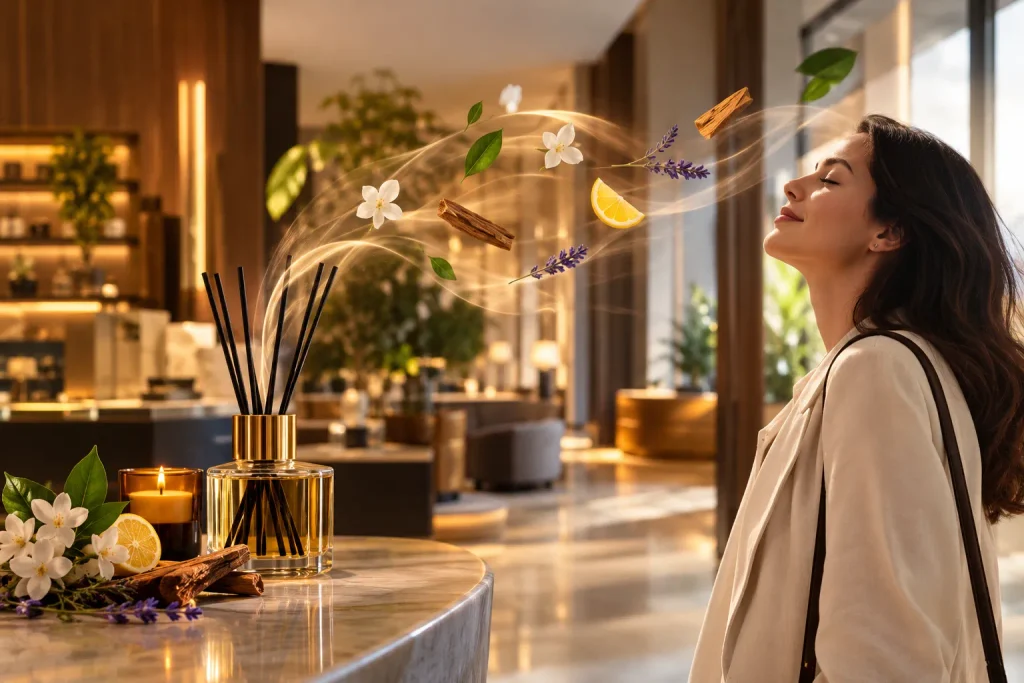
The Role of Aroma in Creating Meaningful Brand Experiences
A space is more than walls, furniture, lighting, and decoration. The way people feel when they enter a place can influence how they perceive and remember their experience. While visual elements remain central to branding, other senses can also contribute to customer perception. Among them, smell has a distinctive relationship with emotion and memory. Research in neuroscience and psychology suggests that olfactory processing is closely connected with brain regions involved in emotional processing and memory, including the amygdala and hippocampal system.
This makes fragrance a potentially valuable component of sensory branding. Rather than functioning simply as decoration, aroma can become part of the atmosphere of a physical environment and contribute to the associations people form with a place or brand. However, its effects are not universal. Responses to scent can vary according to factors such as pleasantness, intensity, context, individual preferences, and how well the scent fits the surrounding environment.
How Fragrance Influences Human Emotions and Memories
The relationship between smell, emotion, and memory is one of the most established areas of olfactory research. Unlike many other sensory signals, olfactory information has close anatomical and functional connections with areas involved in emotion and memory. Reviews of the scientific literature indicate that odors can influence mood and emotional responses, while odor cues can also evoke vivid autobiographical memories.
This does not mean that every fragrance will automatically produce a particular emotion or memory. Personal experience, cultural background, familiarity, and the pleasantness of an odor can all affect how it is perceived. Nevertheless, the close relationship between olfaction and emotional-memory systems provides a scientific basis for considering fragrance as part of an environment’s overall sensory design.
For example, a hotel may select a subtle fragrance that complements an atmosphere of calm and sophistication, while a wellness environment might favor aromas that are perceived as fresh or relaxing. The objective should be to support the intended experience rather than assume that a particular scent will produce the same response in every visitor.
Turning Physical Locations Into Emotional Experiences
Modern customer experiences are shaped by multiple environmental cues. Lighting, sound, temperature, materials, layout, visual identity, and scent can work together to influence how a space is perceived. Research in sensory marketing and hospitality has increasingly examined how these different sensory elements contribute to the customer journey.
A consistent fragrance can therefore become one element of a broader brand identity. When an aroma is repeatedly experienced in association with a particular environment, it may contribute to recognition and associative memory. The effectiveness of this approach, however, depends on context and consistency rather than fragrance alone.
This is particularly relevant to Scent Marketing, where businesses use controlled fragrance experiences as part of their broader environmental and branding strategy. Instead of treating scent as an isolated promotional device, brands can consider how aroma works alongside architecture, interior design, service, music, lighting, and other elements of the customer experience.
The Connection Between Scent and Customer Behavior
Research suggests that ambient scent can influence consumer evaluations, emotions, and certain behavioral responses, but these effects depend heavily on the circumstances. Academic studies have found that factors such as scent intensity, congruence with the environment, retail setting, and consumer expectations can affect outcomes.
For example, field research in a supermarket found that ambient scent could affect shoppers’ evaluations and, under particular experimental conditions, time spent in the store and store-level sales. These findings should not be interpreted as evidence that any pleasant fragrance will automatically increase customer engagement or spending. Rather, they demonstrate that scent can interact with other environmental and psychological factors in ways that may influence consumer responses.
A 2024 meta-analysis examining 55 articles and 102 effect sizes found positive effects of pleasant ambient scent across affective, cognitive, and behavioral responses in both retail and hospitality settings. It also found that the strength of these effects varied between contexts, with hospitality showing stronger effects on cognitive and behavioral responses than retail.
Based on this body of research, a thoughtfully designed scent strategy may support objectives such as:
- Creating a more distinctive environmental experience.
- Supporting positive perceptions of a physical space.
- Contributing to customer comfort when the fragrance is appropriate and well balanced.
- Strengthening associations between a place and a particular sensory identity.
- Providing an additional cue through which customers may remember an experience.
These outcomes should be viewed as potential effects rather than guaranteed results.
Why Businesses Need a Signature Fragrance
Brands often use visual identity, typography, color, sound, and service style to create recognizable experiences. A signature fragrance can provide another sensory layer to this identity.
The most effective approach is unlikely to be simply choosing the strongest or most noticeable scent. Research indicates that scent intensity, environmental context, and congruence can influence consumer responses. A fragrance that fits the character of a space may be more appropriate than one selected solely because it is considered pleasant in isolation.
For example, a luxury fashion environment might favor a refined fragrance profile that complements its visual identity, while a wellness center could choose a softer aroma consistent with its atmosphere. The fragrance becomes part of the overall sensory language of the brand.
Repeated exposure may also help establish associations between an odor and a particular environment. Because odors can serve as powerful cues for autobiographical memory, a familiar scent may contribute to how people later recall a place or experience.
Industries That Benefit From Fragrance Branding
Fragrance strategies can be relevant across a range of environments, although the appropriate application depends on the audience, setting, and purpose.
- Hotels and Resorts: Aroma can complement the atmosphere and broader multisensory guest experience.
- Retail Stores: Ambient scent may influence environmental evaluations and certain consumer responses when appropriately designed.
- Restaurants and Cafes: Fragrance can contribute to the overall atmosphere, provided it does not conflict with food-related sensory cues.
- Spas and Wellness Centers: Carefully selected aromas can support an environment intended to feel calm or relaxing.
- Corporate Offices: Subtle environmental scents may be considered as part of workplace experience, although individual preferences and sensitivities should be taken into account.
- Luxury Brands: Fragrance can provide an additional sensory element that complements a brand’s visual and experiential identity.
Research in hospitality and retail suggests that scent effects are highly contextual, so businesses should avoid assuming that strategies successful in one environment will produce identical results in another.
The Importance of Choosing the Right Scent Strategy
An effective fragrance strategy requires more than selecting an attractive aroma. Businesses should consider fragrance intensity, spatial dimensions, ventilation, customer expectations, environmental context, and the relationship between the scent and the brand.
Intensity is particularly important. Research has demonstrated that the strength of an ambient scent can influence its effects, while other studies have shown that environmental congruence can affect how consumers respond. A scent that is too strong or poorly matched to its environment may therefore produce an unwanted response rather than improve the experience.
Consumer awareness also matters. Research has found that knowledge of scenting as a marketing tactic can influence consumer evaluations and skepticism. This reinforces the importance of using fragrance thoughtfully rather than treating it as a guaranteed behavioral trigger.
For businesses exploring the psychology of fragrance, the scientific literature provides a more reliable foundation than relying solely on commercial fragrance claims. Evidence from neuroscience, psychology, consumer research, and sensory marketing can help brands make more informed decisions about when and how scent should be incorporated into an environment.
The Future of Sensory Branding
As businesses compete to create distinctive customer experiences, sensory branding offers a way to complement traditional visual and verbal communication. Research in hospitality and consumer psychology suggests that non-visual sensory cues can contribute to how customers experience and evaluate environments.
Scent is particularly interesting because of its relationship with emotion and memory. However, the strongest approach is evidence-based rather than overly promotional. Businesses should consider scent as one component of a wider experience and evaluate its effectiveness according to their specific audience, environment, and objectives.
Future applications of sensory branding may increasingly focus on personalization, contextual scent design, and the interaction between multiple senses. As research develops, businesses may gain a clearer understanding of when fragrance enhances an experience and when it may have little effect or even create an unfavorable response.
Creating Stories That Customers Remember Through Aroma
A memorable brand experience is rarely created by one element alone. Architecture, visual identity, sound, service, materials, lighting, and scent can collectively shape how people perceive a space.
Fragrance has a scientifically documented relationship with emotion and memory, making it an interesting tool for businesses seeking to develop richer sensory experiences.
The goal should not be to assume that a particular aroma will automatically make customers stay longer, spend more, or become more engaged. Instead, businesses can use scent thoughtfully to complement their environment, reinforce brand associations, and potentially contribute to a more distinctive customer experience.
When aroma is carefully matched with a brand’s identity and physical environment, it can become more than an invisible background detail. It can form part of the story a space tells—and, in some circumstances, become one of the sensory cues through which customers remember it.



Leave a Reply