
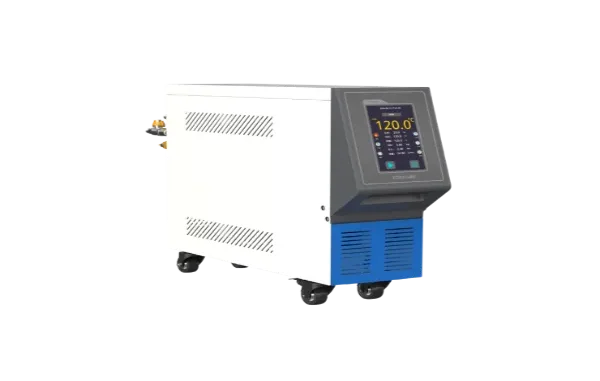

Manufacturers often discover post-molding residual stress issues only after products warp during storage, crack under load, or fail prematurely in customers’ hands. In highly competitive markets—such as those for mobile phone accessories and precision components—these problems can lead to high scrap costs, reputational damage, and missed business opportunities. This article explores how high-performance mould temperature controller effectively reduce post-molding residual stress through stable thermal control. Drawing on Topstar’s comprehensive test data, real-world injection molding metrics, and success stories from leading manufacturers, we offer valuable, practical insights.
The Hidden Impact of Residual Stress in Injection Molding
Residual stress arises during the cooling phase, when different sections of the molded part solidify and shrink at varying rates. In conventional injection molding setups without precise thermal management, these internal stresses remain trapped within the part, increasing the risk of future deformation or failure. Mobile phone cases, thin-walled components, and parts with complex geometries are particularly susceptible, as uneven wall thickness amplifies the effects of non-uniform cooling.
Reliable mould temperature controllers address this challenge by maintaining a uniform mould surface temperature throughout the entire cycle. Topstar mould temperature controllers ensure consistent heat extraction, promoting uniform crystallization and minimizing stress accumulation. Manufacturers implementing proper thermal control report significantly reduced post-molding deformation and improved dimensional stability across production batches.
Minimizing Stress Generation through Uniform Cooling with Mould Temperature Controllers
Achieving uniform cooling with a precision mould temperature controller synchronizes solidification throughout the part, thereby directly reducing stress generation. Topstar systems circulate temperature-controlled fluid through key channels within the mold to maintain a constant surface temperature. This method effectively prevents the uneven shrinkage caused by localized overheating or overcooling—the primary drivers of residual stress.
Mould temperature controller works in tandem with the molding machine to optimize cooling rates for specific materials and geometries. Operators can set ideal temperature profiles to strike the right balance between shortening cycle times and minimizing stress. Our advanced equipment features rapid-response capabilities, enabling adjustments to changes during production to ensure consistent product quality across every molding cycle.
Precision Temperature Control Capabilities
Precise temperature regulation is a key advantage of Topstar mould temperature controllers when addressing residual stress issues. The system employs advanced PID control algorithms and high-precision sensors to maintain mold temperatures within extremely tight tolerances (typically ±0.5°C). Multi-zone independent control enables customized temperature profiles that meet the specific processing requirements of different product sections.
Topstar mould temperature controllers integrate seamlessly with modern molding machines, optimizing overall process performance through data exchange. Features such as auto-tuning and real-time monitoring ensure the equipment maintains ideal processing conditions during long-term continuous production or material changes. This precise control effectively prevents harmful internal stresses caused by temperature fluctuations. Real-world production cases clearly demonstrate these benefits; for instance, an automotive interior parts manufacturer reduced its defect rate—previously caused by post-molding stress—from 12% to below 2% after upgrading its temperature-control system.
Material-Specific Thermal Management Strategies
Adopting thermal management strategies tailored to specific materials maximizes the mould temperature controller’s effectiveness in reducing residual stress. Different polymers—such as ABS, polypropylene (PP), TPU, and glass-fiber reinforced resins—often achieve optimal molding results under specific temperature profiles. Topstar provides comprehensive application guidelines and assists customers in setting optimal process parameters for their specific materials and injection molding machines.
For semi-crystalline materials, the controller helps establish appropriate crystallization conditions, minimizing internal stress conflicts during cooling; for amorphous materials, controlled cooling rates help reduce “frozen-in” stresses.
Reducing Residual Stress to Enhance Quality and Performance
When manufacturers reduce residual stress by maintaining stable mold temperature control, improvements in product quality and performance become evident. Parts exhibit superior dimensional accuracy, enhanced mechanical properties, and greater environmental resilience (such as resistance to thermal cycling and chemical exposure). These advantages translate directly into higher customer satisfaction and lower field failure rates. A stable process benefits molding equipment by reducing wear and tear on molds and machine components. Production teams experience fewer interruptions caused by quality-related adjustments, thereby boosting overall production efficiency. Many Topstar customers report significant reductions in scrap rates and the need for downstream secondary processing after implementing effective thermal control solutions.
Integration and Optimization Strategies for Mould Temperature Controllers and Molding Machines
Integration and optimization strategies ensure that mould temperature controllers deliver peak performance when paired with modern molding machines. Topstar systems feature user-friendly interfaces and communication capabilities that enable seamless coordination with the molding machine’s control system. Centralized monitoring functions help operators maintain optimal operating conditions throughout the production unit.
Regular process validation and temperature parameter assessments help maintain equipment performance at an optimal level. The training and ongoing technical support provided by Topstar empower customers to continuously refine their thermal control strategies. This collaborative approach not only maximizes return on investment but also offers the flexibility to adapt to evolving production requirements.
Related posts:
 The Complete Guide to Using Telegram for Secure and Smart Communication
 The Chemistry Behind Firefighting Foam: How Surfactants Make Fire Suppression Work
 Dell Latitude 5540 Performance Tested: Can It Handle Your Workflow?
 Best Traction Tools for Lifted Jeeps & SUVs on the Trail
 Building a Smarter Digital Infrastructure With Cloud and Dynamics 365 in Qatar
Leave a Reply