
Complete Beginner Guide
Moving to LA:
What Nobody Tells You Before You Go
The costs, the neighborhoods, the traffic reality, the fire season, the job market, and the honest answer to whether Los Angeles is worth it in 2026.
The honest upfront number: A single person needs at least $75,000/year to live comfortably in LA in 2026. The average one-bedroom apartment costs $2,538/month. LA’s cost of living is 49.7% above the national average. If these numbers work for you, read on — because LA is worth it.
~4MCity population
$2,749Avg. rent (all sizes)
49.7%Above nat’l avg cost
$3,834Avg monthly take-home
300+Sunny days per year
People stay because Los Angeles, despite being genuinely difficult and expensive and sprawling and occasionally on fire, delivers on that feeling more than almost anywhere else. This guide exists to help you survive the transition between those two truths.
Los Angeles is the second-largest city in the United States, a metro area of roughly 10 million people spread across 4,752 square miles of ocean, desert, mountain, and everything between. It is also the most misunderstood major city in America — simultaneously over-hyped and under-explained. The guides that rank above this one on Google will tell you LA is expensive (true), traffic is bad (true), neighborhoods vary widely (also true). What they mostly skip is the why, the how much exactly, the parts that are actually hard, and the parts that are genuinely extraordinary.
This guide was written specifically for 2026 — which means it addresses the reality of the housing market after the January 2025 Palisades and Eaton wildfires destroyed more than 16,000 structures and displaced tens of thousands of residents, pushing rent up in surrounding neighborhoods by up to 200% in some cases. It addresses the Metro expansion that has genuinely changed transit options in parts of the city. It addresses what $75,000 versus $100,000 versus $150,000 actually buys you here. And it addresses whether moving to LA in 2026 is still a smart decision — because the honest answer is more nuanced than yes or no.
Moving to LA Quick Facts (2026)
- Minimum comfortable salary: $75,000
- Average 1-bedroom rent: $2,500+
- Car required? Usually yes
- Best neighborhood for newcomers: Culver City, Koreatown, Pasadena
- Sunny days per year: 300+
- Cost of living: 49.7% above US average
If I Moved to LA Again in 2026
- I’d rent before buying
- I’d choose commute over apartment size
- I’d get roommates for year one
- I’d spend a month exploring neighborhoods before signing a long lease

Moving to LA in 2026: What You Need to Know First
Most guides bury the cost of living section in the middle. We are starting here because getting the money wrong is the most common reason newcomers have a bad first year in LA. Nothing about the city is enjoyable when you are stretched so thin financially that every decision is stressful.
Los Angeles’s cost of living is 49.7% higher than the national average as of 2026. Housing costs alone are 133% higher than the national average. The city’s own data suggests a single person needs approximately $75,000 gross per year — or roughly $28.88 per hour — to cover basic expenses comfortably. A family of four typically needs $130,000–$150,000.
The Real Monthly Budget for a Single Person
| Expense | Budget Option | Comfortable Option | Notes |
|---|---|---|---|
| Rent (1BR) | $1,600–$2,000 | $2,500–$3,200 | Budget = East LA, Van Nuys, Koreatown. Comfortable = Silver Lake, Culver City, WeHo |
| Car (payment + insurance + gas) | $300–$500 | $700–$1,100 | Insurance averages $150–$450/mo in LA. Gas is consistently above national average |
| Groceries | $300–$400 | $450–$650 | LA prices ~19% above national avg. Trader Joe’s and ethnic markets save significantly |
| Utilities | $200–$280 | $280–$450 | Avg LA household spends ~$375/mo. Summer AC spikes electric bills significantly |
| Dining & Entertainment | $200–$350 | $400–$700 | LA restaurant scene is world-class but pricey. Budget options exist in every neighborhood |
| Health Insurance | $150–$300 | $300–$500 | Employer plans vary widely. Individual plans through Covered California from ~$150/mo |
| Miscellaneous | $200 | $400 | Personal care, subscriptions, clothing, unexpected costs |
| Monthly Total | $2,950–$4,030 | $5,130–$7,000 | Before savings, taxes, or childcare |
Note: The Number Most Guides Skip
The Gap Between Take-Home Pay and LA Costs
The average monthly net salary after tax in Los Angeles is $3,834. The average monthly cost of living for a single person — including rent — is approximately $4,316. That gap is real. It means the average LA wage literally does not cover the average LA cost of living for a single resident. This is why roommates are the norm, not the exception. It is why LA’s unofficial survival strategy for most people under 35 is to either earn above the median, share housing costs, or both.
The Sunshine Tax — And What It Buys
Locals call it the Sunshine Tax: the premium you pay to live in a city with 300+ sunny days per year, the Pacific Ocean within driving distance, world-class food, genuine career opportunities across entertainment, tech, healthcare, and logistics, and an outdoor lifestyle that is genuinely available year-round in a way it simply is not in Chicago or New York in February.
The Sunshine Tax is real. Whether it is worth paying depends entirely on your income, your industry, and what you actually value in daily life. The people for whom LA works brilliantly tend to be those who earn well above the median, those in industries that specifically require LA (entertainment, music, fashion, tech), and those who genuinely love the lifestyle rather than just the idea of it. The people for whom it does not work tend to have arrived for the aesthetic rather than the substance — and left within two years when the math stopped adding up.
5 Myths About Moving to LA That Will Cost You Money
Los Angeles has a mythology problem. Decades of film and television set in LA have produced a version of the city in people’s minds that is both more glamorous and more scary than the actual place. Here are the five beliefs that cause the most practical damage to newcomers.
Myth 1
“I can find a good apartment quickly if I’m flexible.”
✓ Reality
LA’s rental market is competitive and fast-moving. Desirable apartments often go within 24–48 hours of listing. Searching remotely from another city is genuinely difficult — many landlords require in-person viewings. Budget 60–90 days minimum for a proper search.
Myth 2
“I’ll just use Uber and not deal with owning a car.”
✓ Reality
Unless you live in one of LA’s handful of genuinely walkable neighborhoods (WeHo, Downtown, parts of Santa Monica), going car-free is punishing and expensive. Daily Ubers in a car-dependent neighborhood will exceed a car payment within weeks. Budget for a car unless your specific neighborhood supports car-free living.
Myth 3
“The entertainment industry will hire me once I’m here.”
✓ Reality
The entertainment industry is relationship-driven and stratified. Being physically present in LA is necessary but not sufficient. Most entry-level entertainment jobs pay poorly (PAs often earn $700–$900/week) and require years of networking before leading to a sustainable career. Have a financial runway or a backup industry before arriving with entertainment as your primary plan.
Myth 4
“The weather is perfect year-round — no problems there.”
✓ Reality
LA has micro-climates so extreme they might as well be different cities. Coastal neighborhoods can sit at 68°F while inland areas hit 100°F on the same afternoon. Santa Ana wind events create fire conditions that can close schools and highways. “Perfect weather” requires knowing which part of the city you are in.
Myth 5
“I’ll work remotely and live near the beach for cheap.”
✓ Reality
The beach-adjacent neighborhoods (Santa Monica, Venice, Manhattan Beach, Malibu) are among the most expensive in the entire country. A one-bedroom in Santa Monica averages $3,200+/month. The beach is accessible from anywhere in LA by car — you do not need to live next to it to enjoy it.
Neighborhoods: A Genuinely Useful Guide by Lifestyle
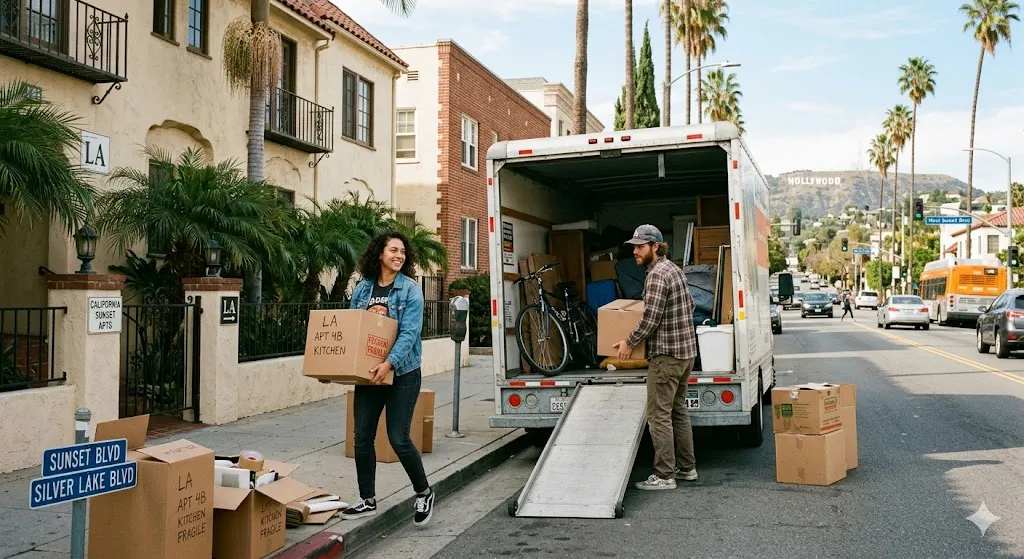
Los Angeles is not a city — it is a collection of 88 incorporated cities and dozens of unincorporated communities spread across a county the size of some states. The neighborhood you choose determines your commute, your social life, your weekend options, your grocery store, your vibe, and your monthly budget more than any other single decision you make before moving.
The single most important rule, confirmed by everyone who has lived here long enough to learn it the hard way: live within five miles of where you spend most of your time. A 10-mile commute can take 15 minutes at 10am or 75 minutes at 5:30pm. LA geography has a multiplier effect on distance that newcomers consistently underestimate.
For the Creative Professional
| Neighborhood | Core Features | Avg Rent (1BR) | Vibe |
|---|---|---|---|
|
Silver Lake
|
Creative
Independent
Established
|
$2,200–$2,800/mo | Creative · Independent · Established |
The neighborhood that attracts musicians, writers, designers, and independent film types. Walkable commercial strips, mid-century architecture, excellent restaurants and coffee. Has gentrified significantly but retains genuine character. Good for people who want texture in their daily environment.
| Neighborhood | Core Features | Avg Rent (1BR) | Vibe |
|---|---|---|---|
|
Highland Park
|
Walkable
Creative scene
Hilly terrain
|
$1,800–$2,400/mo | Up-and-coming · Affordable · Artsy |
What Silver Lake was a decade ago. York Boulevard and Figueroa Street are packed with record stores, vegan bakeries, natural wine bars, and murals. The Arts District feel at lower prices. Strong sense of community and rapid development. Northeast LA’s most talked-about neighborhood in 2026.
| Neighborhood | Core Features | Avg Rent (1BR) | Vibe |
|---|---|---|---|
|
Los Feliz
|
Budget-friendly
Arts scene
Growing fast
|
$2,300–$3,000/mo | Relaxed · Leafy · Established |
At the foot of Griffith Park, Los Feliz offers indie theaters, diverse dining, and a quieter pace than Silver Lake next door. Attracting young families and established creatives. One of the few neighborhoods where you can walk to Griffith Observatory — a genuinely remarkable daily luxury.
Park accessQuiet streetsIndie culture
For the Tech and Business Professional
| Neighborhood | Core Features | Avg Rent (1BR) | Vibe |
|---|---|---|---|
|
Culver City
|
Central
Walkable
Professional
|
$2,400–$3,200/mo | Central · Walkable · Professional |
The sleeper hit of the LA neighborhood conversation. Home to Sony Pictures, Amazon Studios, Apple TV+, and HBO — Culver City became a content production hub and the neighborhood around it followed. Walkable downtown, excellent schools, and genuinely central location. Best option for tech and entertainment professionals who want quality of life without the Westside premium.
| Neighborhood | Core Features | Avg Rent (1BR) | Vibe |
|---|---|---|---|
|
Playa Vista
|
Walkable
Studios nearby
Good schools
|
$2,800–$3,600/mo | Silicon Beach · Modern · Car-optional |
Google, Facebook, YouTube, Snap, and dozens of other tech companies have offices here, creating LA’s “Silicon Beach.” Entirely planned community — modern, clean, walkable within itself, and close to the beach. Higher price point but realistic car-optional living for those working in the immediate area.
| Neighborhood | Core Features | Avg Rent (1BR) | Vibe |
|---|---|---|---|
|
Pasadena
|
Tech hub
Modern
Beach access
|
$2,000–$2,800/mo | Historic · Family · Real City Feel |
The rare LA neighborhood that feels like an actual city with its own identity, history, and architecture. Old Pasadena is walkable and excellent. The Metro A Line makes commuting downtown genuinely pleasant. Top-rated public schools make this the go-to for families. CalTech and NASA’s Jet Propulsion Laboratory drive a strong tech and science community.
Metro accessTop schoolsHistoric
For Those Who Want to Be Near the Energy
| Neighborhood | Core Features | Avg Rent (1BR) | Vibe |
|---|---|---|---|
|
West Hollywood
|
LGBTQ+ Friendly
Walkable
Nightlife
|
$2,600–$3,500/mo | LGBTQ+ Friendly · Walkable · Nightlife |
The most walkable square mile in California. WeHo is the epicenter of LA’s LGBTQ+ community, the Sunset Strip nightlife, and the entertainment industry’s social scene. The only neighborhood where car-free living is genuinely comfortable — groceries, gyms, restaurants, and nightlife all within walking distance. Expensive but unique.
| Neighborhood | Core Features | Avg Rent (1BR) | Vibe |
|---|---|---|---|
|
Downtown LA
|
Most walkable
LGBTQ+
Nightlife
|
$2,000–$2,800/mo | Urban · Transit · Arts |
Downtown has transformed over the past decade. The Arts District is genuinely world-class. 36 bus lines and six rail lines make it the best-served transit hub in the city. More affordable than Westside neighborhoods with better transit. The catch: Downtown LA requires active engagement with street-level realities that not all newcomers expect.
| Neighborhood | Core Features | Avg Rent (1BR) | Vibe |
|---|---|---|---|
|
Santa Monica
|
Coastal
Premium
Walkable
|
$3,000–$4,200/mo | Coastal · Premium · Walkable |
If budget allows — and it needs to — Santa Monica offers the best combination of walkability, beach access, excellent restaurants, and quality of life in the city. Walk Score of 92. The Third Street Promenade and Main Street provide genuine street life. Most expensive neighborhood on this list by a significant margin.
For the Budget-Conscious Newcomer
| Neighborhood | Core Features | Avg Rent (1BR) | Vibe |
|---|---|---|---|
|
Koreatown
|
Affordable
Metro Access
Food Scene
|
$1,700–$2,300/mo | Dense · Diverse · Central |
One of the most dense and lively neighborhoods in the city. Excellent Korean food (obviously) plus some of the best Filipino, Mexican, and Thai restaurants in LA. Central location. Two Metro lines. Among the most affordable options that does not require sacrificing access to the rest of the city.
| Neighborhood | Core Features | Avg Rent (1BR) | Vibe |
|---|---|---|---|
|
Eagle Rock
|
Affordable
Metro Access
Food Scene
|
$1,800–$2,400/mo | Chill · Community · Northeast LA |
Adjacent to Highland Park and Los Feliz but slightly more affordable and quieter. Strong neighborhood identity, independent businesses, and a community feel that is hard to find at this price in LA. Growing faster than most guides acknowledge — worth considering before prices catch up with the adjacent neighborhoods.
AffordableCommunity feelGrowing
Burbank / Glendale
Suburban · Quiet · Entertainment Adjacent
1BR avg: $1,800–$2,500/mo
Technically separate cities but functionally part of greater LA. Home to Warner Bros., Disney, DreamWorks, and NBC Universal — if you work in studio production, living here eliminates a brutal commute. More suburban feel, better parking, and more affordable than most Westside equivalents. Often overlooked in neighborhood guides.
| Neighborhood | Biggest Advantage | Biggest Drawback |
|---|---|---|
| Culver City | Central location | Expensive |
| Koreatown | Affordable + transit | Parking |
| Pasadena | Family-friendly | Further from beach |
| Santa Monica | Lifestyle | Very expensive |
Finding Housing in 2026: The Post-Wildfire Market Reality
The January 2025 Palisades and Eaton wildfires destroyed more than 16,000 structures and displaced tens of thousands of residents. This is not background context — it directly affects the housing market you are entering as a newcomer in 2026.
Note: Critical 2026 Context
How the 2025 Wildfires Changed the Rental Market
The fires burned 57,000 acres and destroyed over 16,000 structures, including more than 11,000 single-family homes. The displaced households — many from Pacific Palisades and Altadena, where median home values approached $1.95 million — flooded the rental market in surrounding communities. Within five miles of the fire perimeters, median list rents rose 3.4% through late 2025, compared to 1.7% in more distant areas. In some specific cases, rents increased by up to 200% as displaced wealthy households competed for available units. Price gouging laws exist in California but enforcement is imperfect. As a newcomer, you are entering a market that is tighter and more expensive than it was 18 months ago, particularly in the west and northwest parts of the city.
Practical Rules for Apartment Hunting in LA
Start your search 60–90 days before your move date. Good apartments in desirable neighborhoods move within 24–48 hours of listing. Searching remotely is genuinely difficult — most landlords and property management companies require in-person viewings and California law requires specific disclosures during showings that make virtual-only searches impractical.
Budget for a first month, last month, and security deposit upfront. This is standard in LA and means having three months of rent liquid before you arrive. On a $2,500/month apartment that is $7,500 in move-in costs before your first month’s bills arrive.
Know your credit score. LA landlords typically require a credit score above 700 for competitive apartments. Have your score, two recent pay stubs, and bank statements ready to move fast when you find something.
Consider spending your first month in a furnished short-term rental while you search in person. This costs more upfront but prevents the very common newcomer mistake of signing a lease on an apartment you found online without understanding the neighborhood’s daily reality.
Housing Tip
The Roommate Math in 2026
A two-bedroom apartment in Silver Lake averaging $3,400/month split two ways is $1,700 each — significantly more comfortable than a solo one-bedroom at $2,500. Three-bedroom splits in good neighborhoods can bring per-person costs down to $1,300–$1,600. In a city where the average take-home pay barely covers solo living costs, roommates are not a compromise — they are a financial strategy. Rooms in shared houses can be found from $1,050–$1,500/month in most neighborhoods, including furnished options with utilities included.
Traffic, Transit, and the Car Question
LA traffic has a reputation that is simultaneously accurate and misleading. The 405 at 5:30pm on a Friday is every story you have heard. A Tuesday morning surface street commute of four miles in Silver Lake can also take 8 minutes. The difference between miserable and manageable in LA traffic is almost entirely about when and where you drive, and whether you choose a neighborhood that minimizes necessary driving.
The Car Question: Do You Actually Need One?
Honest answer: probably yes, unless you live in one of about five neighborhoods. West Hollywood, Downtown LA, Santa Monica, and parts of Koreatown are genuinely livable without a car. Everywhere else — you need one, or you will spend so much on rideshares that you would have been better off with a car payment.
The good news is the Metro system has genuinely expanded. The K Line (Crenshaw/LAX), D Line extension to Westwood, and various other projects have made transit viable for more commutes than it was five years ago. The Metro A Line connecting Downtown to Pasadena is one of the best transit experiences in the city. But outside specific corridors, the bus system requires patience and schedule flexibility that does not match most professional working environments.
The Most Important Thing Anyone Will Tell You About LA
Do not live more than five miles from where you spend most of your time. This is the closest thing to a universal survival rule in Los Angeles. A five-mile commute can be 10 minutes at 10am or 55 minutes at 6pm. A ten-mile commute under the same conditions becomes 20 minutes or 90 minutes. Distance in LA is not measured in miles — it is measured in time, and time varies dramatically based on when you travel. Before you sign a lease, drive your commute route at commute time. Not on a Saturday. On a Wednesday at 8:15am.
The LA Job Market: Where the Work Actually Is in 2026
Los Angeles has a more diverse economy than its entertainment reputation suggests. Yes, the entertainment industry is the largest and most iconic employer. But LA is also the largest manufacturing center in the United States, a major international trade hub through the Port of Los Angeles, a growing technology center concentrated in Silicon Beach, and one of the country’s largest healthcare markets.
The Industries That Are Actually Hiring
Technology: Silicon Beach (Santa Monica, Venice, Playa Vista) hosts Google, YouTube, Snap, TikTok, Hulu, and hundreds of startups. LA’s tech sector grew significantly post-2020 and remains active. Salaries are comparable to San Francisco at lower (though still high) cost of living.
Healthcare: Cedars-Sinai, UCLA Health, Kaiser Permanente, USC Keck, and dozens of specialty hospitals make healthcare one of LA’s most stable employment sectors. Growing rapidly as the city’s population ages.
Entertainment: Still the dominant industry but restructured significantly post-streaming. Traditional studio roles have contracted. Content creation, digital media, gaming, and creator economy roles have expanded. The industry is hiring differently than it was five years ago.
Logistics and Trade: The Port of Los Angeles and Port of Long Beach handle 40% of US container imports. Supply chain, logistics, and international trade employ hundreds of thousands in the region — often overlooked by newcomers focused on glamour industries.
“Following a 0.7% growth baseline from last year, LA’s nonfarm job market in mid-2026 is seeing the most significant hiring velocity in tech, healthcare, and hospitality.”— Economic forecast, 2026
What You Need to Earn to Thrive — Not Just Survive
Surviving in LA (shared housing, no savings, no discretionary spending): $50,000–$65,000/year. Living comfortably as a single person (your own apartment, regular dining out, travel): $75,000–$100,000/year. Thriving as a single person (desirable neighborhood, savings, lifestyle): $100,000–$130,000+/year. Family of four living well: $150,000+/year. These are not exaggerations — they reflect the 49.7% cost-of-living premium LA charges for the privilege of the sunshine.
Your First Year in LA: What to Expect Month by Month
The first year in any new city is hard. The first year in LA is hard in specific ways that are worth knowing in advance.
Months 1–2
The Overwhelm Phase
Everything takes longer than expected. Setting up banking, a California driver’s license (required within 10 days of becoming a resident), car registration, utilities, and finding your regular grocery store all happen simultaneously. Budget more time and money than you think you need. The city has not revealed itself yet — you are still navigating infrastructure.
Months 3–4
The Questioning Phase
The newness has worn off. The cost of everything has registered. Traffic has happened to you multiple times. This is when many newcomers first seriously consider leaving. It is also when people who stay start to discover their specific corner of the city — the neighborhood coffee shop, the hiking trail, the restaurant they return to.
Months 5–8
The Finding Phase
Social connections begin forming. You understand where you fit in the city. You have opinions about neighborhoods. You have discovered that the hiking, the food, the weather, and the access to genuinely extraordinary experiences are real — not just marketing copy. LA starts rewarding you for staying.
Months 9–12
The Settling Phase
You have survived a summer (hot and smoky in some neighborhoods), experienced the Santa Ana winds, and possibly your first earthquake. You know which freeway to avoid and when. You have friends who also moved here and friends who are from here. The city has become legible. This is when most people who stay make the decision to stay for several more years — and rarely regret it.
Fire Season: What Newcomers Need to Know in 2026
The January 2025 wildfires were not a freak event. They were an extreme version of a recurring reality that every LA resident needs to understand before choosing where to live and how to prepare.
The Four Things to Know Before You Move
1. High Fire Hazard Severity Zones (HFHSZ): Before signing any lease or buying any property, check whether it falls within a High Fire Hazard Severity Zone. The California Department of Forestry and Fire Protection (CAL FIRE) maintains a public map. Canyon, hillside, and foothill neighborhoods — including parts of Pacific Palisades, Altadena, Malibu, Topanga, and the Hollywood Hills — carry elevated risk.
2. Home insurance has become extremely difficult to obtain: Multiple major insurers have exited the California market. If you are buying, securing homeowners insurance is now a significant challenge in fire-risk areas. Renters insurance remains more accessible but is still a must-have.
3. Air quality during fire events: Even if your neighborhood is not at direct risk, wildfire smoke affects air quality across the entire basin. A HEPA air purifier is a worthwhile investment for any LA home regardless of fire proximity.
4. Santa Ana winds are the trigger condition: Dry, hot winds from the inland desert arrive in fall and winter, dropping humidity to single digits and driving rapid fire spread. These events can develop quickly. Have an emergency plan, keep your car’s gas tank above half, and know your evacuation routes before you need them.
None of this means you should not move to LA. Millions of people live here safely through fire seasons every year. It means you should choose your neighborhood with awareness, prepare appropriately, and take the annual risk seriously rather than dismissing it as something that only happens to other people.
Complete Moving to LA Checklist
Before You Move (60–90 Days Out)
- Establish your monthly budget using the tables in this guide — be honest about the numbers
- Research neighborhoods based on your workplace location — apply the 5-mile rule
- Begin apartment search remotely but plan for an in-person visit before signing
- Check fire hazard zone status for any neighborhood you are seriously considering
- Start saving for first month + last month + security deposit (3x your rent)
- Research car insurance — budget $150–$450/month for LA rates
- Get your credit score above 700 if it is not already
- Prepare documents: pay stubs, bank statements, references, photo ID
First Two Weeks After Arrival
- Get a California Driver’s License — required by law within 10 days of establishing residency
- Register your out-of-state vehicle — required within 20 days
- Set up California auto insurance — your current policy may not meet CA requirements
- Establish your address with USPS mail forwarding from old address
- Register to vote at your new California address
- Open utility accounts (DWP for electricity/water if in City of LA)
- Download the Metro app and load a TAP card for transit
- Drive your actual commute route at actual commute times — both directions
- Learn your street parking permit zone rules — read every sign
First Month Practical Priorities
- Purchase renters insurance — required by most landlords and essential regardless
- Buy a HEPA air purifier — useful year-round, essential during fire season
- Locate your nearest emergency exits and evacuation routes if in a fire-risk area
- Find your local farmers market — LA has excellent ones and they improve life quality significantly
- Identify three grocery options at different price points in your neighborhood
- Explore your neighborhood on foot at different times of day and evening
- Set up a dedicated LA emergency fund — 3 months of expenses minimum
The Biggest Mistakes New LA Residents Make
Many newcomers assume their biggest challenge will be finding housing or dealing with traffic. In reality, the most expensive mistakes happen after the move. One common example is choosing an apartment based on rent alone rather than commute time. Saving $300 per month on rent can easily cost 15–20 hours per month in additional driving.
Another frequent mistake is underestimating the social geography of Los Angeles. Unlike dense cities where social life naturally develops around a few central neighborhoods, LA operates through dozens of local communities. Living far from your workplace, friends, or preferred activities can make the city feel isolating even when surrounded by millions of people.
The residents who adapt fastest are usually those who choose a neighborhood first and an apartment second. They understand that in Los Angeles, convenience often matters more than square footage.
What Surprised People Most After Moving to LA
People expect the sunshine. They expect the palm trees. They expect the traffic. What often surprises them is how much nature exists inside the city itself.
Within a single weekend, residents can hike in the mountains, relax at the beach, visit a desert landscape, and explore urban neighborhoods that feel completely different from one another. Few major cities offer that range without requiring flights or long-distance travel.
Another surprise is how specialized the city becomes over time. Newcomers often see Los Angeles as one giant metro area. Long-term residents tend to experience it as a collection of smaller cities, each with its own culture, food scene, architecture, and rhythm.
Is LA Better Than New York, Chicago, or Miami?
The answer depends less on the cities themselves and more on the lifestyle you want.
New York rewards people who value density, public transportation, and constant activity. Chicago offers a lower cost of living and stronger affordability relative to income. Miami provides tropical weather and a growing business environment.
Los Angeles appeals to people who prioritize climate, outdoor living, creative industries, and flexibility. It offers more personal space than New York, more economic diversity than Miami, and better year-round weather than Chicago.
For many residents, LA’s biggest advantage is not any single feature but the combination of career opportunities, cultural diversity, outdoor recreation, and climate that few other American cities can match.
The Lifestyle Inflation Trap in Los Angeles
Most budgeting guides fail to include one major factor: LA quietly increases your spending habits without you noticing.
It doesn’t happen immediately. It starts with small adjustments:
- You go out for coffee more often because the weather is always nice.
- You meet friends in different neighborhoods, increasing transportation costs.
- You try restaurants more frequently because the food scene is genuinely exceptional.
Then it becomes structural:
- Gym memberships in different neighborhoods
- Weekend trips (Joshua Tree, Santa Barbara, San Diego)
- Parking fees you didn’t anticipate
- “Convenience Ubers” when driving feels inefficient
The real difference in LA is not just rent or groceries — it is frequency of spending. In most cities, bad weather naturally limits activity. In LA, nothing stops you from going out. That freedom has a price, even if you don’t notice it month one.
The Emotional Shock No One Prepares You For
The first thing most newcomers notice isn’t the palm trees or sunshine — it’s the scale. Everything is farther than expected, even when Google Maps says it isn’t. A “15-minute drive” feels like a gamble. A “quick grocery run” becomes a 45-minute round trip depending on traffic.
There is also a strange emotional contrast in the first days. You can be sitting in bright sunlight at 10 AM, eating something incredible from a tiny restaurant in a strip mall, and still feel slightly disoriented — because LA doesn’t introduce itself like a normal city. It doesn’t “welcome” you. It waits for you to learn how it works.
Most people don’t talk about this part, but it matters: LA rewards adaptation, not excitement. The sooner you stop trying to “understand the whole city” and instead focus on your small pocket of it, the sooner it starts feeling livable.
The Compelling Tradeoff That Keeps People in LA
Most LA residents will complain about:
- rent
- traffic
- parking
- cost of everything
And yet, they don’t leave.
The reason is simple: LA offers a density of experiences that is hard to replicate elsewhere in the US.
Within a single week, you can realistically experience:
- Ocean sunrise in Santa Monica
- Studio audience taping or film event
- Mountain hiking in Griffith Park
- Live music or underground art show
- Food from almost any global cuisine at a high level
The city is not easy, but it is highly variable. That variation is what makes people tolerate the inconvenience.
The Two Versions of “Perfect Weather”
Everyone says LA has perfect weather. What they don’t explain is that there are two LA climates operating at once:
- Coastal LA: mild, breezy, often cloudy mornings, stable temperatures
- Inland LA: hotter, drier, more extreme temperature swings
The difference can feel like two different cities.
A common newcomer mistake is choosing housing based on “beach proximity” without realizing:
- Coastal fog can last until midday
- Inland areas are hotter but sunnier earlier
- Commutes between zones create micro-climate fatigue (AC in car → cold ocean breeze → hot inland heat)
Understanding this early prevents a lot of discomfort — especially for people sensitive to temperature changes.
Why Your First Choice of Neighborhood Usually Isn’t Your Final One
Almost nobody gets their first LA neighborhood “perfect.”
What usually happens:
- You pick a neighborhood based on budget and online research
- You move in
- You slowly discover what you actually value (walkability, commute time, social scene, quiet, etc.)
- You realize a different area fits your life better
After about 4–8 months, many people experience a subtle shift:
- From “where can I afford to live?”
→ to - “where does my actual life happen?”
This is when people often move from:
- Downtown → Silver Lake
- Valley → Westside
- Westside → Pasadena or Culver City
This isn’t failure — it’s calibration. LA is too large and fragmented to get right on the first attempt without local experience.
LA vs. NYC vs. Chicago: Relocation Comparison
If you are weighing your options between major US metros, here is how Los Angeles stack up against the competition:
- New York City: Rewards density and 24/7 public transit, but offers virtually zero personal space.
- Chicago: Highly affordable relative to local incomes, but forces you to endure brutal winter climates.
- Los Angeles: Offers an unparalleled mix of creative industries, outdoor geographic diversity, and year-round perfection in climate—but expects you to pay a high premium (“Sunshine Tax”) to access it.
Should You Actually Move to LA in 2026?
The honest answer is that Los Angeles is worth moving to if — and specifically if — two things are true: your income either already covers the cost, or your industry and trajectory give you a realistic path to that income within a year of arriving. And second, the things you value in daily life are the things LA actually delivers: outdoor lifestyle, cultural density, culinary excellence, creative community, and a city that is genuinely alive in ways that most American cities are not.
If you are moving to LA because you think it will be glamorous and warm and you have vague plans to “make it” — you should probably have a very specific plan before booking the moving truck. The people who leave within two years are mostly people who arrived for the idea of LA rather than the reality. The reality is a sprawling, expensive, occasionally smoky, traffic-saturated, impossibly beautiful, deeply interesting city that rewards specificity and punishes vagueness.
If you know which neighborhood fits your life, which industry you are entering, what salary you need to feel comfortable, and what you want your daily environment to actually look like — LA in 2026 is one of the best places in the world to live. The wildfire recovery is actively creating new development. The Metro expansion is gradually changing the transit calculus. The food, the weather, the hiking, the culture, and the people who live here make the Sunshine Tax feel worth paying — once you can actually afford to pay it.
The Bottom Line
LA rewards people who arrive with a plan, a realistic budget, and genuine love for what the city actually is — not what they imagined it would be.
$75,000 minimum to live comfortably. Five miles maximum from where you spend your time. Research your neighborhood’s fire hazard status. Prepare for traffic that defies logic and weather that redeems everything. The city is worth it — but it demands that you understand it first.
Frequently Asked Questions
At minimum, have six months of expected monthly expenses saved before you arrive — not three. The first month requires first + last month + security deposit (three months of rent), plus moving costs, car registration transfer, and the inevitable unexpected expenses of a new city. For a single person moving into a $2,500/month apartment, plan on having $20,000–$25,000 accessible before you leave. This sounds like a lot because it is — and it is genuinely necessary.
Koreatown, Eagle Rock, Highland Park, and parts of the San Fernando Valley (particularly North Hollywood and Burbank) offer the best combination of relative affordability, safety, and access to the rest of the city. Koreatown specifically benefits from strong Metro connectivity. Budget one-bedroom apartments in these areas can be found in the $1,600–$2,000 range, though fire-driven pressure has tightened inventory across the board in 2026.
In most neighborhoods, yes. The exceptions are West Hollywood, Downtown LA, Santa Monica, Koreatown (with Metro access), and Playa Vista for people working locally. Everywhere else, the combination of limited bus coverage, suburban street design, and the time cost of transit for longer distances makes a car the practical necessity. Budget $400–$800/month total for car payment, insurance, gas, and parking.
It is tighter and more expensive than pre-fire, particularly in the western and northwestern parts of the city. Rents within five miles of the Palisades and Eaton fire perimeters rose 3.4% through late 2025. In some specific pockets, increases were far more dramatic. The displacement of thousands of high-income households into the rental market increased competition at the mid-to-high end of the rental spectrum. For newcomers, this means budgeting slightly higher than pre-2025 guides suggest and expecting more competition for desirable units.
If the entertainment industry is genuinely your career path — yes, you need to be in LA. There is no alternative geography for most entertainment roles. But arrive with realistic expectations: most entry-level roles pay poorly ($700–$900/week for production assistants), the industry is relationship-driven and takes years to navigate, and the streaming restructuring has reduced some traditional pathways. Have a financial runway of 12–18 months minimum, a specific entry point (not just a general aspiration), and a supplementary income plan for the lean early period.
Rather than listing neighborhoods to avoid entirely — which oversimplifies a complex city — focus on understanding what you are looking for and matching it specifically. Parts of South LA, Skid Row, and areas immediately adjacent to the wildfire zones require more local knowledge than a newcomer typically has. Research specific blocks using the LA Times neighborhood crime data, walk the area at different times of day, and talk to residents — not just real estate websites — before committing.
All cost data sourced from RentCafe (May 2026), Salary.com (April 2026), OysterLink (January 2026), Wise Cost of Living (2026), and Zillow wildfire analysis (December 2025). Fire statistics from Frontline Wildfire Defense and UCLA Lewis Center research (2025).
© 2026 · Independently written and unsponsored. Not financial or legal advice.





Leave a Reply