
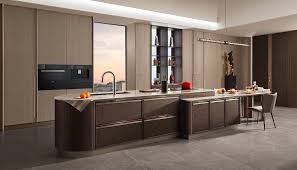

The Quiet Revolution You Haven’t Heard About
If someone told you fifteen years ago that a Chinese furniture brand would become a respected name in homes from Sydney to San Francisco, you’d probably have laughed. Back then, “Made in China” still meant cheap particleboard and imitation finishes. But today, a quiet revolution has taken place — and OPPEIN is at the very heart of it.
From its origins as a local kitchen cabinet maker in Guangzhou to a publicly traded company serving over 15 million families worldwide, OPPEIN has rewritten the rulebook on what Chinese furniture manufacturers can achieve. This isn’t just a success story about one company. It’s a case study in how quality, innovation, and customer focus can turn an entire industry’s reputation around.
So how did OPPEIN make that leap from local giant to global name? Let’s unpack the journey — including the tough lessons, the smart bets, and the manufacturing secrets that the rest of the world is finally waking up to.
The Early Days: Winning at Home First
In 1994, a room of opportunity was first discovered. Yao Liangsong, the founder of OPPEIN, came across European-style kitchen cabinets in a show flat of a Hong Kong real estate developer and recognized that this market segment was still blank in mainland China. Under this catalyst, OPPEIN was born.
OPPEIN took a different path from the start. It introduced the concept of “whole kitchen” customization — a model that was already popular in Europe but almost unheard of in China at the time. Instead of selling standalone cabinets, OPPEIN offered to design, manufacture, and coordinate full kitchen solutions for entire apartments.
By 2004, OPPEIN had opened its first overseas store in Los Angeles and was exporting products to more than 20 countries and regions, including the United States, Japan, Canada and Australia. The company was no longer just a local name — it was quietly building the foundation for something much bigger.
Going Global, Step by Step
Taking a brand international requires more than just ambition. It requires adaptation.
Today, OPPEIN exports to over 100 countries and regions worldwide. As of 2025, the company’s overseas channel revenue reached 471 million yuan, representing a year-on-year increase of 9.66%, with the overseas distribution channel business growing by more than 20%. Southeast Asia, Europe and the Middle East each saw business growth exceeding 30%. The company’s branded stores now cover 62 countries and regions globally.
In June 2024, OPPEIN opened its flagship store in Panama, with the newly inaugurated president of Panama attending the opening ceremony and cutting the ribbon in person — a remarkable milestone that speaks to the brand’s growing international recognition.
What makes this global growth particularly interesting? Unlike many Chinese furniture manufacturers that rely solely on wholesale distribution, OPPEIN operates through a carefully built network. As of November 2025, the company had 29 overseas dealers, with business spanning 23 countries and regions including Canada, Australia, the UAE, Vietnam and Thailand. Meanwhile, through partnerships with overseas developers and contractors, OPPEIN provides one-stop whole-home customization solutions for approximately 132 projects across 32 countries and regions.
This isn’t a brand that simply ships products overseas. It’s a brand that builds showrooms, trains local dealers, and tailors its offerings to local preferences. In North America, that means meeting NKBA guidelines. In Europe, it’s about adapting to smaller apartment dimensions. In the Middle East, it’s working with luxury developers. That level of market-specific adaptation is what separates OPPEIN from many other Chinese furniture manufacturers.
The Manufacturing Muscle Behind the Name
You can’t build a global reputation without world-class production. OPPEIN operates five intelligent manufacturing bases in Tianjin, Qingyuan, Wuxi, Chengdu and Wuhan, with a total construction area exceeding 3.15 million square meters. The manufacturing scale of OPPEIN is the largest in Asia.
What’s truly notable, however, is the quality consistency. OPPEIN has long partnered with HOMAG, the German woodworking machinery giant. The company has entrusted HOMAG with its Industry 4.0 strategy, establishing a strategic partnership on the overall production concept. In 2017 alone, OPPEIN ordered more than 300 units of HOMAG equipment, adding to the over 1,000 units already operating in its factories. In its production bases, HOMAG equipment runs alongside other advanced machinery, forming fully automated panel furniture production lines.
In terms of innovation, OPPEIN has built a large and advanced furniture laboratory and was recognized as a “High-tech Enterprise” in 2014. As of December 2021, the company held over 500 patents, covering product design, manufacturing processes and hardware innovations.
Annual production capacity is another area where OPPEIN leads. In 2021 alone, the company’s output included over 920,000 sets of kitchen cabinets, nearly 2.93 million sets of wardrobes, approximately 596,000 bathroom vanity units, and over 1.027 million wooden doors.
This combination of scale, advanced equipment and ongoing R&D investment explains why OPPEIN continues to be the benchmark among Chinese furniture manufacturers.
Redefining What “Chinese Furniture Manufacturing” Means
Let’s circle back to the bigger picture. When people hear Chinese furniture manufacturers, many still imagine cheap, disposable goods. But OPPEIN has spent nearly three decades proving that stereotype is outdated.
Today, OPPEIN competes with German and Italian kitchen brands in terms of quality, design and manufacturing precision, while maintaining a pricing advantage that comes from efficient, vertically integrated production. It’s not about being cheap anymore — it’s about delivering genuine value.
What makes OPPEIN different from many other Chinese furniture manufacturers? It’s not one single factor. It’s the scale of the factories combined with attention to quality. It’s the willingness to work with international partners at product development level. And it’s the recognition that running a global brand means thinking about customers not as “export markets” but as distinct groups of people with their own preferences, needs and expectations.
As of 2025, OPPEIN has over 7,400 branded stores worldwide, covering six continents and serving more than 15 million families. The company reported annual revenue of 17.232 billion yuan for 2025. While the domestic market remains the primary source of revenue, overseas revenue is growing steadily as part of its long-term strategy.
The Takeaway
From a local startup in Guangzhou to a global brand serving families across six continents, OPPEIN has earned its reputation the hard way: by investing in quality, embracing new technology, and never underestimating the importance of understanding local markets. They’ve not only built a successful business — they’ve helped redefine what Chinese furniture manufacturers can be.
If you’re a contractor, developer, or homeowner who wants high-quality cabinetry without the inflated price tags of European luxury brands, OPPEIN is worth a serious look. The local giant has truly become a global name. And the best part? They’re building for the long term.





Leave a Reply