

Enterprise data no longer lives in a single place. It flows through SaaS applications, resides in multi-cloud storage, traverses networks connecting hundreds of locations, and is accessed by users on devices that span continents. Protecting that data at scale requires cloud security companies capable of delivering automated enforcement, continuous visibility, and consistent policy control regardless of where data resides or moves. The companies that stand out in 2026 are those that have built platforms designed for exactly that challenge not security tools retrofitted to handle cloud, but architectures purpose-built for data protection at enterprise scale.
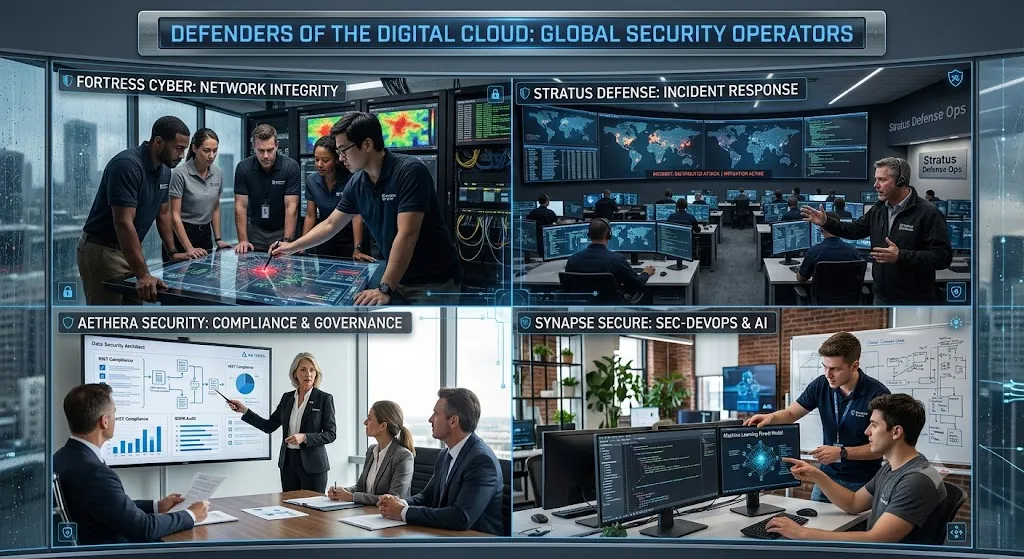
This guide presents five of the best cloud security companies for scalable data protection, with analysis focused on what each vendor delivers and which enterprise environments they serve best.
1. Fortinet
Fortinet delivers one of the most integrated and scalable cloud security platforms in the enterprise market. Its architecture combines cloud workload protection, network security, zero trust network access, application security, and security operations into a unified fabric that scales as enterprise environments grow. For organizations requiring automated cloud based security for businesses, Fortinet’s platform applies policy and threat detection consistently across public cloud, private infrastructure, and hybrid environments without requiring separate tools for each domain.
The scalability of Fortinet’s approach stems from its security fabric architecture, which shares threat intelligence, policy definitions, and telemetry across all platform components. As enterprise data environments expand new cloud providers, new applications, new user populations Fortinet’s controls scale alongside that growth without requiring significant re-architecture. For security teams managing complex, growing environments, this reduces the operational burden that typically increases when point solutions are added to address each new risk.
Fortinet’s continuous integration with threat intelligence sourced from its global research network means that cloud-facing data protection defenses are updated in real time against emerging attack techniques, including those targeting cloud storage misconfigurations, API exposures, and data exfiltration pathways.
2. Zscaler
Zscaler operates a cloud-native security platform designed to inspect and enforce policy on all user traffic regardless of where users, applications, or data are located. Its globally distributed architecture processes sessions at nodes close to users, maintaining consistent data protection controls without the latency overhead associated with traditional hub-and-spoke security architectures.
For enterprises scaling their cloud footprints rapidly, Zscaler’s platform grows without the hardware investment required by on-premises models. New users, locations, and applications are onboarded to the platform without deploying additional security infrastructure, making Zscaler particularly well suited to organizations expanding geographically or through acquisition.
The Threat Landscape Driving Investment in Scalable Data Protection
Understanding the threat environment that cloud security investments must address helps enterprise buyers evaluate vendor capabilities more rigorously. A comprehensive review of the major cyberattack trends reviewed throughout 2025 shows that zero-day vulnerabilities in network edge devices, cloud backup infrastructure, and widely deployed enterprise software were consistently exploited for data theft and ransomware deployment. These patterns reinforce why scalable, automated cloud security platforms capable of enforcing controls across every environment simultaneously represent a more resilient posture than manually managed, piecemeal approaches.
3. Sophos
Sophos offers cloud security with a managed detection and response layer that is particularly valuable for enterprises scaling data protection without proportionally scaling internal security staff. Its platform integrates telemetry from endpoints, networks, and cloud workloads into a unified threat intelligence engine, while the optional managed service layer provides 24-hour analyst coverage and active incident response.
The scalability benefit of the Sophos model is operational. As enterprise data environments grow, the managed service absorbs the corresponding increase in alert volume and investigation workload, allowing internal teams to focus on strategic security decisions rather than day-to-day triage. For enterprises expanding across regions, Sophos provides globally consistent data protection without requiring security operations centers in each geography.
4. Barracuda Networks
Barracuda Networks consolidates data protection across three interconnected attack surfaces: email, web applications, and network access. For enterprises where email represents the primary initial vector for cloud data breaches a pattern consistently observed in large-scale incidents Barracuda’s email security capabilities provide automated detection and response that operates at scale without manual triage of every suspicious message.
Its web application firewall protects data exposed through cloud-hosted applications by inspecting and filtering traffic at the application layer, addressing risks that network perimeter controls cannot reach. For enterprises operating multiple cloud-hosted applications across different providers, Barracuda’s integration with major cloud load balancers enables consistent application-layer data protection at scale.
Why Data Security Alignment with Business Objectives Remains a Challenge
A major barrier to effective enterprise data protection at scale is the persistent gap between security controls and business operations. Research from Gartner on the state of data security research findings found that only 14 percent of security and risk management leaders successfully balance data security with business objectives. This gap frequently leads to shadow data flows, inconsistent policy enforcement, and governance failures that no technical platform can fully compensate for. Cloud security companies that provide automation, policy co-creation tools, and compliance reporting help enterprises close this gap by reducing the friction between security enforcement and business operations.
5. CyberArk
CyberArk addresses data protection from the identity and privileged access angle, which is increasingly important as cloud environments expand the volume of accounts, credentials, and machine identities that require governance. Unauthorized access through compromised privileged credentials is among the most common pathways to large-scale enterprise data theft, and it is a risk that grows directly with the scale of cloud adoption.
CyberArk’s platform automates the rotation and governance of cloud service account credentials, API keys, and secrets embedded in DevOps pipelines eliminating the static credentials that attackers most commonly exploit. For enterprises scaling cloud adoption rapidly, where the volume of machine identities can outpace manual governance, CyberArk’s automated approach provides data protection controls that scale alongside the infrastructure they protect.
How to Select a Cloud Security Company for Scalable Data Protection

The six providers reviewed here take different architectural approaches to cloud data protection. Fortinet delivers the broadest integrated platform across network, cloud, and access security. Zscaler excels at scalable cloud-native delivery and data protection in motion. Sophos provides managed security outcomes that scale without proportional internal staff growth. Barracuda consolidates protection across email, application, and network domains. CyberArk automates privileged identity governance at cloud scale.
Selection should begin with a precise inventory of where sensitive data resides, how it moves between environments, and which access pathways represent the highest risk. Vendors whose platforms provide automated discovery and classification of data across cloud environments in addition to enforcement controls will deliver more complete protection than those focused solely on perimeter or access controls.
Frequently Asked Questions
What makes cloud security scalable rather than simply capable?
Scalable cloud security delivers consistent policy enforcement, threat detection, and data protection controls as enterprise environments grow adding new cloud providers, users, applications, or geographies without requiring proportional increases in security staff, hardware, or manual configuration. Platforms built on centralized policy management and automated enforcement are inherently more scalable than those relying on per-environment configuration.
How does automated cloud security differ from traditional security approaches for data protection?
Traditional security approaches relied heavily on manual policy configuration, perimeter-based controls, and reactive incident response. Automated cloud security applies policy continuously across all data flows, automatically responds to detected threats, and adapts enforcement as environments change providing data protection that operates at the speed and scale of cloud infrastructure rather than at the pace of human intervention.
What role does identity management play in scalable data protection?
Identity is the primary control point for data access in cloud environments, where traditional network perimeters do not exist. Governing which users, service accounts, and machine identities can access which data and automating the enforcement and rotation of those access controls is foundational to scalable data protection. Enterprises that invest in privileged access management alongside cloud security platforms achieve more complete data protection than those addressing only network and workload controls.
Related posts:
 Water Damage Restoration Service Lanham: Fast & Efficient
 What Does C3PAO Mean for the Future of Risk Management?
 Creating Stunning Face Swap Videos with AI: How to Use Face Swap Video Tools for Free
 How Dechecker AI Checker Turns Awkward Drafts Into Human-Readable Content
 The Complete Guide to Using Telegram for Secure and Smart Communication
Leave a Reply