
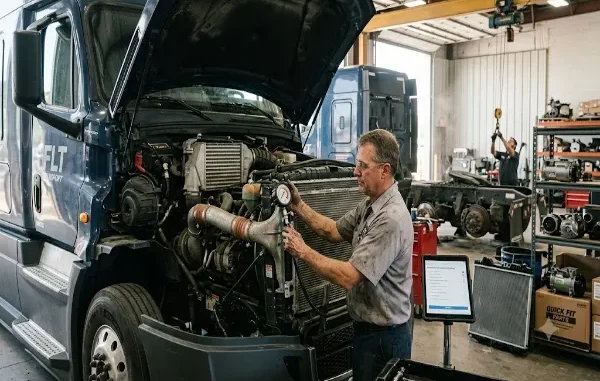
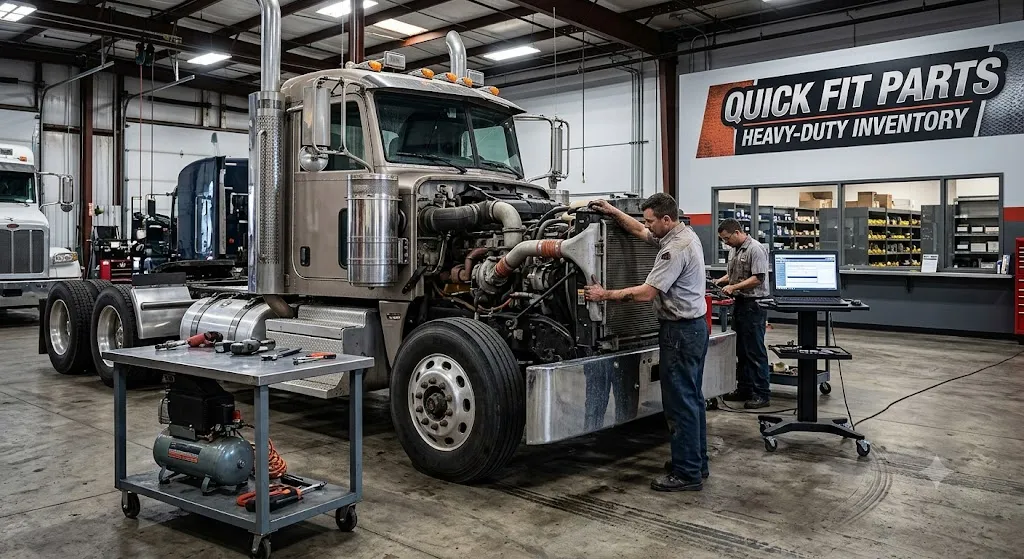
Most people think of vehicle maintenance in terms of the family car: an oil change every few months, new tyres when the tread wears down, maybe a battery replacement every few years. But for commercial fleets running heavy-duty trucks, the stakes look completely different. A single mechanical failure doesn’t just mean an inconvenient trip to the shop — it can mean a missed delivery window, a stranded driver, and a repair bill that dwarfs the cost of the part that failed in the first place.
Cooling and climate systems are a good example of how quickly small issues escalate. A semi truck engine runs under sustained heavy loads for hours at a stretch, often through stop-and-go traffic or long idling periods at loading docks. That kind of continuous thermal stress wears down radiators, AC compressors, and charge air coolers faster than most owners expect, and once one of these components fails, the truck is off the road until it’s fixed.
What makes this particularly costly is that downtime rarely stays contained to a single day. A truck sitting in a repair bay for a cooling system issue often means a delayed shipment, a driver waiting on a replacement part, and, in some cases, a client relationship that takes a hit because a delivery window was missed. For smaller operators without a backup vehicle, one unexpected breakdown can throw off an entire week’s schedule.
The upside is that most of these failures give warning signs long before they become a full breakdown. Coolant residue under the vehicle, unusual compressor noise, weaker cabin airflow, or corrosion around hose fittings are all early indicators that a component is nearing the end of its life. Building a habit of seasonal inspections — rather than waiting for something to fail outright — is one of the simplest ways fleet operators protect both uptime and long-term repair costs.
The other piece of the puzzle is speed, once a part needs replacing. Finding the correct OEM-fit radiator, condenser, or compressor for a specific truck make and model can take days if a shop has to go through a slow dealership order process, and every day the truck sits idle adds to the real cost of the breakdown. This is why many fleet operators build a relationship with a specialized parts supplier ahead of time, rather than scrambling to find one after something has already gone wrong — a company like Quick Fit Parts keeps heavy-duty inventory on hand specifically so trucks aren’t stuck waiting weeks for a replacement part.
Whether it’s a delivery fleet, a construction company running its own trucks, or an independent owner-operator, the underlying lesson is the same: heavy-duty vehicles are far less forgiving of deferred maintenance than passenger cars. A little attention paid to wear-prone systems, paired with knowing where to source a part quickly, tends to be the difference between a minor repair and a week of lost revenue.





Leave a Reply