
Hair loss affects millions of men and women worldwide, and the search for solutions has never been more active or more diverse. Among the options that have grown significantly in popularity over the last decade, scalp micropigmentation stands out as one of the most distinctive non-surgical techniques that creates the appearance of a closely shaved head or adds the illusion of density to thinning hair through the precise application of specialized pigment to the scalp. For men who prefer the shaved head aesthetic, for those who are not surgical candidates, or for those seeking to complement the results of a previous hair transplant, scalp micropigmentation offers a compelling and immediate solution. Understanding how it works, what it can and cannot achieve, and how it compares to surgical restoration helps every patient make the most informed decision for their specific situation. Consulting: Redefine Clinic for Hair Transplant ensures you receive an honest and expert assessment of which approach or combination of approaches is genuinely most appropriate for your pattern of hair loss and your personal goals.

What Is Scalp Micropigmentation
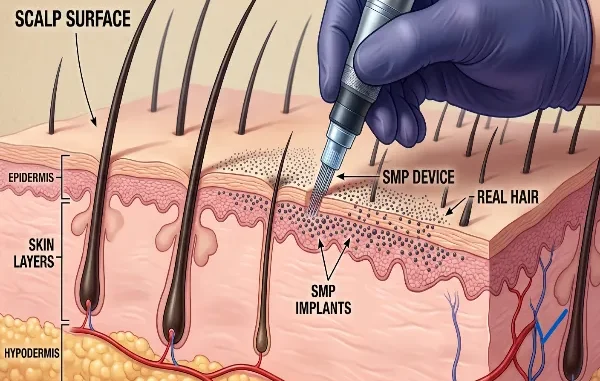
Scalp micropigmentation, commonly known as SMP, is a specialized cosmetic procedure that uses micro-needles to deposit pigment into the upper dermis of the scalp in a pattern that replicates the appearance of hair follicles. When performed correctly, each pigment deposit mimics the natural look of a hair follicle at the scalp level, creating the impression of a full head of closely cropped hair even in areas where no hair is present. The procedure requires multiple sessions, typically two to four, ur spaced several weeks apart, and the final result, when viewed from a normal social distance,e is remarkably convincing. SMP is used for several different applications, including creating the appearance of a shaved head in men with advanced baldness, adding density to thinning hair in both men and women, camouflaging scars from previous hair transplant procedures or injuries, and recreating a hairline in patients who have undergone chemotherapy or suffer from alopecia.
How SMP Compares to Hair Transplant
The most important distinction between scalp micropigmentation and hair transplant is that SMP creates an illusion of hair, while a transplant grows real hair. This distinction has profound practical implications. SMP is non-surgical, involves no recovery period, produces immediate visible results, and is available to patients who are not surgical candidates due to insufficient donor hair or health considerations. A hair transplant produces actual growing hair that can be styled, cut, and treated exactly like native hair, but requires surgery, a recovery period, and sufficient donor hair to be viable. SMP requires periodic touch-up sessions every three to five years as the pigment naturally fades, whereas a hair transplant produces permanent results that never require maintenance. For men committed to the shaved head look, SMP is often the superior choice. Patients researching their options can find verified specialist profiles and clinic listings across trusted platforms like Practo, Lybrate, and Clinicspots to compare providers, read patient reviews, and make a fully informed decision before committing to any procedure. For men who want the ability to grow and style their hair, a transplant remains the only permanent solution.
Who Is an Ideal Candidate for SMP
Scalp micropigmentation is suitable for a broad range of patients across different hair loss patterns and stages. Men with advanced baldness who do not have sufficient donor hair for a transplant benefit enormously from SMP, as it provides a complete aesthetic solution without surgery. Men who have previously undergone hair transplants and want to add the appearance of greater density between transplanted grafts use SMP very effectively as a complementary treatment. Women with diffuse thinning who want to reduce the visibility of the scalp through thinning areas without surgery are increasingly choosing SMP as a natural-looking solution. Patients with scarring alopecia or linear scars from FUT strip harvesting use SMP to camouflage scarring that would otherwise be visible with shorter hairstyles.
Conclusion
Scalp micropigmentation and hair transplant are not competing solutions but rather complementary options that serve different needs and different patients. Neither is universally better than the other — the right choice depends entirely on the individual’s pattern of hair loss, donor hair availability, lifestyle preferences, aesthetic goals, and willingness to undergo surgery. For some patients, SMP alone provides everything they need. For others, a hair transplant delivers results that no pigmentation technique can replicate. And for many, the most satisfying outcome comes from combining both approaches strategically. The starting point for any of these decisions is an honest and thorough consultation with a specialist who understands all available options and can guide you toward the one that genuinely serves your goals.
Frequently Asked Questions
SMP pigment typically begins to fade gradually after three to five years, depending on skin type, sun exposure, and aftercare practices. Touch-up sessions restore the original appearance and are significantly less involved than the initial treatment. Most patients find that proper sun protection significantly extends the longevity of their SMP results.
When performed by a skilled and experienced SMP practitioner using appropriate pigment colors and needle sizes matched to the individual’s skin tone and existing hair color, the results look convincingly natural even at close range. The most important factor in achieving natural-looking results is the skill and artistic judgment of the practitioner performing the procedure.
Yes, and this combination is increasingly popular. SMP can be used to add the appearance of density between transplanted grafts, to camouflage the donor scar from FUT strip harvesting, and to create a more defined hairline that complements the transplanted hair. The two techniques work very effectively together when planned as part of a coordinated treatment approach.
Most patients describe the sensation during SMP as mild to moderate discomfort, similar to a light scratching or stinging sensation. Topical anesthetic creams are applied before the procedure to minimize discomfort. The scalp varies in sensitivity across different areas, and most patients find the procedure entirely tolerable across all sessions.
Yes. SMP pigment can be removed using a laser treatment similar to tattoo removal, though the specialized pigments used in SMP are generally more responsive to laser removal than traditional tattoo inks. Removal typically requires multiple laser sessions. The possibility of removal provides reassurance for patients who are uncertain about committing to a permanent aesthetic change.
Related posts:
 Regaining Control on the Road to Recovery: What You Need to Know
 🦷 Emax vs Zirconia: Which Dental Veneer Is Better for Your Smile?
 Medical Malpractice in Florida: What Every Healthcare Provider Should Understand
 Why Migraine and Motion Sickness Often Travel Together
 How PRP Therapy Is Being Used for TMJ and Jaw Pain in Florida Clinics
Leave a Reply