
If you have ever stood in a shop or scrolled online looking at dehumidifiers, you have probably seen the phrase “pints per day” on the spec sheet.
It sounds technical, but it is actually the simplest way to understand how much moisture a machine can pull from the air in 24 hours.
Getting your head around this number makes choosing the right unit far easier, whether you need something for a damp bedroom or a flooded warehouse.
What pints per day really measures
Pints per day is the manufacturer’s tested capacity under standard conditions. A small home unit might be rated at 10 to 20 pints per day, while a powerful commercial machine can hit 100 pints or more.
The higher the number, the more water it can extract in tough conditions. This rating helps you match the machine to the size of the space and the level of dampness you are dealing with.
Choosing the right capacity for home use
For most households, a 12 to 20 pint model works well for Home Dehumidifiers in living rooms or bedrooms. If you are tackling a damp loft or garage, you will often need something a bit stronger.
Loft Dehumidifiers and Garage Dehumidifiers usually perform best around the 25 to 40 pint mark because those spaces are larger and often cooler. Small dehumidifiers in a single room rarely need to go above 15 pints unless the problem is very severe.
When you need bigger capacity
Larger spaces demand more power. Large Dehumidifiers rated at 50 to 80 pints per day are common for basements, whole-house setups or small commercial areas. For serious jobs like flood recovery, Flood Dehumidifiers with 80 to 150 pints capacity get the space dry much faster. Commercial & Industrial Dehumidifiers often start at 100 pints and go way higher because they have to cope with huge volumes and constant moisture.
Compressor versus desiccant capacity differences
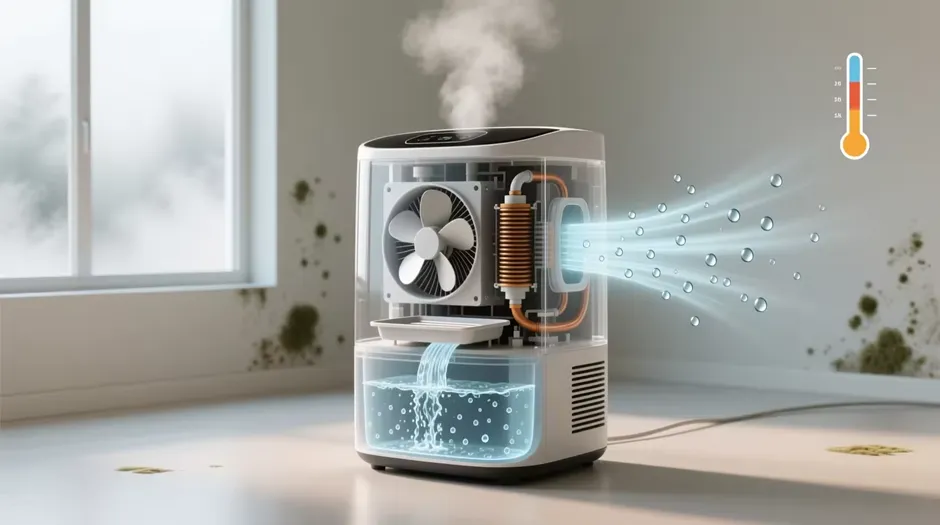
Compressor Dehumidifiers tend to have higher pints-per-day ratings in warm rooms, making them popular for everyday home use. Desiccant Dehumidifiers might show slightly lower numbers on paper, but they keep performing in colder temperatures where compressor models slow down. That is why many people choose based on both the rating and the typical temperature of the space.
How to work out what you actually need
A quick rule of thumb is to measure the room in cubic metres and check the manufacturer’s guidance. A very damp area might need double the capacity of a mildly humid one. Also factor in how long the machine will run. A slightly bigger unit that finishes the job quicker often uses less energy overall than a smaller one running flat out for days.
At the end of the day, pints per day is not just a number on a box. It is the clearest guide to picking a dehumidifier that will actually solve your problem without wasting money or electricity.
Whether you are after Small Dehumidifiers for a flat, Large Dehumidifiers for a business or anything in between, understanding this rating takes the guesswork out of the decision. You end up with the right machine for the job and drier air much sooner than you expected.
Case Study: Matching Dehumidifier Capacity to Space
Client: Homeowner with 60 m² of basement problems plagued with dampness
Issue: Installed small 15 pint unit. The unit ran continuously but humidity stayed above 65%. The basement stayed damp and smelled musty.
Solution:
- Evaluated size of damp area.
- Installed appropriate capacity unit (50 pint) meant for large spaces with heavy moisture.
- Centrally located unit and gave space for air to travel in/out front.
- Left on continuously with a drain hose attached.
- Keep an eye on humidity levels with a hygrometer.
Results:
- Humidity levels went from 65% to 45% in under two days.
- The musty smell is gone after several days.
- Did not have to run as much after reaching desired humidity levels (energy efficient)
- I was able to enjoy the basement space again.
Memorable Lesson:
Buy the correct pints-per-day capacity. If your unit is too small it will run constantly and not perform like you want.
FAQs
Dehumidifiers advertise how many pints of water they can remove from the air every 24 hours.
This will vary depending on how big your room is and how damp it is.
Bigger units have higher pint ratings meaning they are more powerful. However, a unit that is too big will waste energy.
Bedrooms generally require a 10–20 pint dehumidifier.
Basements will most commonly use 40–60 pint units.
Due to the amount of water that needs to evaporate during a flood, you should use a 80+ pint unit or commercial dehumidifier.
Both types are listed by how many pints they can extract in 24 hours. However, desiccant models can outperform compressor models in cold temperatures, despite having a “lower” pint rating.
If your living room is larger than what your dehumidifier is designed for then your unit will run continuously and have no effect on humidity.
Not necessarily. Since a larger unit will get the job done quicker it may use less energy.
Make sure your dehumidifier is the appropriate size for the space. You could have poor ventilation or another unseen issue.





Leave a Reply