
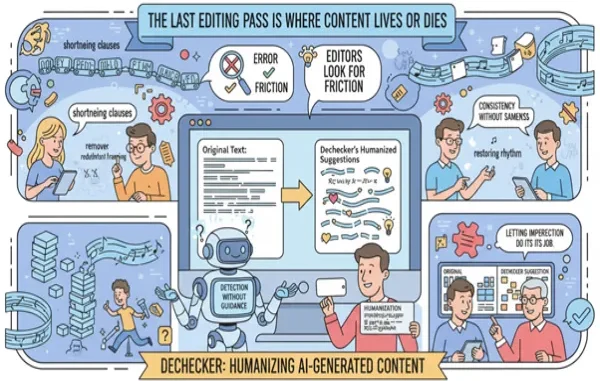
Most content doesn’t fail because it’s wrong. It fails because it feels processed. Editors know this moment well. The facts check out, the structure works, and yet something in the language keeps readers at a distance. Dechecker is designed for that exact stage, where detection alone is not enough and humanization becomes the real work.
The Last Editing Pass Is Where Content Lives or Dies
Editors don’t look for errors, they look for friction
In mature editorial workflows, early drafts are allowed to be rough. The pressure appears near the end. Editors read not to fix grammar, but to sense where the text slows down, over-explains, or sounds like it’s trying too hard to be neutral.
Running a near-final draft through an AI Checker often confirms those instincts. The sentences flagged are rarely shocking. They are the ones editors already hesitated over. Dechecker doesn’t introduce new concerns. It sharpens existing ones.
Detection without guidance creates extra work
Many AI detection tools stop at labeling. They tell editors what might be AI-generated and leave the rest unresolved. That creates a second problem. Editors now know where the issue is, but not how to fix it efficiently. This is where Dechecker’s humanization suggestions change the workflow.
Where Humanization Actually Matters
Mechanical clarity versus human rhythm
AI-generated sentences often prioritize clarity over cadence. They explain relationships explicitly, restate context, or balance claims in ways that sound polite but unnatural. Dechecker’s suggestions focus on restoring rhythm. Shortening clauses. Removing redundant framing. Allowing implied meaning to stand.
Editors don’t need philosophical advice about “sounding human.” They need concrete alternatives. Dechecker offers rewrites that preserve meaning while adjusting tone, density, and flow.
Editing isn’t rewriting from scratch
In real editorial environments, time is limited. Dechecker’s sentence-level approach respects that. Editors can accept, modify, or ignore suggestions selectively. The goal isn’t to replace the editor’s voice, but to speed up decisions about what to keep.
Originality Is Often a Byproduct of Restraint
Over-polished language hides authorship
One paradox editors notice quickly is that highly polished AI-assisted text often feels less original. The language is smooth, but interchangeable. Dechecker’s humanization suggestions often involve subtraction rather than embellishment. Removing generic qualifiers. Dropping phrases that signal explanation instead of judgment.
As these edits accumulate, authorship becomes clearer. The text stops sounding like it could belong anywhere and starts sounding like it came from someone specific.
Letting imperfection do its job
Human writing is uneven. Some sentences are blunt. Others trail off. AI tends to average those differences out. Dechecker’s suggested rewrites frequently reintroduce asymmetry. That unevenness signals intent. Editors learn to trust it again.
Editorial Teams Working at Scale
Consistency without sameness
Large editorial teams struggle with a different problem. Maintaining quality without flattening the voice. AI accelerates output, but also amplifies sameness. Dechecker helps teams identify which sentences feel templated across multiple pieces.
Editors can then adjust guidelines based on observed patterns. The AI Checker becomes a feedback loop, not just a gatekeeper.
Training junior editors through examples
For newer editors, knowing why a sentence feels off is hard to articulate. Dechecker’s side-by-side suggestions make those judgments visible. Over time, editors internalize these patterns and rely less on detection.
Multi-Language Editing and Humanization
Translation preserves meaning, not tone
When content is translated or adapted across languages, AI often preserves structure too faithfully. The result is technically correct but socially awkward language. Dechecker’s multi-language detection helps editors identify sentences that feel translated rather than written.
Humanization suggestions guide local editors toward more natural phrasing without losing intent. This matters especially in content meant to persuade or guide, not just inform.
Respecting cultural reading habits
Different languages tolerate different levels of explicitness. Dechecker doesn’t impose a single standard. It highlights where AI defaults conflict with local norms. Editors remain in control of the final voice.
From Spoken Drafts to Polished Articles
Many drafts start as a conversation
Editorial teams increasingly rely on spoken ideation. Writers record thoughts, meetings are transcribed, and drafts are assembled from those materials using an audio to text converter. These early versions often carry natural pacing that resonates with readers.
Heavy AI rewriting can flatten that voice. Dechecker helps editors identify where conversational phrasing was replaced by generic prose. Humanization suggestions often move the text closer to its spoken origins.
Preserving momentum in revision
Editors know when a piece loses momentum. It usually happens during excessive polishing. Dechecker’s targeted suggestions allow editors to intervene precisely, without reopening the entire draft.
How Editors Change After Repeated Use
After extended use, editorial teams stop having abstract debates about whether something “sounds right.” That vague discomfort gradually turns into something concrete. Detection paired with humanization gives editors language for instincts they previously struggled to explain. Instead of circling tone issues endlessly, they point to specific sentences and describe exactly what feels mechanical, evasive, or over-processed.
This clarity changes how drafts are written upstream. Writers begin anticipating which lines will need revision before an editor ever flags them. Explanatory buffers shrink. Sentences carry more intent earlier. The editing process becomes less about rescuing tone at the end and more about reinforcing judgment throughout. Over time, the AI Checker fades into the background. Not because it’s less useful, but because its influence has already reshaped how teams write and revise.
What Dechecker’s Suggestions Are Not
They are not stylistic prescriptions
Dechecker does not impose a brand voice or aesthetic preference. Its suggestions do not aim to make content sound casual, emotional, or polished by default. They focus on removing friction that interferes with readability and intent. Editors retain full control over style, tone, and personality. The tool supports decisions rather than replacing them.
They are not optimization tricks
Humanization suggestions are not designed to “beat” detection systems or manipulate perception. Overcorrecting language to appear quirky or irregular often creates new problems. Dechecker’s recommendations favor moderation. They help editors avoid mechanical phrasing without introducing artificial distortion.
They do not override editorial judgment
There are moments when awkwardness is appropriate. Uncertainty, complexity, or tension sometimes deserve to remain visible in the text. Dechecker supports those choices by making them conscious. Editors can keep a sentence precisely because they understand why it stands out, not because they missed it.
Where Dechecker Fits in the Editorial Stack
As a collaborator, not a judge
Editors who use Dechecker effectively don’t treat it as an authority. They treat it as a second reader. One that flags mechanical tendencies and offers alternatives without insisting.
Supporting originality under pressure
Deadlines compress creativity. Dechecker helps protect originality when speed would otherwise erase it. The AI Checker doesn’t slow teams down. It prevents subtle degradation.
Humanization is not about adding emotion or flair. It’s about restoring judgment, rhythm, and restraint. Dechecker operates at that level. Not teaching editors how to write, but helping them notice when writing stopped sounding like it came from a person at all.
Related posts:
 AI Photo Generators Elevate Your Editing Without Quality Loss
 Avatar vs. Human: Who’s Better at Explaining Your Product in 30 Seconds?
 Can Treasury Management Software Make Borrowing Safer and Smarter?
 Water Damage Restoration Service Lanham: Fast & Efficient
 Voyage Through Time: When will Time Travel be Possible
Leave a Reply