
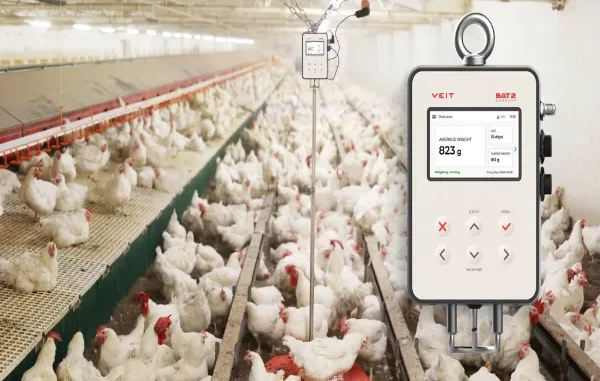
If you raise broilers — whether on a commercial scale or in a backyard setup — one question keeps coming up: are my birds growing fast enough? The answer is in the numbers. A reliable broiler weight chart by age gives you weekly benchmarks to compare your flock against. And catching a deviation early can mean the difference between a profitable batch and a costly one.
This guide covers standard weekly weight norms for Ross 308 and Cobb 500 strains (the two dominant commercial breeds worldwide), explains what drives or suppresses growth rate, and shows how to measure your birds accurately enough to actually trust the data.
Why Weekly Weight Benchmarks Actually Matter
Most producers focus on the finish line: slaughter weight. That’s a mistake. By the time you spot a problem at week 6, you’ve already lost two or three weeks of corrective time.
Tracking broiler chicken weight week by week tells you where a problem started — nutritional, environmental, disease-related, or simply a batch of poor-quality chicks. Each issue has a completely different solution. You can’t find the right fix without knowing where things first went off track.
Broiler Weight Chart by Age (Week 1–7)
The table below shows average live body weight for Ross 308 broilers under standard commercial conditions. Expect ±5–8% variation depending on genetics, housing, and flock management.
Age / Avg Live Weight (g) / Daily Gain (g/day) / Cumulative Feed (g) / Target FCR
Day 1 (hatch) / 42 g / — / — / —
Week 1 (day 7) / 180 g / 20 / 160 / 0.90
Week 2 (day 14) / 465 g / 41 / 490 / 1.15
Week 3 (day 21) / 900 g / 62 / 1,100 / 1.38
Week 4 (day 28) / 1,520 g / 89 / 2,200 / 1.63
Week 5 (day 35) / 2,200 g / 97 / 3,700 / 1.78
Week 6 (day 42) / 2,900 g / 100 / 5,500 / 1.93
Week 7 (day 49) / 3,550 g / 93 / 7,400 / 2.10
A bird at week 3 should land close to 900 g. If your flock is averaging 650–700 g at that point, something is wrong — and it won’t fix itself going forward.
The Three Growth Phases You Need to Understand
Broiler development isn’t linear. Three phases drive total performance, and each responds to different management inputs.
Starter Phase (Days 1–10)
Gut development and immune programming happen here. Chick body weight at day 7 is one of the strongest predictors of final slaughter weight in the scientific literature. A weak starter performance almost never fully recovers — compensatory growth helps, but rarely closes the gap completely.
Grower Phase (Days 11–28)
Rapid muscle accretion. Skeletal and breast muscle growth peaks during this window. The broiler growth rate chart shows the steepest daily gain curve here — average daily gain climbs from roughly 40 g/day at day 14 to nearly 90 g/day by day 28.
Finisher Phase (Days 29–Slaughter)
Efficiency drops, fat deposition increases. The average weight of a broiler chicken at slaughter in commercial operations typically falls between 2.4 kg and 3.2 kg live weight, depending on target market specification and strain. Extending the grow-out past day 49 usually hurts FCR more than it adds value.
Feed Conversion Ratio: The Hidden Performance Metric
Live weight tells you what your birds weigh. Feed conversion ratio (FCR) tells you how efficiently they got there. For broilers, FCR = total feed consumed (kg) ÷ live weight gained (kg). Lower is better.
A broiler feed conversion ratio above 2.0 at week 6 is a warning signal — not necessarily a disaster, but worth investigating. The most common culprits: feeder height set incorrectly, crude protein levels in the grower feed below spec, or water line pressure issues limiting intake. Fix water first. Always.
What Drives (and Kills) Weekly Weight Gain
Genetics are fixed before the chick hatches. Everything else is in your hands.
- Temperature. Cold brooding destroys the first week. A single day at 28°C instead of 33°C on day 3 can cost 20–30 g by day 7 — and that gap follows the bird all the way to slaughter.
- Water intake. Feed intake follows water intake. Always. If birds aren’t drinking, they’re not eating. Check drinker pressure and nipple flow rates before you blame the poultry feed.
- Amino acid balance. Methionine and lysine are the first-limiting amino acids in broiler diets. A chicken feed with correct crude protein but wrong amino acid profile will still underperform. Don’t just read the protein percentage — check the amino acid declaration.
- Stocking density. Overcrowding stresses birds, increases competition for feed and water, and pulls down the average weekly weight gain across the whole flock. Standard commercial density runs around 30–38 kg/m² at slaughter.
- Lighting program. Continuous low-intensity light (5–10 lux) increases feeding time and improves early growth rate. Completely dark periods exceeding 6 hours slow starter phase performance meaningfully.
Did You Know? In 1957, it took a broiler around 84 days to reach 1.8 kg. Today, commercial strains hit the same weight in roughly 28 days — and reach 2.5 kg by day 38. This change is almost entirely the result of selective breeding and nutrition optimization. Hormone use in poultry production is banned in most countries, including the US, EU, and UK. The modern broiler is simply a very different animal than its ancestor.
How to Weigh Broilers Accurately
A broiler weight chart is only as useful as the data going into it. Inaccurate weighing leads to wrong conclusions — and wrong decisions.
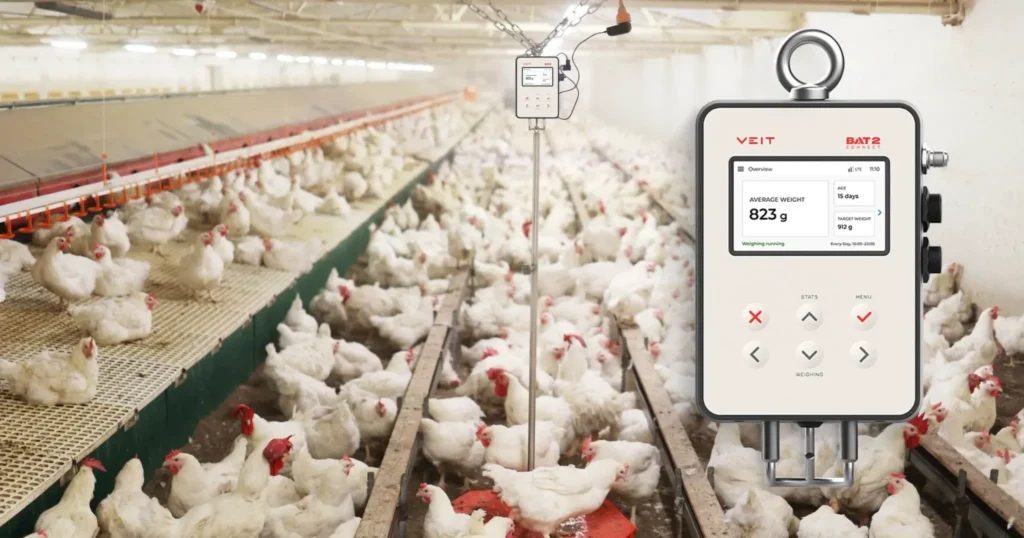
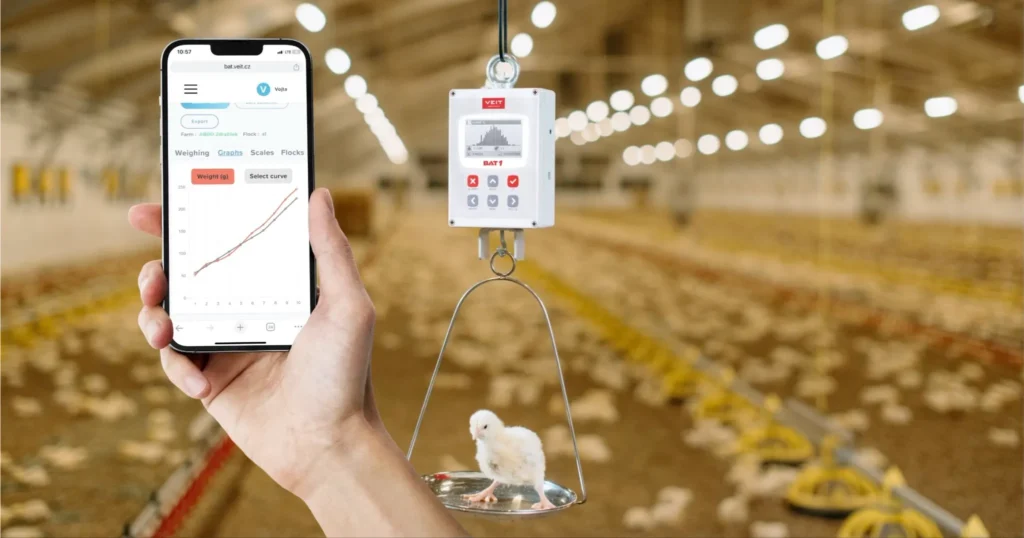
The gold standard for commercial operations is a dedicated poultry scale — either a hanging crate scale or a platform-style automatic scale integrated into a data management system. Manual sampling requires a minimum of 100 birds per house for statistical validity, weighed at the same time each day (typically early morning, before peak feeding activity).
Key weighing rules:
- Weigh before the first feeding of the day to avoid inflated crop weight in the recorded figure
- Use at least 3–5 different sampling locations spread across the house — center, corners, and near feeders/drinkers
- Calculate coefficient of variation (CV) alongside average weight — high CV signals uneven distribution, not just low average weight
A CV above 12% at week 4 usually points to litter, ventilation, or feeder/drinker distribution problems. High CV with acceptable average weight is still a flock management issue — it means a portion of your birds are significantly underperforming.
Feed Conversion Ratio by Week: Target Ranges
Age (weeks) / Target FCR Range / Performance Notes
Week 1 / 0.85–0.95 / Best FCR of the grow-out; very efficient early growth
Week 2 / 1.10–1.20 / Efficiency drops as structural growth demands increase
Week 3 / 1.30–1.45 / Switch to grower feed phase; monitor for respiratory issues
Week 4 / 1.55–1.70 / Breast muscle development peaks; high protein demand
Week 5 / 1.70–1.85 / Watch stocking density; heat stress risk rising
Week 6 / 1.85–2.00 / FCR >2.0 here is a performance warning
Week 7 / 2.00–2.20 / Extended grow-outs rarely justified economically
Frequently Asked Questions
Under standard commercial conditions with Ross 308 or Cobb 500 genetics, average live weight at 42 days is approximately 2.8–2.9 kg. Slower-growing strains or suboptimal management typically produce 2.3–2.5 kg at the same age.
The average weight of a broiler chicken at slaughter varies by market target. Whole-bird retail programs in the US typically target 2.4–3.0 kg live weight. Deboning and parts operations often target 3.2–3.8 kg, requiring a longer grow-out.
A solid overall feed conversion ratio for broilers across a full grow-out (day 1 to slaughter at day 38–42) falls between 1.70 and 1.90. Elite commercial performances regularly achieve FCR below 1.65 with optimized nutrition and health programs.
The most common reasons: cold stress in the first week, poor water access, low crude protein or energy density in the starter feed, high pathogen pressure (respiratory or enteric disease), or overcrowding. The key is to identify which week your flock first dropped below the standard weight chart — that’s where to begin the investigation, not at the end of the grow-out.
In commercial operations, weekly weighing is the minimum standard. High-performing farms weigh twice per week during the critical starter and early grower phases (days 1–21) to catch deviations before they compound. Use calibrated poultry scales and consistent sampling methodology for results you can actually compare week over week.
Consistent, accurate weighing is the foundation of broiler performance management. Without reliable weight data, everything else — feed programs, health interventions, stocking decisions — is guesswork. If you’re serious about hitting the numbers in the broiler weight chart, start with the tool that makes the data trustworthy.
Explore dedicated poultry weighing scales for broiler operations at poultryscales.com.
Photo source: Poultryscales.com





Leave a Reply