

Quick Answer: Press release distribution could help establish the authority of the brand, as it disseminates relevant and accurate news about the company to journalists, customers, partners, and industry players. Even a cheap crypto press release can support that trust when the news is real and verifiable. Trust is built when announcements have actual evidence, align with the company’s activities, and promote a clear brand message in the long run. But posting often does not necessarily entail a sense of credibility; the nature and validity of the news are the most important.
Introduction
It is not possible to build trust in a single announcement. It is cultivated when individuals are subjected many times to a firm that talks straight, fulfills its commitments, and has dependable information. The release of crypto press releases can assist businesses on blockchains to update on their projects and clarify what is happening. Whereas other companies may employ press releases to inform about business launches, collaborations, achievements, research, and more.
Publishing many announcements is not, however, similar to brand authority. Once all the releases are sweeping and untested claims, the watchers may begin questioning the credentials of the firm. Traditional communications are best achieved when all the announcements are real updates and remind people what the brand can do and demonstrate.
This is a guide outlining how press release distribution can assist in building brand authority, developing a consistent news strategy, and the less obvious actions that can help safeguard trust in the long term.
Key Takeaways
- Regular press releases help the audience understand what a company is, what it represents, and how it evolves.
- Messages of promotion which are supported by evidence are more credible than a repetitive series of promotions.
- The PR plan has a close relationship between media coverage and the company updates, expert input and customer correspondence.
- Measures trust-building through proper coverage, accuracy of messages, response of the audienc,e and business impact.
What Is Brand Authority in Press Release Distribution?
The term brand authority is used to refer to the reputation that a business acquires when its audiences are aware that the business is informed, trustworthy in the information presented and can be proven by evidence. Press releases can contribute to creating that reputation through sharing important developments and providing information about the company to those for whom it is pertinent. A press release company can help structure and distribute these updates, but the evidence behind the news still has to come from the business itself.
As an example, the software company, which regularly publishes verified product updates, talks about technical advancement, and publishes customer results, may be taken into consideration, which can give the reader a more profound understanding of the company experience. A firm that keeps on claiming that it is a market leader but fails to prove this by example conveys a lot less.
How Consistent News Builds Brand Trust
Stability helps viewers map personal announcements onto a company story that they know. As a business reports its progress to the people in a transparent manner over time, people can get a better understanding of its priorities, capabilities, and direction.
It creates a recognizable brand message.
An organization ought to convey the same image in its press releases, website, executive, and media interviews. One can make changes to the wording to suit different groups, although the general facts and values should remain the same.
Similarly, when a company sells itself as being surrounded by product reliability, then its message should demonstrate evidence of how it has tested the products, improved service or customer care, as opposed to making general statements and claims about quality.
It shows progress instead of repeating promises.
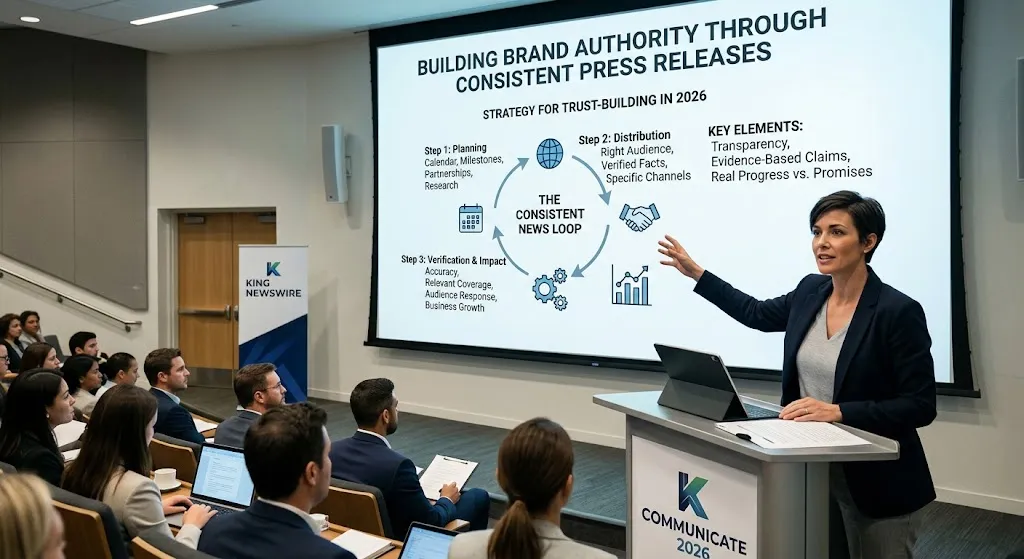
The real development of the company is followed by a powerful PR calendar. One announcement can be about launching a product, another can be about a significant enhancement, and a subsequent announcement can tell about an established milestone.
This forms a significant flow of updates. Users are able to observe what has happened, what was learned by the company and what it has provided following a prior announcement.
It makes the company easier to understand
Relevant and frequent news makes people learn about the products, expertise, partners and the activities of a company in the market. It also enables journalists to have a better understanding of the business whenever there is a related story.
Which Types of Press Releases Strengthen Brand Authority?

The various announcements provide credibility in different ways. The most suitable is one that can be demonstrated by the company and must be familiar to its audience.
- Product launches: Why does the product do what it does, who is it serving, and how does it fulfill a real need?
- Research and industry intelligence: Publicize original discoveries, describe how, and give the data that supports significant inferences.
- Partnership announcements: Determine who the partners are, and what the partnership is all about.
- Milestones of business: Recount verifiably witnessed accomplishments, such as an effective business expansion, a new product, or a product description of an operational accomplishment.
- The leadership and commentary: Can be by commentators of the first quality: Add value by commenting on something with relevant experience.
- Customer success updates: Updated approved case studies, where the outcomes are clear, timeframes and how the outcomes were measured.
Internal updates cannot be viewed as a grand public announcement by an organization. Select news that makes a difference to customers, journalists, partners, or industry generally.
How to Build a Consistent Press Release Strategy
A plan should have a set date to start publishing, not a random one. Businesses should then determine which of the news they can literally communicate and tie it to their overall strategies.
Create a news calendar around real milestones.
Plan product launches, research launches, expansion planning, big partnerships, events and other actual developments. Allow a little room to take a surprise, but it is not necessary to announce in order tomeetn a monthly target.
Find the right audience for each announcement.
Technical news can be considered topical to a specialist publication; a local business press can be interested in a regional expansion. Select distribution channels based on the news, geography and audience, not the number of placements alone.
Be consistent in its facts.
Before releasing, standardize the press release with the company’s online presence, product pages, executive statements and other information available to the public. Partnership of name, date, figures, availability of the products and description of the partnerships.
Check what the listeners react to.
Monitor what issues attract useful media attention, referrals, enquiries or valuable interaction. Apply such findings to the next announcement without making assumptions that a successful release will be successful next time.
The Trust-Evidence Framework: A Step Competitors May Underemphasize
There are numerous PR books that inform us on how to release news regularly. A further measure is to determine whether each announcement provides the reader with sufficient evidence to credence its statements.
Before releasing an issue, consider it by asking four questions:
- What is the claim? Determine the key message that the audience should get.
- What supports it? Locate the information, documentation, first-hand evidence, or identified source of the assertion.
- What would you say is lacking in context? Explain applicable time frame, limitations, comparison, or conditions.
- Would the company be able to defend it in the future? Ensure that the statement will hold and could be elaborated in case journalists or customers pose follow-up questions.
For example, when a company claims to have increased its customer base by a significant figure, it ought to establish the time frame and what constitutes a customer. A proposed collaboration is not a signed agreement, which should be announced by a business speaking about a partnership.
The framework renders trust a realistic aspect of the editorial process rather than believing that it is a universal branding objective.
The way a Press Release Example Can show credibility.
A useful press release example should show how a company communicates evidence, context, and a clear message without exaggerating its achievements.
Take a scenario of a fictional software company with the announcement of a new reporting feature. A feebly announced announcement could say that the feature is transforming business intelligence and that it produces unparalleled results. Such statements give little information that can be confirmed by a journalist or customer.
A better announcement would tell about what the feature does, whom it is available to, when it is available, and what issues it is meant to address. In case the company has done tests, it would be able to explain the procedure and the outcome. When there is no data on the performance, it must not make the assumption that there are already known results.
How to Protect Brand Trust When Negative News Appears
The number of placements may indicate how a campaign has spread out, but it is not able to quantify comprehensively whether a brand has gained increased trust. An improved strategy would be a combination of media outcomes and proof of audience interpretation and reaction.
Track these indicators:
- Relevant media coverage: Find out what credible, industry-relevant media cover the news.
- Accuracy of the messaging: Determine whether coverage is a proper announcement about the company.
- Brand mentions: Track what the company is being talked about in the appropriate media and discussions in the industry.
- Referral traffic: Count traffic caused by press releases and media coverage.
- Viewer involvement: Evaluate significant engagement, requests, and visits to product pages.
- Business outcomes: Monitor qualified leads, registrations, or other measures where appropriate measures can be made.
- Trust indicators: Customer feedback (use and reuse), surveys (with careful design to understand shifts in perception of the audience).
Independent editorial coverage, in separate syndicated copies of a release. Both can help visibility and are not interchangeable evidence of independent media interest.
Compare the results over time and consider other variables, including advertising, product modification, and market expansion. This simplifies the process of knowing whether the PR strategy is adding to the enhancement of stronger relationships or merely creating more publications.
How King Newswire Supports Consistent Brand Communication

King Newswire can provide press release writing, publishing, distributing and reporting services to assist businesses in announcing. These services are part of a broader scheme of product news, milestones, partnerships, and various other pertinent developments that can be shared by companies.
Before selecting one of the distribution packages, it is advisable to consider the existing King Newswire packages and ensure the packages’ outlets, services, and reporting in the selected package meet your needs.
To achieve the most effective outcomes, one must develop the announcements based on authentic company events, verify facts prior to release, and measure the outcomes against definite communication objectives. Distribution may be useful in making the news reach a broader audience, but it will not assure independent media coverage, customer confidence, search ranking, and business development.
Conclusion
The distribution of press releases can strengthen brand authority if a company shares important news regularly, evidences its statements, and communicates effectively through the channels. It is not sufficient to publish more often and announce the same promotional messages without demonstrating actual progress.
Create a realistic news calendar, verify all the assertions, select distribution channels that would suit the audience and work out a straightforward course of action in such embarrassing scenarios. Monitor pertinent coverage and audience results as opposed to counting placements.
The best way to guarantee trust is consistency, transparency, and verifiable placement in 2026. Once every announcement adds some value to the overall narrative of the company, the distribution of press releases can become a sustainable element of an authentic brand communication process.
Author Expertise
Authored by: King Newswire Editorial Strategy Desk| PR Distribution and Media Intelligence Team.
The editorial team deals with press release strategy, media distribution and digital PR, focusing more on how to enable businesses to communicate key updates effectively and create better relationships with their audiences.
Related posts:
 What Is a Road Trading Strategy? A Trend Method for FX Beginners
 Refinancing Your Home Loan After RBI Rate Cuts: A Smart Way to Save
 Building a Scalable Business Through Accelerator Mentorship and Capital
 How Charter Bus Rentals In Brooklyn Improve The Group Travel Experience
 Industrial Asbestos Removal: What Facility Owners Need to Know Before Work Begins
Leave a Reply