
Peptides are small, but producing them is a demanding process. These short chains of amino acids come up in discussions about research, skincare, wellness, fitness, and pharmaceutical development, which gives them an advanced reputation. Behind every single peptide, though, is a manufacturing process that is highly regulated and far from simple.
Making peptides is not a matter of combining ingredients and hoping the result works out. It requires assembling a precise sequence of steps, where every single component must be added in the exact correct order.
One incorrect step, one impurity, or one lapse in quality control can alter the final product. That is why understanding how peptides are made matters just as much as understanding what they are, and why you should always consult the best peptide tracker and calculator when using them.
What Are Peptides?
Peptides are short chains of amino acids, the same basic building blocks that make up proteins. The difference is usually size: peptides are smaller, while proteins are longer and more complex.
The order of those amino acids is extremely important. A peptide’s sequence helps determine its structure, behavior, and intended function. Swap one ingredient, skip a step, or scramble the order, and you may no longer have the peptide you thought you had.
Step One: Designing the Peptide Sequence
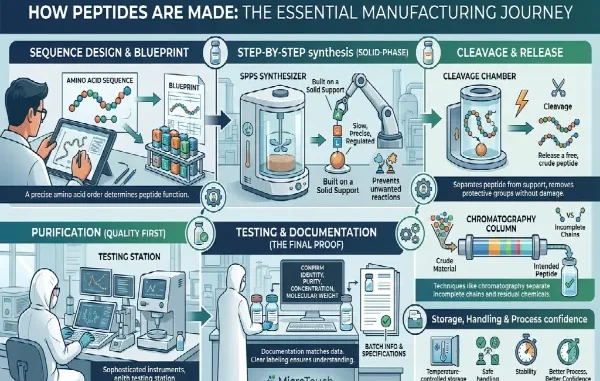
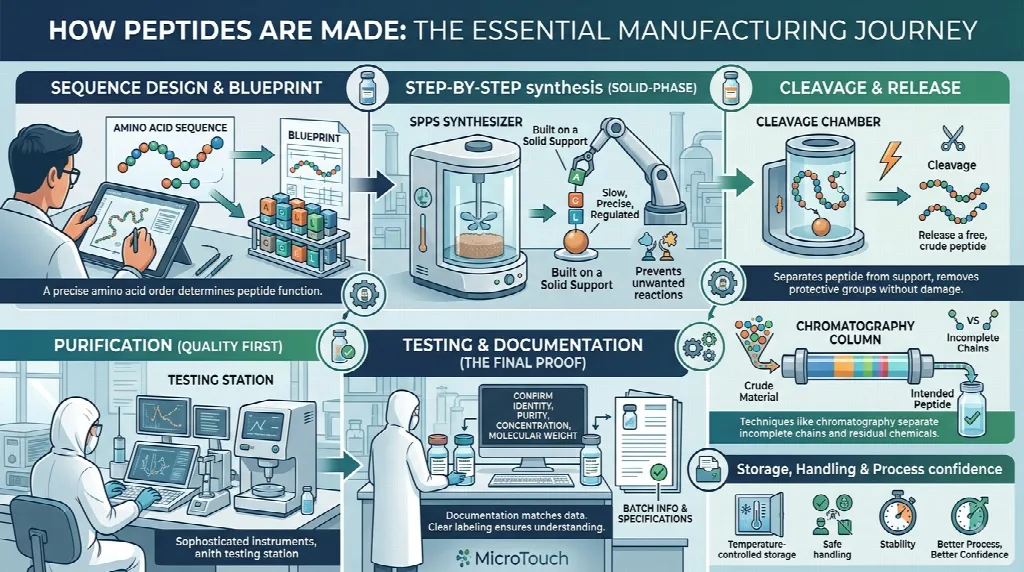
The first real step is deciding exactly which amino acids belong in the peptide and in what order. This sequence is the blueprint. If the blueprint is wrong, the finished product will be wrong, too.
Peptide design may be based on existing research, a desired biological target, or a specific experimental goal. Whatever the purpose, the sequence has to be clearly defined before synthesis begins. Manufacturing can only be as accurate as the instructions it receives.
Step Two: Building the Peptide One Amino Acid at a Time
Most peptides are made using a method called solid-phase peptide synthesis. In simple terms, the peptide is built on a solid support, and amino acids are added one at a time in a carefully controlled order.
Each amino acid must attach correctly before the next one is added. Protective chemical groups are often used to prevent unwanted reactions. It is slow, precise, and regulated.
Step Three: Cleaving and Releasing the Peptide
Once the amino acid chain has been assembled, the peptide has to be removed from the solid support. This step is called cleavage, a fitting name given its significance to the process.
During cleavage, the finished peptide is separated from the resin used during synthesis. Any protective groups are also removed. The goal is to release the peptide without damaging or contaminating it, and without undoing all the careful work from the previous steps.
Step Four: Purification, Because Close Enough Is Not Good Enough
After synthesis and cleavage, the peptide is not automatically ready for use. The crude material may contain incomplete chains, residual chemicals, or byproducts from the manufacturing process.
Purification helps separate the intended peptide from everything else. Techniques such as chromatography are often used to isolate the desired material and improve purity. This step matters because even small impurities can affect consistency, reliability, and the confidence with which the peptide can be studied or used.
Step Five: Testing the Final Product
Once purified, the peptide needs to prove it is what the label says it is. Quality testing may confirm identity, purity, concentration, molecular weight, and overall composition. Manufacturers may also check for unwanted contaminants, depending on the intended application.
This is where documentation becomes just as important as the science. A peptide should include clear test records, batch information, and specifications. Without testing, you are mostly relying on trust, and trust is not a good substitute for data.
Storage, Handling, and Documentation Also Count
The work does not stop once the peptide is made. Many peptides are sensitive to heat, moisture, light, or repeated handling. Poor storage can affect stability, even if the peptide was manufactured well in the first place.
Clear labeling and documentation are part of responsible handling, too. Batch numbers, storage instructions, concentration details, and expiration or stability information help users understand what they have and how to manage it.
Better Process, Better Confidence
Peptides may be tiny, but making them well requires a disciplined process. From sequence design to synthesis, purification, testing, storage, and documentation, every step plays a role in the final product.
That is why manufacturing matters. A peptide is only as trustworthy as the process behind it. When you understand how peptides are made, it becomes easier to look beyond flashy labels and focus on what really counts: precision, consistency, transparency, and quality.





Leave a Reply