
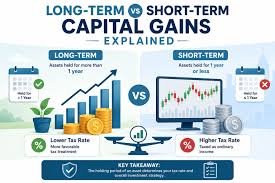
Investment returns are often discussed before tax. A fund gave 14 percent. A stock doubled. A property appreciated. Gold moved steadily. These statements are useful, but they are incomplete until the tax treatment is understood. Long term capital gain tax comes into the picture when an asset is sold after it has been held for the period required to qualify as long-term. Until there is a sale or transfer, the gain is only visible on paper.
This distinction matters. A portfolio can look good on an app, but tax affects the money that finally reaches your bank account after redemption. The effect may be small in some cases and meaningful in others. It depends on asset type, holding period, exemption limit, purchase cost, sale value, and the tax rules applicable in that year.
Capital gains tax begins with two questions
1. What asset did you sell?
2. How long did you hold it before selling?
These two questions decide whether the gain is treated as short-term or long-term. Short term capital gains tax may apply when the asset is sold before completing the specified holding period. Long term capital gain tax may apply when the asset crosses that period. The holding period is not the same for all assets, so equity shares, equity mutual funds, property, gold, and debt funds cannot be lazily grouped together.
Where LTCG can affect actual returns
| Situation | How tax enters the return picture | What to check |
| Redeeming equity mutual funds after long holding | LTCG may apply above the available exemption threshold | Total gains in the financial year |
| Selling listed shares | Tax applies based on holding period and applicable equity rules | Purchase price, sale price, and exempt limit |
| Selling property | LTCG may apply if the property qualifies as long-term | Date of purchase, transfer date, and available options |
| Rebalancing portfolio | Selling winners can create taxable gains | Whether rebalancing can be phased |
| Switching investments | Exit from one asset may be treated as a sale | Tax effect before moving money |
Paper gains and realised gains are different things
A mutual fund investment may show a gain of Rs. 3 lakh. No tax is paid merely because the value has increased. Tax is considered when units are redeemed or switched in a way that qualifies as transfer. This is why long-term investors sometimes plan redemptions across years. They are not avoiding the goal; they are trying to make the exit more tax-aware.
There is a certain discipline in this. If money is needed for a child’s education fee, house purchase, or retirement income, tax should be estimated before redemption. The redemption amount you require and the redemption amount you place may not be the same after tax is considered.
Short-term gains can change the rhythm of investing
Short term capital gains tax is the reason frequent buying and selling needs more care. If an investment is sold too early, the tax treatment may be different from what would have applied after a longer holding period. This does not mean every short-term sale is unsuitable. Sometimes money is needed, or an asset allocation decision must be made. But the tax result should be known before acting.
- Check the holding period before redeeming.
- Estimate the gain, not only the sale value.
- See whether any exemption threshold or special rate applies.
- Look at all gains in the financial year, because they may combine for tax purposes.
- Keep purchase statements and transaction records safely.
Tax can influence, but should not dominate, the decision
A slightly mechanical investor may hold an unsuitable asset only because selling will create tax. That is also not ideal. Tax is one part of return planning. Risk suitability, goal timing, liquidity, and portfolio balance also matter. If an asset has served its purpose, or if money is required for a planned goal, tax should be calculated and provided for. It should not freeze the entire decision.
In a long-term financial plan, life insurance savings products, retirement plans, mutual funds, deposits, and other assets may play different roles. Some create protection. Some provide income. Some create growth. Capital gains tax mainly affects assets where gains are realised through sale or transfer. Understanding this helps you avoid comparing products only by headline returns.
Property gains need special attention
Property transactions involve dates, cost records, improvement expenses, stamp duty values, and reinvestment possibilities. A property may have been held for many years, but the taxable gain still needs proper working. For certain cases, tax rules may allow specific options or exemptions subject to conditions. This is one area where a casual estimate can be quite different from the final tax calculation.
How to make investment exits more tax-aware
1. Mark the purchase date and expected long-term qualification date.
2. Estimate tax before placing a redemption or sale request.
3. Use an income tax calculator or capital gains calculator for a first view.
4. Check whether redemptions can be spread across financial years where suitable.
5. Keep all contract notes, account statements, and cost records ready for filing.
Final view
Long term capital gain tax affects investment returns when a gain is actually realised through sale, redemption, switch, or transfer. Its impact depends on the asset, holding period, exemption limits, and current tax rules. A good investor does not panic about tax, and does not ignore it either. The more mature habit is to calculate post-tax returns before exiting, and then make the decision in line with the original goal.



Leave a Reply