
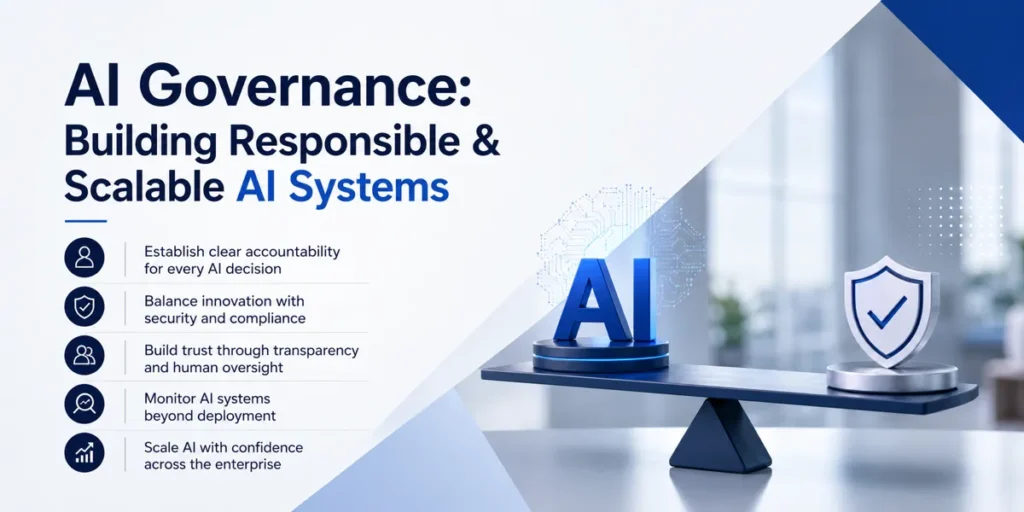
You’ve probably witnessed a particular kind of silence, the one that falls over a room when someone finally asks, “Who signed off on this model going into production?” There’s a pause. A few glances exchanged. Then the slow realization that the honest answer is “sort of everyone, and also no one.” It’s an uncomfortable moment. It’s also a useful one, because it’s usually the point where you stop treating governance as paperwork to file after the fact and start taking it seriously.
Governance has a reputation for being the unglamorous half of AI work slower, less exciting, easy to defer while you focus on model performance instead. But if you look at the organizations that actually scale AI successfully, you’ll notice they stopped treating governance as a constraint on innovation and started treating it as the thing that makes scaling possible in the first place. Systems without guardrails don’t scale. They eventually get pulled back, quietly, after something goes wrong.
Why You Postpone Governance And Why That Backfires
It’s an understandable instinct. Early in an AI initiative, your priority is proving the concept works at all. Governance conversations feel premature when you’re not even sure the model will perform well enough to matter. The trouble is that governance structures are much harder to retrofit than to build in from the start.
The Retrofit Problem
Once a system is embedded in daily operations, adding oversight after the fact means untangling decisions you never documented, explaining behavior nobody can fully reconstruct, and often rebuilding parts of the pipeline just to make it auditable. If you’ve been through this, you already know it’s considerably more painful than building governance from day one, even though that felt like the slower path at the time.
Governance Isn’t Just Compliance
It’s worth separating two things you might be conflating: regulatory compliance and operational governance. Compliance asks whether you’re meeting external legal or industry requirements. Governance is broader; it’s your internal discipline of knowing what your systems are doing, why, and what happens when they get it wrong. You can be fully compliant and still have no real governance, which is a more precarious position than it sounds.
What Responsible AI Actually Looks Like in Practice
You’ve probably noticed “responsible AI” gets used as a broad, almost decorative phrase in a lot of corporate messaging. Strip it down to something concrete, and it tends to rest on a handful of practical pillars.
Explainability, Not Just Accuracy
A model that performs well but can’t explain its reasoning creates a specific kind of risk for you: nobody can defend a decision when it’s challenged. This matters more in some contexts than others; a recommendation engine suggesting products carries a very different risk profile than a model influencing credit decisions or hiring but the principle holds broadly. If a decision affects a person’s outcome, someone on your team needs to be able to explain, in plain language, why the system reached that conclusion.
Human Oversight at the Right Points
Full automation sounds efficient until the first edge case slips through unnoticed. Effective governance means identifying which decisions genuinely need a human in the loop and which don’t, rather than defaulting to either extreme. Lean too heavily on human review and you slow everything down, defeating the purpose. Lean too little and you remove the safety net exactly when you need it most.
- Map your decisions by consequence severity, not just by technical complexity
- Reserve mandatory human review for high-consequence or irreversible outcomes
- Build lightweight audit sampling for lower-risk, high-volume decisions
Bias Isn’t a One-Time Check
Bias testing before launch is standard practice for you at this point, but you may not have a real process for monitoring drift after deployment. Data shifts, user behavior shifts, and a model that was fair at launch can quietly become less so over eighteen months without you noticing because nobody set up ongoing measurement in the first place.
Getting these mechanisms right, explainability standards, oversight thresholds, ongoing bias monitoring is often where an outside perspective helps you most. If you’re working with an enterprise AI consulting firm, you’ll likely find it useful precisely because governance frameworks benefit from having been built and refined across multiple organizations, rather than designed from scratch under your own internal time pressure.
Making Governance Scale With Your Organization
A governance framework that works for one AI use case running in one department won’t automatically work once you have a dozen systems running across the business. This is where a lot of well-intentioned governance efforts start to strain.
Centralized Standards, Distributed Accountability
The pattern that tends to hold up for you: a central governance function sets the standards of what documentation is required, what testing thresholds apply, how incidents get escalated while your individual business units remain accountable for applying those standards to their own systems. Fully centralize governance and it becomes a bottleneck. Fully distribute it and it becomes inconsistent. You’ll most likely land somewhere in between, and it usually takes a round or two of adjustment to find the right balance.
Documentation You’ll Actually Use
Governance documentation has a tendency to become a compliance artifact that sits in a shared drive and never gets read. The more useful version is a living reference: your engineers and business owners actually consult model cards that explain what a system does and doesn’t do, decision logs that make your audits faster instead of dreadful, and update processes that don’t require a committee meeting every time something minor changes.
This is also where the practical integration work matters. Your governance framework only functions if it’s actually wired into how systems get built and deployed, not layered on as a separate approval step at the end. If you bring in AI integration services as part of the rollout rather than treating governance and integration as separate workstreams you tend to end up with oversight that’s built into the pipeline instead of bolted onto it afterward.
Trends Shaping AI Governance Right Now
- Regulatory frameworks are converging on similar principles transparency, accountability, and risk-tiering even where the specific legal language differs by region
- Model documentation standards are becoming more formalized, with structured model cards and risk assessments moving from best practice to expected practice in regulated industries
- Governance roles are professionalizing AI risk and governance is increasingly a distinct function rather than something absorbed into your existing compliance or data science teams
None of these are dramatic shifts on their own, but together they suggest governance is moving from an afterthought to a designed-in requirement, a meaningful change in how you’ll need to plan these projects from the outset.
Practical Takeaways
- Build governance requirements into your project plan before development starts, not after launch
- Separate compliance obligations from operational governance they overlap but aren’t the same
- Match human oversight to consequence severity rather than applying it uniformly
- Set up recurring bias and drift monitoring, not just a pre-launch check
- Balance centralized standards with distributed accountability as your systems multiply
A Final Thought
Governance will probably never be the exciting part of your AI work, and that’s fine it isn’t supposed to be. Its value shows up quietly, in the incidents that don’t happen and the audits that don’t turn into crises. As more of your systems move from experimental to load-bearing, you’ll likely be glad you built governance early, still running it with confidence a few years from now, rather than explaining, after the fact, who was supposed to be watching.
It’s worth asking, the next time a new AI system comes up for approval on your end: did the governance conversation happen before the build started, or is it still waiting to happen?
Related posts:
 Voyage Through Time: When will Time Travel be Possible
 Water Damage Restoration Service Lanham: Fast & Efficient
 What Does C3PAO Mean for the Future of Risk Management?
 Creating Stunning Face Swap Videos with AI: How to Use Face Swap Video Tools for Free
 Dell Latitude 5540 Performance Tested: Can It Handle Your Workflow?
Leave a Reply