
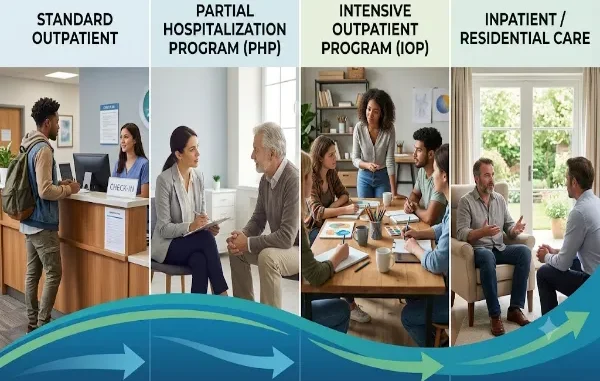
When someone decides to get help for a substance use problem, one of the first and most important questions is: what kind of treatment do I actually need? There is no single answer that fits everyone. Addiction affects people differently depending on their history, the substances involved, their living situation, their mental health, and a dozen other factors. Because of this, the addiction treatment field has developed a range of care options designed to meet people where they are. Understanding how these levels of care differ can help individuals and families make more informed decisions and avoid the common mistake of choosing a program based solely on convenience or cost.
Why the Level of Care Matters
Choosing the right level of care is not just a logistical decision — it can meaningfully affect outcomes. Someone with a severe alcohol use disorder and a history of withdrawal complications has different needs than someone who has been misusing prescription pain medication for several months. Matching the intensity of care to the severity of the problem is a core principle in addiction medicine.
For many people, especially those with long-term or high-severity addiction, residential substance use treatment provides the structure and support that makes early recovery possible. Living on-site at a treatment facility removes a person from the environments, relationships, and stressors that can trigger use, allowing them to focus entirely on getting well. This kind of immersive setting is often recommended when someone has tried outpatient treatment before without success, when their home environment is unstable, or when the severity of their addiction requires round-the-clock clinical oversight.
But residential care is just one part of a broader continuum. Knowing what else exists — and how the pieces fit together — gives people more options and a clearer picture of what a full recovery journey can look like.
The Continuum of Care: From Most to Least Intensive
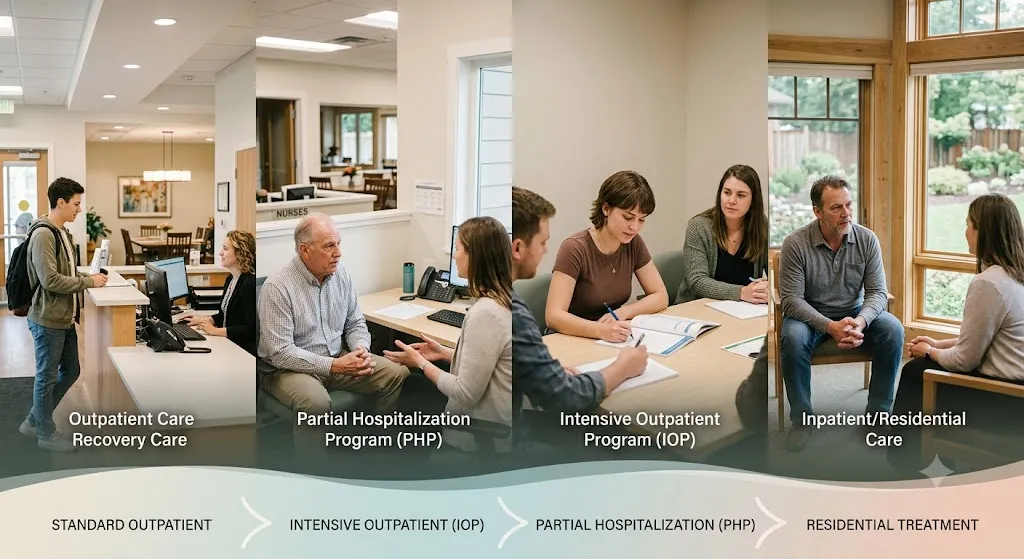
The American Society of Addiction Medicine (ASAM) has established widely used criteria for matching patients to treatment settings. The continuum generally flows from the most intensive services down to ongoing support:
Medical Detoxification
For people whose bodies have become physically dependent on substances like alcohol, benzodiazepines, or opioids, detox is often the first step. Withdrawal from some substances can be medically serious — in the case of alcohol, it can be life-threatening. Medical detox provides supervised withdrawal management, sometimes with medications to ease symptoms and reduce risk. Detox alone is not treatment; it is the beginning of the process.
Inpatient and Residential Programs
After detox, many people transition into an inpatient or residential program. These programs vary in length — typically ranging from 28 days to 90 days or longer — and in the services they offer. Most include individual therapy, group counseling, educational sessions about addiction and recovery, and some form of aftercare planning. The live-in format means that every part of a person’s day is structured around treatment, reducing idle time and exposure to triggers.
Partial Hospitalization Programs (PHP)
A partial hospitalization program offers a high level of clinical care — often five to six hours of programming per day, five days a week — without requiring an overnight stay. PHP is a common step-down option after residential treatment, or an entry point for people who do not need 24-hour supervision but still require intensive daily support. It also works well for people who have family or work obligations they cannot put entirely on hold.
Intensive Outpatient Programs (IOP)
Intensive outpatient programs typically involve nine or more hours of structured treatment per week, spread across several sessions. IOPs are flexible enough to allow people to live at home or in a sober living environment while maintaining employment or school. They are commonly used as a step-down from PHP, or as the primary level of care for people with moderate addiction and a stable, supportive home environment.
Standard Outpatient Care
Standard outpatient care involves fewer hours of programming per week — often one to two individual or group therapy sessions. This level of care is most appropriate for people with mild substance use problems, or for those who are well into recovery and transitioning away from more intensive services. It can also serve as long-term maintenance, providing ongoing connection to support and clinical oversight.
What Happens Inside Treatment
Regardless of the setting, quality addiction treatment programs typically share several core components. These are not add-ons — they are the building blocks of effective care.
- Individual therapy: One-on-one sessions with a counselor or therapist help people understand the roots of their substance use, develop coping skills, and work through co-occurring mental health concerns. Cognitive behavioral therapy (CBT) and motivational interviewing are among the most commonly used approaches.
- Group therapy: Peer groups provide a space to share experiences, practice communication skills, and build accountability. Many people find that hearing from others in recovery reduces the shame and isolation that often accompanies addiction.
- Medication-assisted treatment (MAT): For opioid and alcohol use disorders, FDA-approved medications can reduce cravings, ease withdrawal, and lower the risk of relapse. Medications like buprenorphine, naltrexone, and methadone are most effective when used alongside behavioral therapy.
- Family involvement: Addiction rarely affects just one person. Family therapy and education sessions help loved ones understand the nature of addiction, repair damaged relationships, and learn how to support recovery without enabling continued use.
- Aftercare planning: A good treatment program starts planning for life after discharge from the beginning. This includes identifying sober support networks, arranging follow-up care, addressing housing and employment needs, and connecting people to community resources.
The Role of Evidence-Based Treatment
According to the National Institute on Drug Abuse, addiction is a chronic, relapsing brain disorder influenced by genetic, developmental, and environmental factors. This framing matters because it shifts the focus from willpower to medical care. Just as someone with diabetes needs ongoing management rather than a single intervention, people with addiction often need sustained, structured support — particularly in early recovery when the risk of relapse is highest.
Evidence-based treatment means using therapies and approaches that have been studied and shown to work. This is an important thing to look for when evaluating a program. It does not mean that every evidence-based program looks the same — but it does mean that the core interventions being used have research behind them, rather than being based purely on tradition or ideology.
Choosing a Program: What to Ask
When evaluating treatment options, whether for yourself or someone you love, it helps to go in with specific questions. Not all programs are equal, and the details matter.
- What level of care do you recommend for my situation, and why?
- Are the therapists and counselors licensed and credentialed?
- Does the program treat co-occurring mental health conditions alongside addiction?
- What therapies do you use, and are they evidence-based?
- How do you involve families in the treatment process?
- What does the aftercare and step-down plan look like?
- Do you work with insurance, and what are the out-of-pocket costs?
A trustworthy program will answer these questions clearly and without pressure. If a program seems more focused on selling you a service than assessing your actual needs, that is worth paying attention to.
Why the Right Start Matters
Recovery is possible — that much is well established. But how someone enters treatment, and whether the level of care matches their needs, can shape the trajectory of their recovery in meaningful ways. Starting at the right level of intensity, with access to qualified clinicians and evidence-based support, gives people the strongest possible foundation for lasting change.
The road from active addiction to stable recovery is rarely straight. There may be setbacks, transitions between levels of care, and moments when more support is needed than expected. That is a normal part of the process for many people. What matters is staying connected to care and continuing to move forward.
If you or someone you care about is struggling with substance use, reaching out to a treatment professional to discuss options is a reasonable and worthwhile first step. You do not need to have everything figured out before asking for help — that is what the assessment process is for.





Leave a Reply