
Introduction
Human minds are now thinking differently about the concept of home design, and the kitchen space is perhaps the most attractive to encompass such transformations. Thanks to the evolution of AI kitchen design, home cooks are no longer compelled to use costly interior designers and know-nothings to build their kitchens; instead, they will receive expert guidance, smart materials, and instant visualizations on their fingertips – for affordable but gorgeous kitchens.
What’s unique about AI kitchen design
Traditional kitchen renovations involve several meetings, lengthy back-and-forth with contractors, and expensive revisions to the design. AI kitchen design cuts out all of that in a matter of seconds.
Cutting-edge AI design platforms use a blend of workflow optimization, spatial analysis, and material intelligence to quickly assess a kitchen and produce custom redesign options almost instantly. The end-product isn’t simply good looks and aesthetic balance – this is a system that makes doing the space smarter.
What sets these solutions apart from the competition is their ability to adapt. The more designs generated, the more a homeowner’s style, cooking approach, and aesthetic opinions are absorbed and learned. Over time, the platform will tailor suggestions even better, giving results that feel more like suggestions from a trusted designer than an automated program.
Using AI kitchen design through Layout Analysis
Perhaps the most impressive feature of AI-driven kitchen design programs is their use of photo-based layout analysis. Upload one picture of your current kitchen and the AI will assess dimensions, recognize cabinet locations and floor plans, and identify movement sequences, all without a physical site visit.
From that analysis, the system will suggest optimized layouts and effective work triangles. A work triangle is the close relationship between the stove, sink, and fridge within a design and is a cornerstone of ergonomic kitchen design. If you get it right, you’ll minimize movement, maximize time, and make the user much happier. AI tools apply this principle automatically to every proposed design, regardless of style, so practical improvements are factored in.
Customizing various styles for any user preference
Whether a homeowner longs for a sleek modern minimalist aesthetic or a cozy farmhouse feel, AI can come up with both cabinet shapes and surface texture options for just about any look.
AI doesn’t see aesthetics as a supplement to function, but instead considers looks and layout as the same. Placement of the appliances, easily accessible storage, and the available counter space are all generated within a specific visually apparent style, so if beauty and functionality are compatible, they arrive together rather than in conflict.
This is a big leap from the sort of style plus layout options offered by most typical design programs, which often require some editing after the user has selected their particular style. With AI, a more holistic proposal will be delivered immediately.
Precise color and material matching
Choosing the correct material for a kitchen can be one of the most daunting aspects of a renovation. With numerous cabinet shades, counter materials, and splashback textures available, it is difficult to choose without soul-searching.
AI design programs go about addressing this by recognizing what kitchen-specific materials go together – but not just for aesthetics, but for practicality, longevity, and ease of maintenance too. The program presents the user with carefully chosen color combinations and materials that blend well and will work efficiently with the environment.
Instead of offering numerous choices with no direction, the AI centers a limited selection around the customer’s preferences and overall design plan. This makes the material turn out to be much quicker and more confident.
Demonstrated in Real Time
One of the most useful capacities of future-focused AI designing software is real-time kitchen preview. Users can instantly review numerous variations of their enhanced design by comparing block colors and layouts before even engaging a builder.
This radically alters the decision-making process as the user doesn’t have to guess whether a countertop or sink will match their style, but can see the result immediately. Feedback can be mitigated early on, design tastes clarified, and mid-project changes are much less probable.
High-quality images generated by these solutions are also practical for sending out to house-builders or for sharing with family and friends. Instead of communicating a rough look, the homeowner can hand over a precise photorealistic model.
How does it work in just 3 simple steps?
With most AI kitchen planning programs, the entire experience is locked down for simplicity:
- Step 1 – Upload your current kitchen photo: Take a snapshot of where you currently are and upload it to the software. The platform will analyze the room straight away.
- Step 2 – Select your style and features: Choose your preferred style of kitchen, types of cabinets, and particular features that are important to you. The program will deliver a tailored result based on your specifications.
- Step 3 – See the renovation process unfold: In seconds, see your kitchen reimagined. You can download the outcome for use in planning or customize it until satisfied.
Extending AI’s capacity to home design as a whole
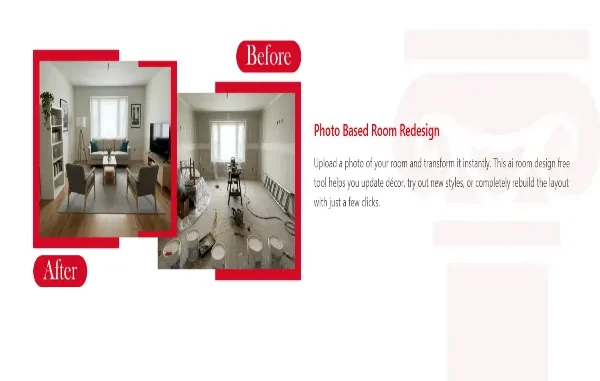
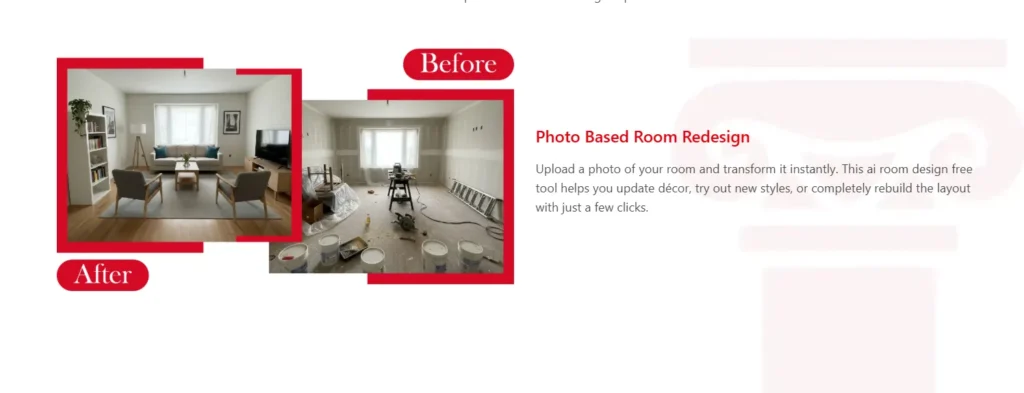
Thanks to the same AI technology used for kitchen transformations, full homes are reshaped in the minds of the user by uploading a photo of any room, be it a games room, a bedroom, an office, or a bathroom.
One may choose to refresh a decor palette, test a new style, or switch around furniture placement, and the over 20 available interior design styles cover all from old-world luxury to state-of-the-art modern styling. The software assesses the input, produces captivating room visualizations, and provides the user with output instantaneously for sharing and building upon.
From kitchens to complete houses, AI-powered design software now handles every room in a home in minutes.
Conclusion
AI kitchen design is about more than a novelty in an emerging form of technology – it is about changing how the home experience is designed, visualized, and realized. Blending in ergonomics, spatial intelligence, ornament, material sensibilities, and instant previews, these platforms allow consumers to do what was not previously possible – produce top-notch design features at home on deadline.
The time periods and high costs associated with traditional kitchen redesigns – along with the confusing number of options and the uncertainty of outcomes have long been a barrier. Now technology is eradicating that issue for good, and making renovation faster, more personal, and more visual from the outset. For homeowners attempting a kitchen upgrade, the new standard is here.
Related posts:
 Voyage Through Time: When will Time Travel be Possible
 Water Damage Restoration Service Lanham: Fast & Efficient
 The Complete Guide to Using Telegram for Secure and Smart Communication
 The Chemistry Behind Firefighting Foam: How Surfactants Make Fire Suppression Work
 Instagram Transcript Generator Shifts Content Approach 2026
Leave a Reply