
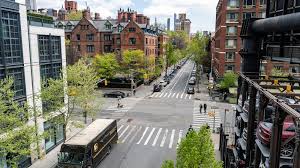
Chelsea has had several reinventions across the last 30 years. It was the gallery district in the 1990s, a tech corridor in the 2010s, and more recently a mixed-use area where creative studios, hybrid offices, and retail flagships share the same blocks. The current cycle is making it one of the most wanted workspace neighbourhoods in Manhattan, and the reasons are worth understanding for any business evaluating its next lease.
Key points
- Chelsea’s combination of loft-style floorplates, transit access, and a mature food and retail scene makes it a strong fit for hybrid-working teams.
- Flexible workspace inventory in Chelsea expanded roughly 40 percent between 2021 and 2025, much of it in building conversions rather than new construction.
- The neighbourhood’s design culture, which stretches back to the 1990s gallery era, remains a meaningful draw for creative teams.
Why floorplates matter here
Chelsea’s building stock is unusual for central Manhattan. Large loft-style floorplates, often in converted former industrial buildings, work well for collaborative layouts. The ceiling heights are generous, the natural light is better than equivalent midtown towers, and the floorplate depth allows teams to combine open collaboration zones with quiet areas for focused work. For a team of 20 to 80 people operating on a hybrid schedule, those physical attributes often matter more than small differences in rent per square foot.
Transit access and neighbourhood amenities
Chelsea sits between the 1, A, C, E, and L subway lines, which means most Manhattan and Brooklyn commuters are practical. The High Line, the Hudson River Park, and the redevelopment around Hudson Yards have made the neighbourhood pleasant to walk across. The food and retail scene is mature enough that team lunches, client dinners, and after-work events all work without leaving the neighbourhood, which matters for teams that want to keep their centre of gravity local.
Flexible workspace and short-term options
Not every team wants to commit to a multi-year direct lease, and Chelsea’s flexible workspace market has grown to match that demand. Coworking spaces, managed-office providers, and private-floor leases are all well-represented. Teams that want to explore office space in Chelsea typically have a wide range of options, from single-desk memberships up to full-floor private leases with dedicated amenities.
When Chelsea is the right fit
Chelsea works particularly well for media, design, technology, and professional services firms where the team benefits from being in a building with a mix of other creative and techn�cal tenants. It works less well for firms that need trader-style dense seating or that benefit from proximity to specific client clusters like law firms or investment banks, which remain concentrated in other neighbourhoods.
Conclusion
Chelsea’s combination of floorplane quality, transit access, amenities, and design culture has brought it back to the front of the Manhattan workspace conversation. The current cycle is likely to run for several more years as tenant preferences continue to favour+�mixed-use neighbourhoods with character rather than large monolithic office districts. For a team evaluating its next lease or flexible workspace move, Chelsea deserves a careful look against the alternatives.





Leave a Reply