
Most organisations believe they have a functioning Security Operations Centre. Alerts are flowing in. Dashboards look busy. Tickets get raised. But when a real incident hits, confidence often slips. Response slows. Ownership becomes unclear. Decisions feel reactive rather than deliberate.
This is where a SOC maturity assessment becomes invaluable. It helps organisations move beyond assumptions and understand how effective their security operations truly are. Not just from a tooling perspective, but across people, processes, and technology. A structured assessment provides clarity, direction, and a realistic roadmap forward.
What is a SOC maturity assessment?
A SOC maturity assessment is a structured evaluation of how well your security operations function across key dimensions such as threat detection, incident response, monitoring coverage, governance, and continuous improvement.
Rather than asking “Do we have a SOC?”, it asks deeper questions:
- How quickly do we detect real threats?
- How consistently do we respond?
- How well do teams collaborate under pressure?
- How measurable is our performance?
The outcome is a clear view of your current maturity level and practical recommendations to move forward.
Why SOC maturity matters more than ever
Threats have changed. Attackers move faster, automate reconnaissance, and exploit gaps between tools and teams. At the same time, security teams face alert fatigue, skills shortages, and increasing scrutiny from regulators and leadership.
A SOC maturity assessment helps organisations prioritise what actually improves outcomes. It separates activity from effectiveness.
From our experience, organisations with higher SOC maturity show three clear advantages:
- Faster and more confident incident response
- Better use of existing security investments
- Clear communication with leadership during crises
Core dimensions evaluated in a SOC maturity assessment
Here are the key components evaluated in a SOC maturity assessment:
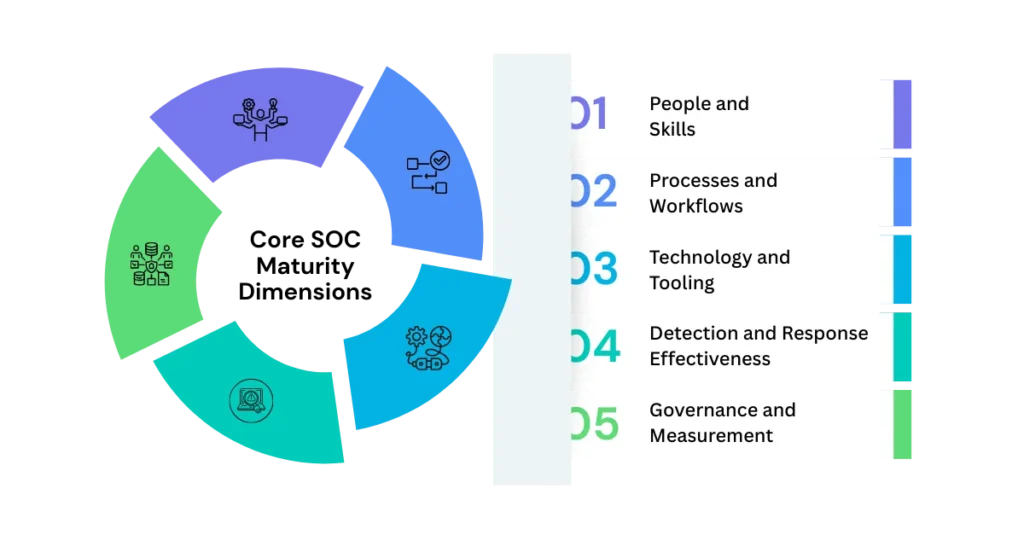
1. People and skills
Technology alone does not detect or stop attacks. Analysts, incident responders, and SOC leads play a critical role.
A SOC maturity assessment evaluates:
- Role clarity and escalation paths
- Skill depth across tiers
- Training, certifications, and continuous learning
- Analyst workload and burnout risk
We often find capable teams struggling simply because expectations and responsibilities are not clearly defined.
2. Processes and workflows
Strong SOCs rely on repeatable, well-tested processes.
Assessment areas typically include:
- Incident detection and triage workflows
- Incident response playbooks
- Threat intelligence usage
- Collaboration with IT, legal, and business teams
When processes are unclear or undocumented, response becomes inconsistent. During incidents, that inconsistency is costly.
3. Technology and tooling
Most SOCs use multiple tools. The question is whether those tools work together effectively.
A SOC maturity assessment reviews:
- SIEM configuration and data quality
- Detection rule coverage and tuning
- SOAR usage and automation maturity
- Visibility across endpoints, network, cloud, and identity
We frequently see organisations underutilising tools they already own. Improving configuration often delivers more value than buying something new.
4. Detection and response effectiveness
This is where maturity becomes measurable.
Key evaluation areas include:
- Mean time to detect and respond
- Alert accuracy and false positive rates
- Incident containment success
- Root cause analysis quality
A SOC maturity assessment turns these into actionable metrics, helping teams focus on what actually reduces risk.
5. Governance and measurement
Without measurement, improvement is guesswork.
This dimension looks at:
- Defined KPIs and reporting
- Alignment with business risk
- Incident review and lessons learned
- Continuous improvement cycles
Mature SOCs learn from every incident and near-miss. Less mature ones repeat the same mistakes.
Common challenges uncovered during SOC maturity assessments
Across industries, similar patterns emerge.
One common issue is alert overload. SOCs receive thousands of alerts but lack prioritisation. Analysts spend time chasing noise while real threats hide in plain sight.
Another challenge is fragmented ownership. Security operations often depend on IT, cloud, and application teams, yet collaboration is informal or slow.
We also see maturity gaps caused by rapid growth. As organisations scale, their SOC processes do not always keep pace.
A SOC maturity assessment helps surface these issues without blame. The focus stays on improvement, not fault-finding.
What maturity levels typically look like
While models vary, SOC maturity is often described in stages.
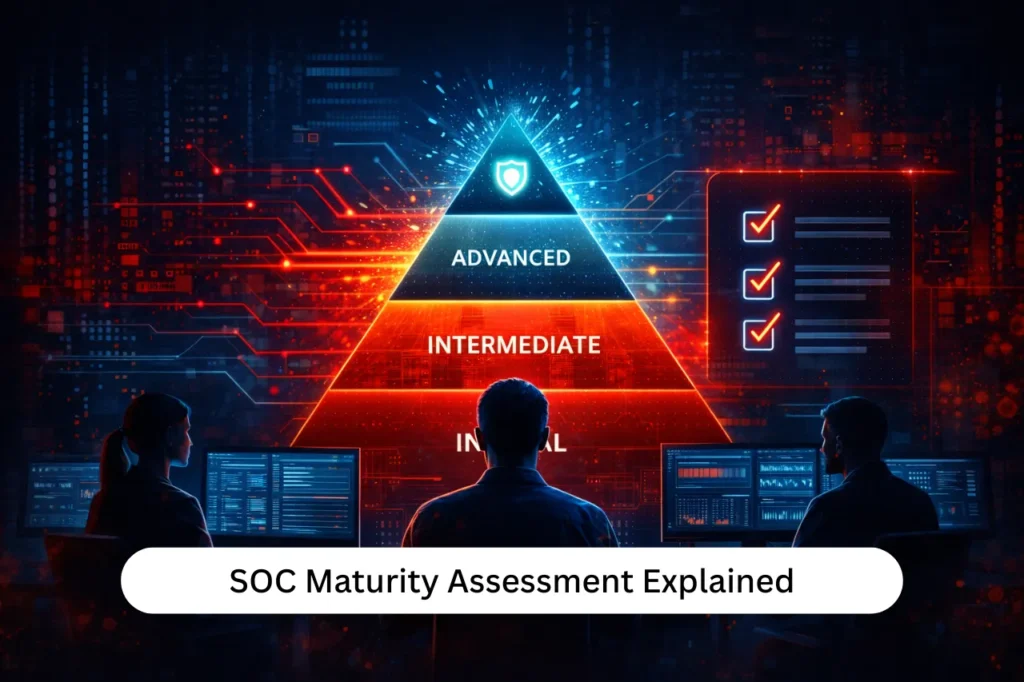
At early stages, monitoring is basic and reactive. Detection relies heavily on default rules. Response depends on individual experience.
At intermediate stages, processes become documented. Threat intelligence is used. Metrics start informing decisions.
At higher maturity, detection is proactive. Automation reduces manual effort. The SOC operates as a coordinated function aligned with business risk.
The goal is not perfection. It is progress that matches your organisation’s risk profile.
Turning assessment findings into action
A SOC maturity assessment only delivers value if it leads to change.
We recommend:
- Prioritising improvements that reduce response time
- Fixing process gaps before adding more tools
- Aligning SOC goals with business impact
- Setting realistic milestones
Small, focused improvements often outperform large transformation programmes.
When should organisations conduct a SOC maturity assessment?
There are several moments when an assessment makes particular sense.
After a major incident, it helps identify what worked and what failed. During tool refresh or SOC redesign initiatives, it guides investment decisions. For regulated industries, it supports audit readiness and assurance.
Even without a trigger, periodic SOC maturity assessments help organisations stay aligned with evolving threats.
Conclusion
A SOC maturity assessment provides something many organisations lack: an objective understanding of their security operations. It highlights strengths, exposes gaps, and offers a structured path forward.
Rather than guessing where to invest time and budget, leaders gain evidence-based insight. Every improvement made strengthens detection, response, and resilience.
If your SOC feels busy but not always effective, a maturity assessment is a powerful place to start. At the same time, it is important to partner with SOC experts who can help your company.
If you are looking to understand and strengthen your SOC capabilities, partner with cybersecurity firms like CyberNX. They can help you conduct a focused SOC maturity assessment and build a roadmap that delivers real security outcomes. They believe SOC maturity assessment should be practical, honest, and achievable. Their approach focuses on how security operations actually function during real incidents.
In addition, they are well known to work alongside your teams, not over them with the goal of helping you strengthen what already exists, not impose abstract models.
Related posts:
 How CMM Inspection Improves Efficiency in Production Lines
 AI Photo Generators Elevate Your Editing Without Quality Loss
 Avatar vs. Human: Who’s Better at Explaining Your Product in 30 Seconds?
 Can Treasury Management Software Make Borrowing Safer and Smarter?
 Water Damage Restoration Service Lanham: Fast & Efficient
Leave a Reply