

A business rarely stays limited to one type of customer. A brand may start with a consumer website, introduce a wholesale portal, and later launch another storefront for a different product range. Each audience needs a different buying experience, but the business still needs accurate stock, consistent product information, and reliable order management.
Managing every storefront as a separate operation can become difficult. Teams repeat product updates, reconcile inventory, and connect the same business systems several times. As the number of stores grows, so does the work behind them.
Headless commerce offers a more flexible approach. It separates the customer-facing storefront from the commerce functions behind it, allowing businesses to build different shopping experiences around a shared foundation. Commerce Engine brings this approach to D2C, B2B, and marketplace commerce through its API-first platform.
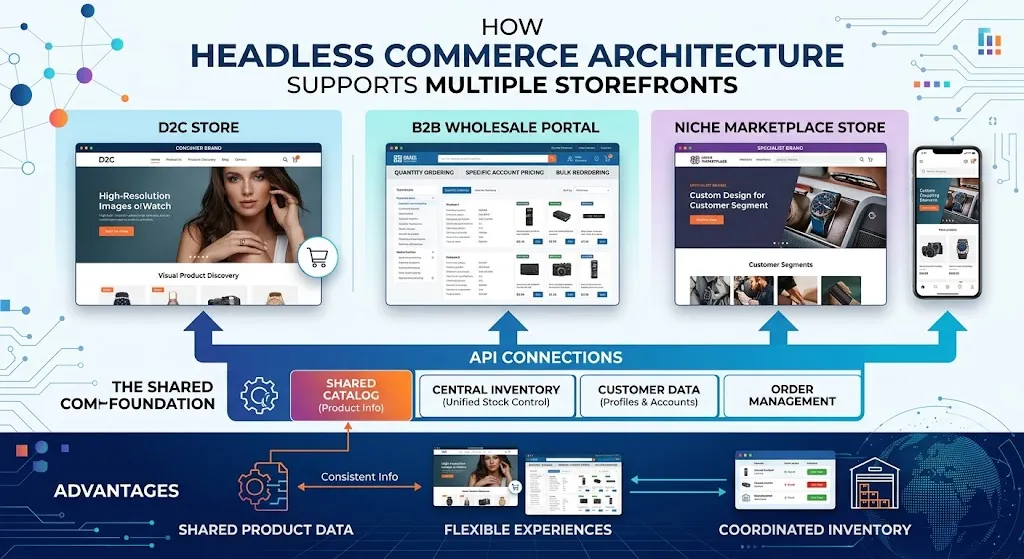
What Is Headless Commerce Architecture?
Headless commerce separates two parts of an ecommerce system: the frontend and the backend.
The frontend is what customers interact with. It includes product pages, navigation, search, shopping carts, and the visual design. The backend manages the commercial rules and data that make buying possible, such as products, prices, inventory, customers, and orders.
APIs connect these two layers. When someone opens a product page, the storefront requests the relevant information from the backend. When they place an order, the storefront passes that transaction to the commerce system.
This separation allows different frontends to use shared commerce services. A consumer website can focus on product discovery, while a wholesale portal prioritises quick ordering. Both can connect to the same underlying commerce foundation.
However, separating the frontend does not automatically create a complete multi-storefront system. The platform also needs appropriate controls for product visibility, pricing, customer access, and store-specific data.
Why Multiple Storefronts Need More Than Different Designs
Two storefronts may sell similar products while serving very different purposes.
A retail shopper might buy one item after reading reviews. A distributor may order several hundred units, expect negotiated prices, and need access to business payment terms. Making both customers follow the same journey creates unnecessary friction.
Consider a manufacturer with three digital stores.
Its consumer store serves individual shoppers who need product discovery, reviews, and a simple checkout.
Its wholesale portal serves retailers and distributors who need bulk quantities, account pricing, and repeat ordering.
Its specialist brand store serves a particular customer segment through a focused assortment, distinct content, and a different visual identity.
A well-designed multi-storefront architecture gives each store its own identity and buying rules while sharing the operational data that should remain consistent. Store modelling can also separate assortments, regional settings, and access permissions within a shared commerce environment.
How Headless Commerce Supports Multiple Storefronts
- Shared Product Information With Controlled Availability
Maintaining separate product records for every website creates avoidable work. A change to a specification or product image may need to be repeated across several systems.
A shared catalog provides a central place to maintain core product information. Each storefront can then display the products relevant to its audience, with its own presentation and supporting content.
For example, a consumer store might highlight individual products, while a wholesale portal makes larger pack sizes easier to find.
Commerce Engine’s catalog page describes shared product records, variant-level channel selection, and inventory connected across websites, apps, physical stores, and marketplaces. These capabilities provide building blocks for managing several selling experiences around consistent product data.
- Different Experiences for Different Buyers
A premium consumer brand may need large photographs, editorial pages, and a guided discovery experience. A distributor portal may work better with compact product lists, clear quantities, and fewer steps between finding a product and ordering it.
Headless architecture gives development teams room to build both experiences without forcing them into an identical storefront layout.
This flexibility is particularly useful for business to business e commerce, where purchasing often depends on an existing commercial relationship. The interface needs to reflect how buyers actually work.
Commerce Engine’s B2B solution lists customer-specific pricing, volume discounts, quote management, and connections to ERP and CRM systems. These functions can support a trade-focused storefront with different requirements from a consumer shop.
- Coordinated Inventory Across Selling Channels
Customers see separate stores, but those stores may draw from the same warehouse.
Without coordinated inventory, two storefronts can promise the same remaining stock. The result may be cancelled orders, delayed fulfilment, or additional work for customer support.
A shared inventory service helps storefronts use a consistent view of availability. The implementation must also account for reservations, cancellations, returns, and warehouse allocation.
For a business selling through several channels, this connection matters as much as the design of each website. A polished storefront cannot compensate for unreliable stock information.
Commerce Engine describes shared stock across channels and inventory tracking across warehouses and batches. Businesses can assess these features against their fulfilment needs when planning their storefront structure.
- Storefront Changes With Fewer Dependencies
When the interface and commerce services are separated, a team can redesign a storefront without replacing the entire commerce system.
Suppose a brand wants to improve mobile navigation or introduce a new product landing page. The frontend team can work on that experience while continuing to use existing product and order APIs.
The same principle applies when launching another storefront. Teams may reuse established integrations and commerce functions, then build the new customer-facing experience around them.
This can reduce repeated implementation work. The actual effort still depends on the new store’s requirements, the quality of the APIs, and how much the business needs to customise.
Where Ecommerce Marketing Automation Fits
Multiple storefronts create more customer journeys to understand. A wholesale buyer and a first-time retail shopper should not necessarily receive the same message or offer.
Ecommerce marketing automation becomes more useful when campaigns respond to relevant actions and customer context.
For example, a consumer cart abandonment reminder might help a shopper return to an unfinished purchase. A distributor campaign might focus on a suitable product range or a relevant reorder opportunity.
The architecture needs to pass useful data to the marketing tools: what happened, which customer acted, and which storefront or channel was involved.
Commerce Engine describes webhooks and storefront events that can feed external email, SMS, and WhatsApp tools. Its marketing page also lists targeted coupons and scheduled promotions. The communication tools handle message delivery, while commerce data provides the context for those workflows.
Teams should define consent, timing, and campaign eligibility carefully. Automation works best when the message fits the customer’s relationship with the business.
How Commerce Engine Fits Into the Architecture
Commerce Engine presents its platform as a shared foundation for different selling models. Its website describes connected commerce functions covering catalog, inventory, orders, payments, shipping, customers, promotions, and analytics.
For a business planning multiple storefronts, the practical value lies in combining those services with interfaces designed for specific audiences.
A consumer storefront could prioritise discovery and a straightforward purchase journey. A B2B portal could prioritise account pricing and bulk buying. Each experience would need the appropriate configuration, integrations, and access controls.
Commerce Engine also offers customisable storefront starters and hosted checkout, which businesses can evaluate when choosing how much of the frontend to build themselves.
What Businesses Should Plan Before Launching
Start by deciding what each storefront needs to share and what it needs to control independently.
Identify the product assortment, pricing rules, customer permissions, payment options, and fulfilment requirements for each store. Then establish how orders and customer activity will reach operational and marketing systems.
Access controls deserve particular attention. A wholesale price should be protected by backend rules, even if the consumer interface never displays it.
Teams also need to plan performance, search visibility, monitoring, and ongoing maintenance for every frontend. Headless architecture creates flexibility, but that flexibility still requires ownership.
Build Each Store Around Its Customers
Multiple storefronts work best when they reflect real differences in how customers buy. Sharing commerce services can reduce repeated work while giving each audience a more suitable experience.
Headless architecture makes that separation possible. Commerce Engine offers relevant capabilities for businesses exploring consumer, wholesale, and marketplace storefronts.
The strongest starting point is a clear view of your buyers and operations. With that in place, each new storefront can extend the business through a shared commerce foundation while delivering the experience its customers need.
Related posts:
 Water Damage Restoration Service Lanham: Fast & Efficient
 What Does C3PAO Mean for the Future of Risk Management?
 Creating Stunning Face Swap Videos with AI: How to Use Face Swap Video Tools for Free
 How Dechecker AI Checker Turns Awkward Drafts Into Human-Readable Content
 The Complete Guide to Using Telegram for Secure and Smart Communication
Leave a Reply