
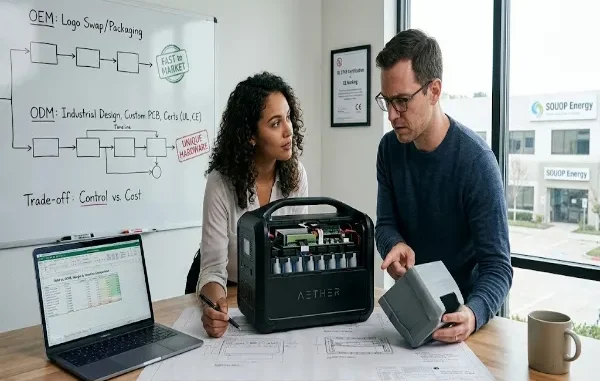
Every private-label power station on the market started as someone’s spreadsheet — a margin calculation, a sourcing question, and a decision about how much control they actually wanted over the product versus how fast they wanted it on a shelf. That decision usually comes down to one acronym fight: OEM or ODM. They get used interchangeably in cold emails from sourcing agents, which is exactly why so many first-time brand owners end up confused about what they’re actually signing up for.
The short version: OEM means you’re customizing something that already exists. ODM means you’re building something closer to new, with the manufacturer doing most of the engineering. Everything else — cost, timeline, how defensible your product actually is against competitors — flows from that one distinction.
OEM: Faster To Market, Less Room To Differentiate
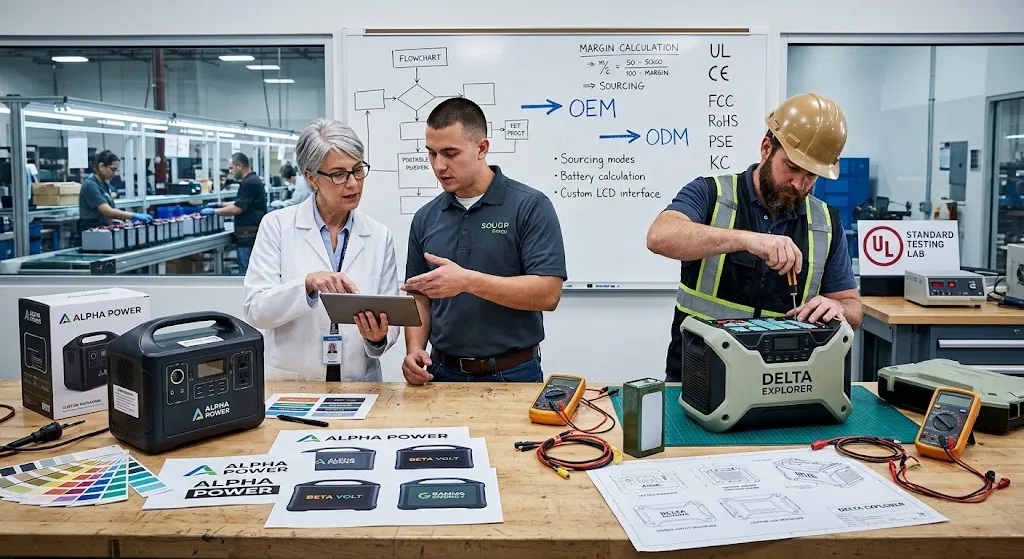
Original Equipment Manufacturing, in the power station world, usually means taking a factory’s existing platform and putting your name on it. At the simplest end, that’s logo placement, custom packaging, and maybe a colorway change — a silk-screened logo on an off-the-shelf 1,000Wh unit, shipped in a box with your branding instead of the factory’s. This is the fastest and cheapest way to get a product to market, and it’s how a lot of Amazon-native power station brands got their start.
A step up from that is what most manufacturers call advanced OEM: you’re still working from an existing platform, but you can request real changes — a different battery capacity, added output ports, a different plug configuration for the markets you’re selling into, adjusted app connectivity. Souop OEM & ODM services split this out explicitly as a middle tier for exactly this reason — brands that want more than a logo swap but aren’t ready to fund a ground-up product.
The trade-off with OEM, at either level, is differentiation. If three other brands are working from the same base platform, your product’s internals look a lot like theirs. You compete on price, marketing, and brand story rather than on the hardware itself. For a lot of new entrants, that’s a completely reasonable place to start — it gets cash flow moving while you learn the market. It’s just worth going in with eyes open about the ceiling.
ODM: Slower And Pricier, But It’s Actually Yours
Original Design Manufacturing flips the starting point. Instead of adapting something that exists, you’re briefing the manufacturer on what you want — capacity, form factor, output specs, target price point — and their engineering team designs it from there, sometimes from a clean sheet, sometimes adapting internal reference designs far enough that the result is genuinely yours. Full ODM work typically includes industrial design, hardware and firmware development, tooling for custom housings, and certification support for whichever markets you’re targeting.
This is a real commitment. Tooling alone — the molds needed to produce a custom enclosure — can run into tens of thousands of dollars before a single unit ships, and certification testing (UL for North America, CE and RoHS for Europe, PSE for Japan, KC for South Korea, depending on where you’re selling) adds both cost and months to the timeline. Minimum order quantities tend to be higher too, since the manufacturer is recovering development costs across the run.
What you get in exchange is a product nobody else is selling. If the whole point of your brand is a specific use case — marine, overlanding, medical backup, a form factor nobody’s built yet — ODM is usually the only path that gets you there. It’s also the harder path to walk back from once you’ve committed tooling money, so the brief needs to be right before development starts.
Questions Worth Asking Before You Pick Either
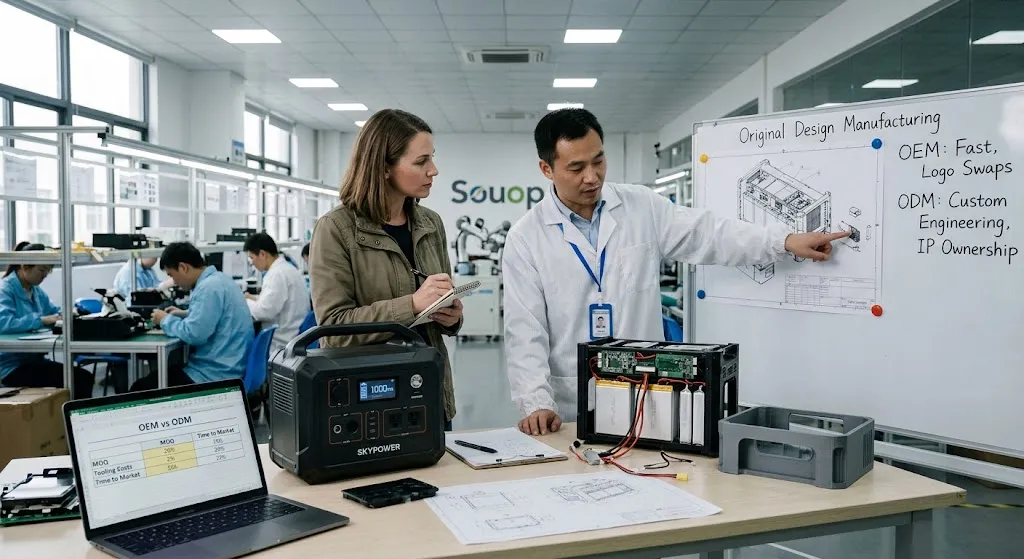
A few things separate a smooth OEM or ODM relationship from a painful one, regardless of which tier you choose. Does the manufacturer control cell sourcing and assembly in-house, or are they subcontracting steps out? A factory running its own production line — cell sorting through final assembly under one roof — has far more control over consistency than one juggling multiple subcontractors. What certifications do they already hold, and which ones do they need to newly test for your spec? Existing UL or CE approval on a platform you’re adapting saves real time versus starting certification from zero. And what does their actual production capacity look like — can they support you at 500 units a month, and can they still support you if that number becomes 20,000?
These aren’t abstract questions. A manufacturer’s scale shows up directly in your lead times once you’re placing repeat orders, which is usually where newer private-label brands get burned — the first order goes fine, and then a factory that was fine at low volume can’t keep pace with a second or third reorder.
Picking A Lane
There’s no universally correct answer between OEM and ODM — there’s only the correct answer for your specific brand, budget, and timeline. A brand testing a new market with limited capital is usually better served starting with basic or advanced OEM, proving demand, and reinvesting toward a custom ODM product once the category is validated. A brand entering with a clear technical differentiator and the capital to back it should probably skip straight to ODM, because a me-too OEM product won’t say what needs saying.
Whichever path fits, the manufacturer relationship matters more than the acronym. Souop Energy runs both tiers under one roof — a 50,000-square-metre factory with in-house production, its own UL-standard testing lab, and certifications spanning UL, CE, FCC, RoHS, PSE, and KC — which is the kind of infrastructure that actually makes either route workable at scale, rather than just on paper.
Related posts:
 Voyage Through Time: When will Time Travel be Possible
 Water Damage Restoration Service Lanham: Fast & Efficient
 What Does C3PAO Mean for the Future of Risk Management?
 Creating Stunning Face Swap Videos with AI: How to Use Face Swap Video Tools for Free
 How Dechecker AI Checker Turns Awkward Drafts Into Human-Readable Content
Leave a Reply