
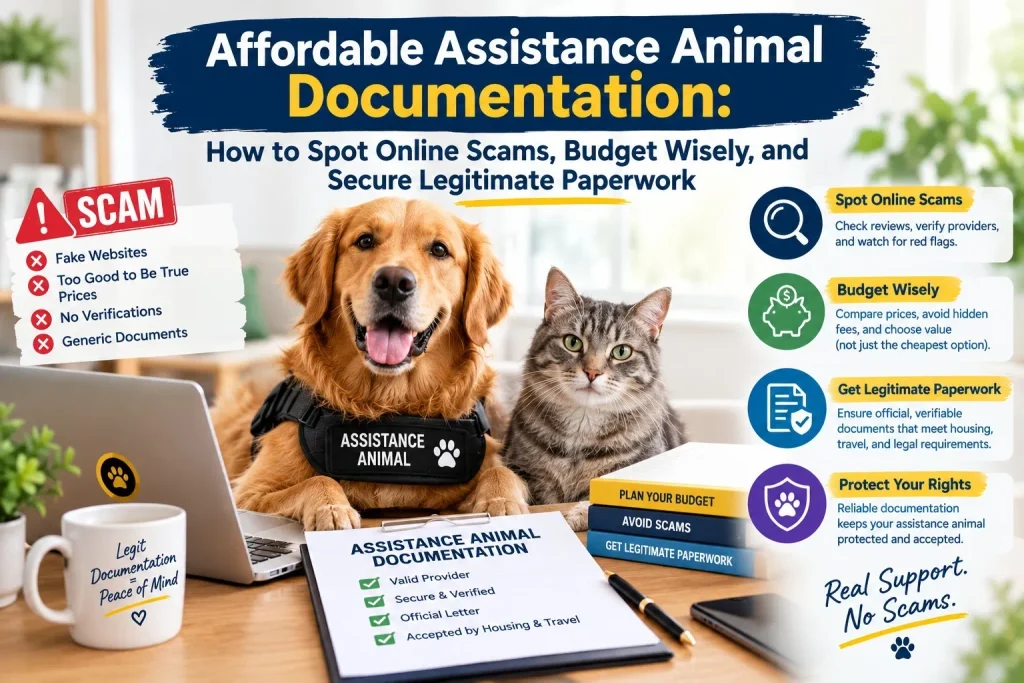
Navigating modern housing costs is an uphill battle. For renters dealing with mental health conditions like chronic anxiety, major depressive disorder, or PTSD, companion animals frequently serve as essential therapeutic anchors. Yet, the financial barriers imposed by landlords can be crippling. Across the rental market, standard pet policies routinely demand non-refundable pet deposits between $250 and $500, upfront registration fees, and recurring “pet rent” adding $30 to $80 to an already inflated monthly lease.
Over an annual lease term, these arbitrary fees can easily drain $600 to $1,400 from a household budget.
Under federal law, qualified individuals with genuine emotional support animals (ESAs) or psychiatric service dogs (PSDs) are legally exempt from every single one of these fees. Unfortunately, predatory operators online know this all too well. A search for assistance animal paperwork reveals hundreds of exploitative websites promising “$29 instant approvals” and “official government registrations.”
Falling for these schemes does not just waste hard-earned cash; it leaves renters with worthless pieces of paper that landlords and screening companies reject immediately, putting housing stability at severe risk.
The Anatomy of an Assistance Animal Scam
Online scams in the assistance animal industry have grown increasingly polished. Deceptive websites mimic official government portals, using official-looking seals, state flags, and legal terminology to mislead consumers. Recognizing the anatomy of these scams is the first step toward protecting both your wallet and your housing rights.
| Scam Tactic / Warning Sign | Legal Reality (HUD & ADA Regulations) |
| Claims of “Official U.S. ESA/Service Dog Registry” or “Government Certification” | There is NO federal, state, or municipal assistance animal registry recognized by HUD or the DOJ. |
| Instant approvals based solely on a 3-minute, multiple-choice automated online quiz | Legitimate evaluations require consultation with an active, state-licensed mental health professional (LMHP). |
| Packages bundling plastic ID badges, holographic badges, and animal vests as “proof” | HUD Notice FHEO-2020-01 explicitly states ID cards and certificates hold zero legal weight in housing reviews. |
| Selling “Lifetime” ESA Letters that claim you never have to renew or re-evaluate ever again | Housing providers typically require an ESA letter to have been issued within the past 12 months. |
Red Flag 1: The “National Database” or “Official Registry”
The most widespread scheme involves charging renters $50 to $150 to enter their dog or cat into a “National ESA Registry” or “U.S. Service Animal Database.”
Neither the U.S. Department of Housing and Urban Development (HUD), the Department of Justice (DOJ), nor the Department of Transportation (DOT) operates, recognizes, or endorses any registry database.
These registries are privately operated websites with zero regulatory authority. A landlord or third-party tenant screening agency (such as PetScreening.com) will dismiss a registration card without hesitation.
Red Flag 2: Automated Approvals and 5-Minute Quizzes
Legitimate medical documentation requires an actual clinical evaluation by a Licensed Mental Health Professional (LMHP). Scam portals use automated questionnaires with questions like “Does your pet make you feel happier when you are sad?” followed by an instant credit card checkout page.
If a website delivers a signed PDF letter seconds after payment without a licensed clinician reviewing your medical background, that document is almost certainly a generic template containing forged, inactive, or non-existent license numbers.
Red Flag 3: Vests, Tags, and Certificates Masquerading as Legal Proof
Scam platforms rely heavily on physical merchandise to make buyers feel protected. They market deluxe packages featuring metallic leash wraps, engraved tags, embroidered vests, and embossed paper certificates.
Under federal guidelines, an assistance animal needs none of these accessories. You cannot buy your way into legal compliance with an orange vest; the sole document that establishes your rights in residential housing is a clinical recommendation letter from a healthcare professional licensed in your jurisdiction.
What Legitimate Clinical Evaluations Actually Cost
Understanding standard healthcare economics helps you identify a realistic budget and steer clear of fraudulent bargains.
| Scam Mills | $25 – $50 | Auto-generated fake PDFs |
| Legitimate Telehealth | $120 – $190 | Full LMHP review & state compliance |
| Private Practice | $250 – $450+ | In-person clinical intake sessions |
A licensed clinician, whether a Licensed Clinical Social Worker (LCSW), Licensed Professional Counselor (LPC), Marriage and Family Therapist (LMFT), or Clinical Psychologist, invests years of postgraduate education and takes direct responsibility under their state licensing board whenever they sign a clinical document.
- In-Person Private Practice ($250 to $450+): If you visit a private psychiatrist or therapist without insurance, an initial diagnostic intake session generally runs several hundred dollars. For ongoing patients, obtaining a letter is often included in routine treatment, but for new patients seeking a one-off evaluation, private clinic fees can be prohibitive.
- Compliant Telehealth Networks ($120 to $190): Specialized telehealth networks partner with state-licensed clinicians to conduct structured mental health screenings remotely. This pricing reflects fair compensation for the clinician’s review time, HIPAA-compliant digital intake infrastructure, and ongoing administrative customer support.
- The Danger Zone ($25 to $50): Any platform offering an ESA letter under $60 is virtually guaranteed to be an unvetted document mill. At that price point, a licensed healthcare provider cannot be paid an ethical wage to review your file. The output is almost invariably an automated, unverified form letter that will fail basic landlord checks.
Safe, Cost-Effective ESA Qualification
Budgeting for an assistance animal does not mean you have to break the bank on high-priced private clinics, but it does mean choosing an avenue that guarantees legal protection.
If you currently attend regular counseling or psychiatric appointments, start there. Ask your existing provider if they are willing to write an accommodation letter per HUD’s FHEO-2020-01 guidelines. Because you have an established clinical history, your therapist can usually draft this letter at little or no extra cost.
However, millions of Americans lack consistent access to dedicated mental health services due to high deductibles, sparse local networks, or long waiting lists. For renters in this situation, utilizing an accredited remote platform to secure an ESA letter online provides an accessible, budget-friendly alternative.
A reputable telehealth provider connects you directly with a clinician licensed in your specific home state, follows clinical assessment standards, and ensures that your letter includes active licensing credentials, practice letterheads, and verified contact numbers that withstand scrutiny.
Documenting Psychiatric Service Dogs Without Getting Exploited
While ESAs provide emotional comfort at home, individuals with debilitating mental health conditions, such as severe agoraphobia, bipolar disorder, or combat-related PTSD, often rely on Psychiatric Service Dogs (PSDs) trained to perform active, lifesaving medical tasks in public.
Because PSDs have public access rights under the Americans with Disabilities Act (ADA) and cabin access on flights under the Air Carrier Access Act (ACAA), fraudulent vendors aggressively target service dog handlers. Scam operations routinely sell fake “Official Service Dog Credentials” and bogus registration cards for $100 to $200.
Carrying a fake service dog ID card offers zero legal protection. In fact, falsely claiming a pet as a service animal carries criminal misdemeanor penalties and substantial fines across more than 30 U.S. states.
Instead of paying for novelty badges, handlers should understand how to get PSD letter through legitimate healthcare channels. An authentic PSD letter substantiates that you have an ADA-qualifying disability and that a service animal is medically indicated for your treatment plan.
While the ADA does not require you to carry this letter into retail stores, having valid documentation from a licensed professional is critical when seeking workplace accommodations from an employer, submitting documentation to university housing boards, or completing travel requirements under federal transit regulations.
The Landlord Verification Test: Will Your Paperwork Hold Up?
Today’s property management companies and private landlords no longer take documents at face value. With assistance animal requests climbing nationwide, housing providers routinely submit tenant letters to compliance verification.
When your landlord examines your documentation, they will verify:
- Active State Licensure: Property managers run the practitioner’s license number through state databases (such as the California Board of Behavioral Sciences or the Florida Department of Health). If the clinician’s license is expired, suspended, or not authorized for practice in the state where the rental property sits, the request will be denied.
- Authentic Contact Channels: Landlords often call or email the practice listed on the letterhead to confirm that the clinician actually evaluated the applicant. Scam mills typically use disconnected phone numbers or automated answering machines that never respond.
- Clinical Justification: Under HUD guidelines, the letter must plainly confirm that the applicant has an impairment that limits major life functions and that the animal mitigates identified symptoms.
Conclusion
Seeking emotional and psychiatric assistance should bring stability, not financial stress and legal jeopardy. While the temptation to click on a cheap, instant registration link is understandable when managing a tight moving budget, cutting corners on assistance animal paperwork is a false economy.
Real savings come from avoiding non-refundable pet deposits and monthly pet rents legitimately under federal law. By bypassing fraudulent databases and novelty credentials, and instead investing in a compliant evaluation with a licensed mental health professional, you safeguard your housing rights, protect your finances, and ensure you and your companion remain safely housed without fear of dispute.
Related posts:
 Who Is Calling From 14075830183? What You Need to Know About This Mysterious Florida Number
 The Many Struggles of a Digital Nomad and How to Deal with Them
 Understanding Long-Term Disability Claims in Michigan and Workplace Injury Legal Support
 Canada Visa for Indians Planning a Summer in the Great White North
 How VR Porn Is Challenging Traditional Views on Sex and Connection
Leave a Reply