
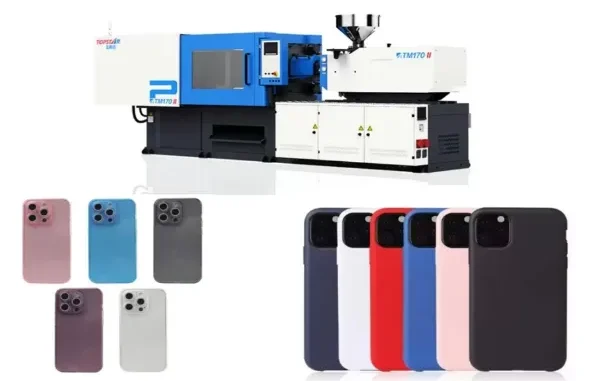
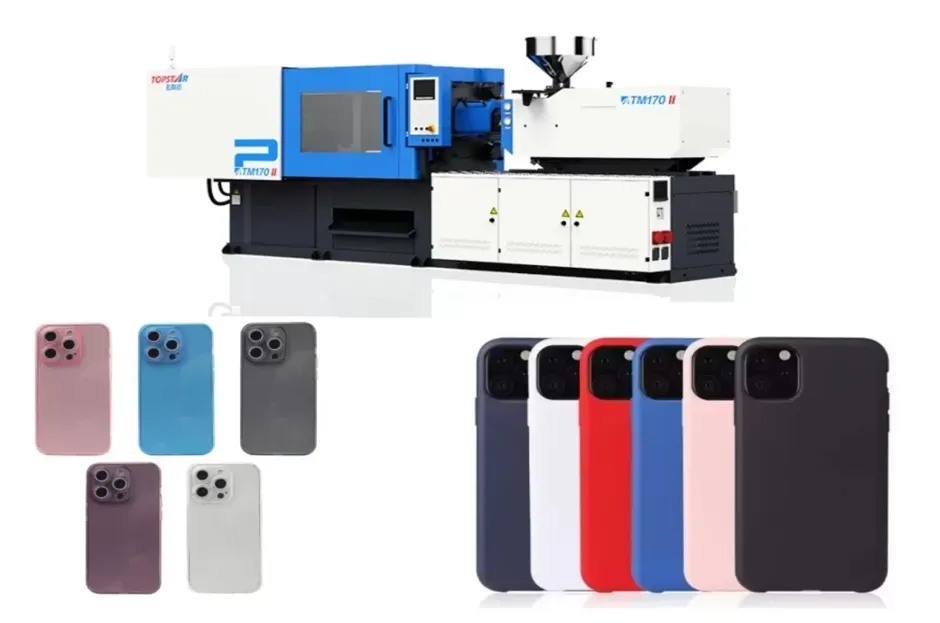
The global smartphone accessory market is constantly pushing the boundaries of product design. Consumers increasingly favor slimmer, lighter, and more stylish cases, prompting manufacturers to pursue thinner wall structures without compromising strength, aesthetics, or dimensional precision. While the production of ultra-thin cases creates new opportunities for brands, it also poses significant challenges for injection molding.
Among all processing parameters, clamping force is one of the most critical yet frequently misunderstood factors. Many manufacturers assume that selecting a larger case-manufacturing machine automatically guarantees better molding results. In reality, excessive clamping force increases operating costs, accelerates mold wear, and reduces production efficiency. Conversely, insufficient clamping force leads to defects such as flash, dimensional instability, and inconsistent product quality.
Why is clamping force crucial for a mobile cover making machine?
Clamping force is the force applied by the mobile cover making machine to keep the two halves of the mold tightly closed during injection molding. When molten plastic enters the mold cavity under high pressure, it generates a separation force that attempts to pry the mold open. The clamping unit must generate sufficient force to counteract this pressure and maintain a completely closed mold throughout the injection and holding phases.
This requirement is particularly important when producing ultra-thin cases. Thin-walled products typically demand higher injection speeds, higher cavity pressures, faster filling rates, and greater dimensional precision.
As the wall thickness decreases, the flow resistance of the molten plastic increases. To ensure the mold fills completely before the plastic cools, manufacturers often increase injection pressure significantly. This raises the force exerted on the mold parting line. If clamping force is inadequate, several issues may arise: flash formation, poor dimensional consistency, surface defects, material leakage, and increased rejection rates. Therefore, selecting the correct clamping force is not merely a matter of machine specifications; it directly impacts production quality and profitability.
How do product dimensions affect the clamping requirements for mobile cover making machines?
One of the primary factors influencing the choice of clamping force is projected area. Projected area refers to the surface area of the molded part as viewed from the direction of the mold opening. The larger the projected area, the greater the force generated within the cavity during injection. Although mobile phone cases are generally much smaller than automotive or appliance components, modern smartphone sizes continue to increase. Larger devices require larger protective cases, which naturally increases their projected area.
Example: Small phone cases
Applications include: compact smartphones, entry-level TPU cases, and lightweight protective shells. Typical machine range: 90T–120T.
Standard smartphone cases
Applications include: mainstream phone models, decorative hard shells, and TPU-PC hybrid products.
Typical machine range: 120T–160T.
Selecting a manufacturing machine based on projected area helps ensure stable molding performance while avoiding unnecessary investment in oversized equipment.
How Material Selection Affects Clamping Force?
Material properties play a crucial role in determining clamping force requirements. Different materials exhibit varying flow characteristics, shrinkage behaviors, and pressure requirements during the molding process.
TPU remains one of the most popular materials for flexible phone cases. Advantages include excellent impact resistance, a soft-touch feel, and superior flexibility. Since TPU generally flows well, clamping force requirements remain moderate in many applications.
PC materials offer advantages such as high rigidity, a premium appearance, and excellent dimensional stability. However, PC typically requires higher processing temperatures and injection pressures, which increases the demand for clamping force.
High-end smartphone cases often combine a rigid PC structure with TPU overmolding. These multi-material designs usually require more complex process control and management of higher cavity pressures. High-performance cases may utilize PC/ABS blends, reinforced polymers, or specialty engineering plastics. These materials often require higher injection pressures, directly increasing the clamping force requirement. Consequently, two phone cases of the same size may require different-sized machines, depending on the chosen material.
How Mold Design Determines Machine Performance?
Mold design significantly impacts the clamping force required during production. Even if two products share the same dimensions, different mold designs can result in vastly different processing requirements.
Number of cavities:
Single-cavity molds generally require lower clamping forces. Multi-cavity molds increase the total projected area, injection volume, and the distribution of cavity pressure. As the number of cavities increases, the requirement for machine tonnage typically rises as well.
Venting Efficiency:
Proper venting allows air trapped during the filling process to escape. Effective venting helps prevent issues such as burn marks, short shots, pressure spikes, and filling instability. High-quality molds distribute pressure evenly within the cavities, thereby enhancing sealing performance. Superior mold precision often enables manufacturers to achieve stable production with lower clamping forces.
Therefore, the choice of molding machine should always be evaluated in conjunction with the mold design, rather than as an isolated decision.
How does injection pressure influence the choice of a mobile cover making machine?
Ultra-thin products present unique filling challenges. When wall thickness drops below 1.0 mm, molten plastic must flow rapidly through narrow channels before it begins to solidify. This typically requires high-speed injection, high-pressure filling, and precise control of holding pressure.
Higher cavity pressure increases the force tending to separate the mold halves. Consequently, the molding machine must provide sufficient clamping force to keep the mold closed throughout the entire molding cycle. For instance, a standard mobile phone case with a 2.0 mm wall thickness might require moderate cavity pressure. In contrast, an ultra-thin case with a 0.8 mm wall thickness might require higher injection pressure to ensure complete filling. Thus, wall thickness alone does not determine the machine size; manufacturers must also consider factors such as material flow behavior, part configuration, surface finish requirements, and production speed targets. A comprehensive assessment facilitates more accurate machine selection and yields better production outcomes.
In Summary
Selecting the appropriate clamping force for the molding machine is a critical decision in the manufacture of ultra-thin mobile phone cases. Successful selection depends on a thorough understanding of projected area, material properties, mold design, cavity pressure, and production goals. For most ultra-thin smartphone case applications, machines in the 90T to 160T range offer a good balance between clamping performance, production efficiency, and operating costs.
However, the optimal machine should always be selected based on the specific product design, material, mold configuration, and production requirements. By matching clamping force to the actual molding conditions rather than simply choosing a larger machine, manufacturers can improve product quality, reduce energy consumption, extend mold life, and achieve more consistent, cost-effective production.
Related posts:
 Water Damage Restoration Service Lanham: Fast & Efficient
 What Does C3PAO Mean for the Future of Risk Management?
 Creating Stunning Face Swap Videos with AI: How to Use Face Swap Video Tools for Free
 How Dechecker AI Checker Turns Awkward Drafts Into Human-Readable Content
 The Complete Guide to Using Telegram for Secure and Smart Communication
Leave a Reply